
Linda Finch and her
team will try to re-create
Amelia Earhart's famous flight
By Susan KreifelsStar-Bulletin

Earhart never reached that goal, disappearing over the Pacific Ocean on July 2, 1937. But her brave attempt inspired a nation and set off decades of research and theories about her fate.
Next Monday, on the 60th anniversary of that historic flight and the centennial year of the famous pilot's birth, another woman will take off from Oakland in an attempt to re-create the 1937 flight. Scheduled stops include four days in Honolulu starting May 19.
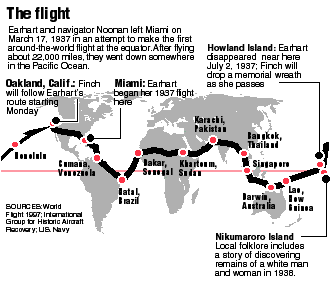
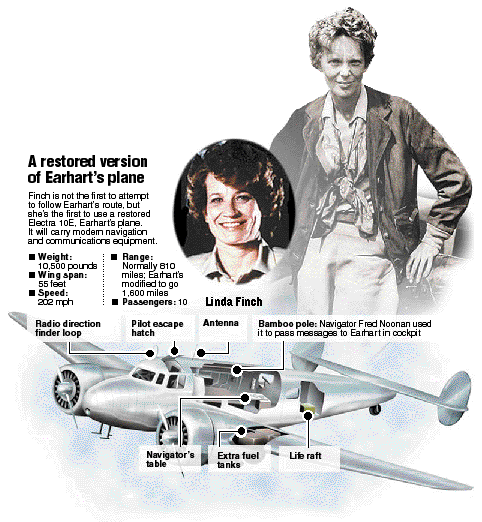
Linda Finch, an experienced pilot and aviation historian from San Antonio, Texas, will follow Earhart's 24,557-mile route as closely as possible. Her plane is the same make and model as Earhart's but equipped with modern navigation and safety equipment. Finch and her team recently restored the 1935 vintage plane, one of only two in existence.
The flight is scheduled to take a little more than two months. Finch will take off from Oakland and fly east, making more than 30 stops in 20 countries including Brazil, Sudan, Pakistan, Thailand, Australia and Nauru. Her around-the-world flight is scheduled to end in Oakland on May 22.
Finch said she was inspired by Earhart's bravery and the challenges she took on.
Finch, the National Geographic Society and aviation-technology specialist Pratt & Whitney are teaming up for the event, called "World Flight 1997." They are also sponsoring the "You Can Soar" education program, which will be used in Hawaii schools and other places to motivate students to set high goals as Earhart did.
Earhart believed "being true to oneself" brought success to a person.
"To want in one's head to do a thing, for its own sake," Earhart said, "to enjoy doing it; to concentrate all of one's energies upon it - that is not only the surest guarantee of its success. It is also being true to oneself."
On March 17, 1937, Earhart, born in Atchison, Kan., took off from Oakland and headed west for Hawaii. But on takeoff from Honolulu she crashed. After extensive repairs, she took off again on May 21. Because of seasonal weather changes, this time she headed east to Miami. Her navigator was friend Fred Noonan.
Earhart sent several radio messages requesting a bearing but did not acknowledge the cutter's responses. Five hours after her first message, she reported receiving the cutter's signals. But her transmission was too brief for the cutter to give her a bearing.
Earhart's last message came less than an hour later, but the Itasca's crew could not reach her again. They received no further word. A massive sea-and-air search found no trace of the plane or crew.
Before taking off, Earhart said she was aware of the hazards.
"I want to do it because I want to do it," Earhart said. "Women must try to do things as men have tried. When they fail, failure must be but a challenge to others."