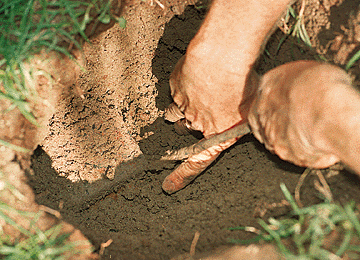
By Craig T. Kojima, Star-Bulletin
The hands of G. Kalani Long point to a piece of
suspected ordinance during a dig in Nanakuli.

Dennis Minga was on the other side of the world, teaching soldiers at Fort Ord, Calif., how to plant land mines. He didn't think about the victims of those mines until a decade later on the Sahara Desert. There, on the shifting sands of wars long past, he watched a 1-year-old wobble across a dune, then vaporize in the explosion of an antitank mine laid during World War II.
After peace treaties are signed and soldiers go home, the land mines they often leave behind can blow up civilians for the next 100 years. Minga and Long separately vowed they would do what they could to end the tragedy.
The two men met in Hawaii four years ago. The result: the Royal Hawaiian Institute for Land Mine Removal & Reform, a nonprofit humanitarian agency. The goal: to make mined rice paddies, jungles and sand dunes around the world safer places for families living atop them.
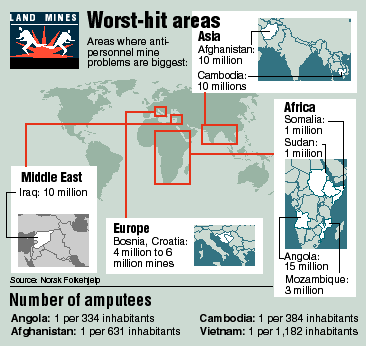
The pair's challenge is daunting. The United Nations estimates that more than 100 million active antipersonnel mines are planted in at least 60 countries. The mines kill and maim 26,000 people a year, up to 80 percent of them civilians. The streets of Phnom Penh, for example, are full of people missing arms and legs, outcasts believed unwhole by the predominant Buddhist religion. There are an estimated 10 million land mines in Cambodia -- one for every Cambodian living there.
"What kind of moral imperative do we need?" asked Long, who retired from the military in 1995 and moved back to Hawaii.
Long believes the United States, with "its high moral values," has an obligation to help clean up land mines.
"If you have ever seen a child mauled or blown up, it's different. Sometimes they have to re-amputate because the stump grows through the skin. It's so painful."
Minga, who moved here in 1970, trained people in the Middle East during the late 1970s to demine their desert countries.
"It dawned on me that these people couldn't even tell me what that war was or who fought in it," Minga said about mines left from World War II. "Generations will be blown up and maimed."
For as little as $3 apiece, mines are cheap killers that even the poorest countries can afford. While 100,000 mines are removed each year, another 2 million are laid. It can cost $300 to $1,000 to remove one mine. Kuwait is the only country that has demined itself. The cost: $1 billion and 80 deminers' lives.
Mine advocates point to the development of "smart mines" that self-destruct in four hours to four months, according to Minga. But their track record is debatable -- a failure rate of 1 percent to 50 percent, depending on who's talking. It doesn't matter, however, if there is one mine or 100 -- the fear is the same.
"The single biggest problem to an economy is the possibility of mines. Just the threat freezes people and agricultural production and shuts down the whole country," Long said.
Long and Minga, deputy director of the city Department of Auditoriums, want their institute to become an international clearinghouse for teaching land-mine detection and clearance in countries around the world. They intend to take a "village-by-village" approach, providing villagers with equipment and training.
The institute will also take advantage of the Maui Research and Technology Park. The park's soon-to-open telecommunications center will be used for long-distance teaching on village televisions, a less costly training method. They will also use the center to educate the public on land-mine issues. Finally, the Maui facility will provide a venue for research and development in detection and clearing.
Long and Minga believe the U.S. government, strapped by budgets and a public unwilling to risk American lives in the dangerous task, will be looking to private organizations for help.
Human-rights groups worldwide have led campaigns to ban the sale and use of land mines. In January, Clinton ordered a permanent ban on U.S. mine exports, but the U.S. military, like that in many nations, maintains that mines are essential.
The Royal Hawaiian Institute has pledges of up to $400,000 from at least five donors, two of them in Hawaii. Minga said all donations will be used for training and demining equipment in Cambodia. To start their first Cambodian training program in Sihanoukville, Minga said the institute needs $120,000.
The U.N. has earmarked $5.5 billion for demining, and the U.S. Congress has tagged $600 million, some of which Minga believes will go to humanitarian organizations such as theirs.
Paul Grab, owner of the Stylists boutiques and spas in hotels here, said he has made a "really substantial" contribution to the institute but declined to say how much. The 30-
year Hawaii resident said he plans to seek support from Rotary clubs and other organizations in Hawaii.
Grab was spared the horrors of World War II that were inflicted upon children living outside Switzerland, where he was born. Unexploded ordnance threatened their safety for years after the war ended.
"It's always stuck with me that those kids didn't have the freedom to run around, while we were safe from those terrible things," Grab said. "This is such a worthwhile cause. We're on target."
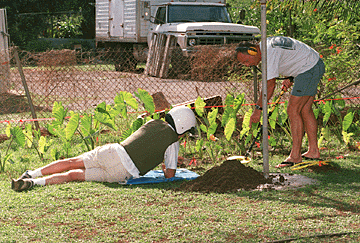
Using a World War I bayonet, he gingerly poked at a 30-degee angle into the soil, feeling for metal explosives that, if hit too hard or at the wrong angle, could kill him.
A few yards away stood a tense father and grandmother. They planned to keep the family's four children inside their home until ordnance experts told them their yard was clear of danger. Just the fear that there might be an unseen explosive that could rip off a child's leg was enough to disrupt the family's life.
The scene was not war-torn Cambodia or Angola. It was Nanakuli. The father was Jeremiah Pi'i, who found a grenade in his yard three years ago, then two mortars last month. His property lies beside a train line that hauled military ordnance during World War II. Fearing he could have a yard full of explosives, he sought help.
So far, he said, he has received virtually none from the military or the government, only from civilian volunteers like G. Kalani Long, who retired from the Army's Special Forces. Last week a police SWAT team dug out what appeared to be a detonator.
"I don't know what to do," said grandmother Stella Generalao, pacing nervously. "I feel somebody is responsible." She and Pi'i now share some of the fears and frustration that millions of people in mined countries live with daily.