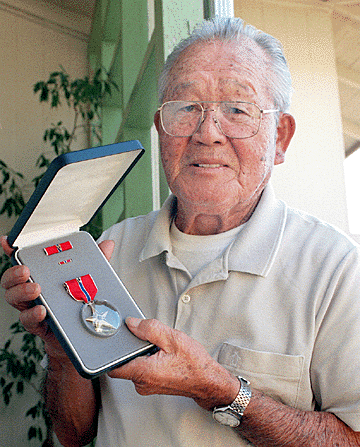
By Ken Sakamoto, Star-Bulletin
Yutaka Masuda has received a Bronze Star medal
for service during World War II.

Masuda is the first Military Intelligence Service veteran to receive reconsideration for military awards under a special federal law drafted by Sen. Daniel Akaka.
Akaka's law created a one-year window, which ended Feb. 9, during which MIS and other military intelligence specialists, never recognized because of the covert nature of their work, could apply for wartime awards or decorations.
Second-generation Japanese Americans, the niseis who formed the MIS were a cadre of elite soldier-linguists who used their special training in the Pacific to intercept and translate Japanese documents and communications and interrogate prisoners of war.
Very few of the 6,000 nisei linguists were ever recognized.
The nisei interpreters were considered one of America's greatest war secrets, and their deeds were classified until very recently.
More than 49 MIS veterans have taken advantage of the new federal law and filed an application with the Army's military awards branch. So far, 17 applications besides Masuda's have been approved. The highest medal awarded at this point is the Legion of Merit citation, which has gone to nine.
"I was surprised how quickly it came," said Masuda, displaying his Bronze Star medal.
"I applied at the end of December and within a month the medal came in the mail."
Masuda, now 81, was born in Hawaii but was sent to Japan when he was 9 after his mother died. He spent eight years there, returning home when he was 17.
On March 24, 1941, Masuda, who was working for Waipahu Plantation, was drafted. He spent nearly three years at Schofield Barracks before he was sent to the Military Intelligence Service language school at Camp Savage, Minn. In 1945, he was sent to Iwo Jima in the Pacific to translate captured Japanese documents and to help patrol the tiny volcanic island.
But his main mission was to try to talk Japanese soldiers hiding out in caves sprinkled throughout the island to surrender.
If he didn't succeed, the caves were sealed shut with explosives or bulldozers.
In one incident, Masuda was blown backward five or six feet from a cave entrance by a grenade. He escaped injury, and after more than an hour of coaxing, 28 Japanese soldiers surrendered.
Masuda's language skills helped him earn the trust of some of the Japanese soldiers he captured. In turn, they joined him as he tried to get other soldiers to surrender.
The process of determining the awards has been going well, said Maj. Terry Mintz, awards branch chief in Alexandria, Va.
"Lots of these veterans have made a good, concerted effort to get the information to us and the Army has been able to react to them in a very timely matter."
Ed Ichiyama, who helped shepherd the process through the 442nd Veterans Club, said he was elated with such positive results. "I'm real happy that we are getting such tangible results. xxx I am really proud."
Ed Thompson, an Akaka aide in Washington, D.C., said the senator has been talking with the staff of the Senate Armed Forces Committee on the possibility of new legislation that would reopen the process for MIS veterans who couldn't make the February deadline. Many MIS veterans say the extension is needed because of the difficult and lengthy process of getting their records from the Army and the National Archives.
Masuda said he was encouraged to apply for the medal by his former commander, Lt. Manny Golderberg of the 309th Intelligence Detachment. Masuda was helped by his daughter, Sharon, who recorded and typed an affidavit for him.
Until this year the only other major medal the Pearl City resident possessed was one that signified that he was at Pearl Harbor when the Japanese attacked on Dec. 7, 1941.
Army historian
By Star-Bulletin staff
working on account of the
Military Intelligence ServiceThe Army is working on an official history of the Military Intelligence Service, a project also generated by U.S. Sen. Daniel Akaka in 1994. The manuscript is being written by Army historian James McNaughton, command historian at the Defense Language Institute at the Presidio of Monterey, who hopes to complete it by the end of the year.
McNaughton also is involved in the two-year research project designed to identify Asian-American and Hawaiian or Pacific Island World War II Distinguished Cross recipients who could receive the Medal of Honor.
So far, packets for 26 members of the 442nd Regimental Combat Team and the 100th Battalion have been assembled and submitted. Fifty-two soldiers in the 442nd/100th and one member in the Military Intelligence Service were awarded the Distinguished Service Cross, the nation's second-ranking medal for valor in combat.
Last year, President Clinton approved the Medal of Honor for seven World War II black American veterans whose exploits also were overlooked. Their names were drawn from a study done at Shaw University at Raleigh, N.C.