Associated Press
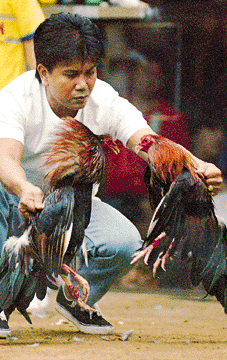
A referee pits two roosters against each other at
a cockfight in Pasay City, a suburb of Manila.

They exchange kicks in midair, slashing with 4-inch-long, razor-sharp steel blades attached to the back of their left legs.
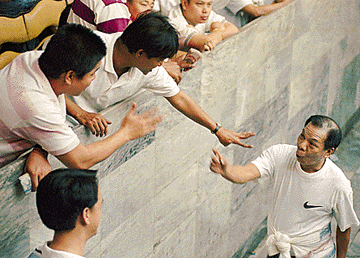
In a few seconds it's over. One bird lies lifeless; the other struggles, maimed on the dirt floor of the pit. Hundreds of roaring spectators settle their bets.
To many foreigners, Philippine cockfighting is shockingly brutal -- far more bloody than cockfights in other countries, where the birds battle with sharpened natural leg spurs or ice pick-like steel gaffs attached to their legs. Filipino roosters fight only one or two matches because of injuries or death.
Despite this twist, the Filipino national betting pastime is becoming internationalized.
American breeders now supply most of the best fighting roosters, and about 30 American cockfighters regularly fight their birds in the Philippines.
Canadians, Japanese and Taiwanese also occasionally compete, although so far with less success.
In January an American, Carol NeSmith of Fulton, Miss., teamed up with two Filipino breeders to best 65 other entries in the Philippines' leading cockfighting competition, the "World Slasher Derby."
Many countries outlaw cockfighting, but the allure of the gambling results in illegal bouts being staged around the world, often in rural areas.
Cockfighting is legal in the Philippines, Mexico and parts or all of five U.S. states - Arizona, Louisiana, Missouri, New Mexico and Oklahoma. Matches also can be found in Ireland, Colombia, Haiti, the Dominican Republic, Cuba, Jamaica and Puerto Rico.
While competition is fierce inside the arena, the arrival of foreign bird breeders has ruffled very few feathers among Filipino aficionados. They share cockfighting secrets and even space in their farms for foreigners to raise birds for local tournaments.
"You have to fight the best to be the very best," said Jun Santiago, the defending Philippine cockfighter of the year and husband of Sen. Miriam Defensor-Santiago, who narrowly lost the 1992 presidential election. "We welcome all comers."
Some of the foreigners are drawn by the thrill of a blood sport not practiced in their home countries.
Ryoichi Saito, a businessman from Tokyo, came to the Philippines six years ago for a business meeting and was taken to a tournament by his hosts. Since then he has bought 600 roosters in the United States and has returned each year to fight his own birds, which he raises on a farm outside Manila.
For others, the attraction is simply money.
Estimates of the number of roosters fought - and killed - each year in the Philippines range from 7 million to 13 million, making the country a bird seller's dream market.
Although poor Filipinos use cheaper native birds, imported "trios" - a rooster and two hens for breeding - usually go for $1,300. A prize rooster can be worth up to $2,500.
The best way for foreign bird breeders to build a reputation is to win local competitions. For them the prize is not the awards, which are generally small, but steady future orders from Filipino cockfighters.
Fighting cocks are bred for aggressiveness and live a privileged childhood. Instead of ordinary chicken mash, they are fed grains, ground meat, fresh vegetables and milk, often with vitamin supplements.
Rich enthusiasts hire full-time veterinarians, farmhands and trainers to exercise their birds and build their muscles.
Among the sport's many well-known participants are former House Speaker Ramon Mitra, House Majority Leader Rodolfo Albano, the brother of former President Corazon Aquino and many governors and mayors.
The sport and gambling associated with it remain illegal in the state despite its popularity, dating to early plantation days and, some experts say, ancient Hawaii.
Alton DeGama sees similarities between the missionaries who forced the activity underground a century ago and today's "powers that be" who insist on keeping it illegal. The Maui firefighter has been a cockfighting enthusiast since he was introduced to the sport while growing up on the sugar cane town of Puukoli.
"We are a dying people in the sense of what we do," he said.
"I tell all the young guys, 'I hope you understand you are the new generation.' When it's gone, it's too late."
DeGama served five days in jail in 1989 after he was arrested at a cockfight and convicted of animal cruelty. In the years since, he has written letters to lawmakers urging them to allow the sport, just as they do high-stakes jackpot fishing tournaments and hole-in-one competitions in golf.
"When I bring up golf, all the politicians shake," he said. "They say, 'Don't mention golf.' The small man, the poor man, he cannot go golf."
But to state Sen. Suzanne Chun Oakland (D, Palama-Alewa Heights), the entertainment comes at too great an expense for the animals. She introduced legislation this year that would have outlawed the sale, manufacture and possession of gaffs, the razorlike blades attached to the roosters' legs that make the till-death battles quick and bloody. The bill died in committee.
"They're putting unnatural things onto the chicken and having them fight with that," she said. "I know there are ethnic values there that in some way we need to be sensitive to, but also, just any kind of situation that involves the pitting of animals against one another for recreational purposes has not settled well with me."
Police on Oahu and the neighbor islands say they'll keep cracking down on the fights, which sometimes draw hundreds to secret rural locations.
A raid in a remote area of South Kohala on the Big Island last month netted five arrests. The fight was attended by more than 200 people from throughout the island, said Capt. Morton Carter, commander of the Criminal Investigations Division.
"It's no longer a friendly little gathering when you have that kind of activity," Carter said. Organized crime clearly has a hand in some of the events, he said.
Sgt. Alan Matsumura of the Honolulu Police Department's gambling detail said police made 23 cockfighting arrests in February and 14 in January. The numbers have stayed relatively steady over the years, he said.
Police monitor known cockfighting sites in Waipahu, Ewa, Ewa Beach, Waianae, Waimanalo, Kahaluu, Aiea and Kalihi, and rely on tips from the public, he said.