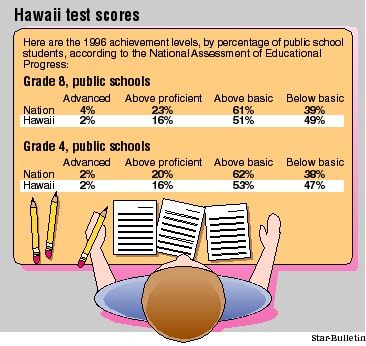

"Hawaii's scores did go up, so that is certainly encouraging ... but obviously we need to improve even more," Selvin Chin-Chance, a test development specialist for the state Department of Education, said in response to National Assessment of Educational Progress results released today.
Despite increased achievement, the majority of students in Hawaii and the nation as a whole do only average work, and many still lack even basic skills, according to the U.S. Education Department, which administers the test.
The national test, which includes multiple choice and open-ended questions, was given nationwide last year, including to more than 4,000 fourth- and eighth-graders in Hawaii public schools. Nationally, 12th-graders were tested, but no 12th graders in Hawaii took the test.
The test was scored on a scale of zero to 500 points. For eighth-graders, scoring less than 262 showed below basic skills, 262 to 298 was basic, 299 to 332 was proficient, and above that was advanced.
For fourth-graders, scoring less than 214 showed below basic skills, 214 to 248 was basic, 249 to 281 was proficient and above 282 was advanced.
Maine, Minnesota and Connecticut had the highest scores among fourth-graders, with each state averaging 232. Among eighth-graders, North Dakota, Maine, Minnesota and Iowa topped the chart, each averaging 284.
The District of Columbia had the lowest average in both grades, 187 among fourth-graders and 233 among eighth-graders.
"We must expect more if students are to match their international peers," said U.S. Education Secretary Richard Riley, who nonetheless cheered the improvements.
President Clinton said today the results bolster his argument for standardized tests that show whether students are meeting national standards.
"The scores are getting better but they also show us why every child should be tested based on these standards," the president told a group of business leaders.
The Clinton administration wants to speed up math instruction, with algebra starting in the eighth grade rather than high school.
In Hawaii, Education Department evaluators will analyze the results to see whether changes in teaching style and curriculum contributed to higher scores, Chin-
Chance said. "We'll try to figure out what's working best and expand it."
The National Assessment of Educational Progress is considered one of the most useful standardized tests because it is administered nationwide under carefully controlled conditions and therefore "allows for valid cross-state comparisons," Chin-Chance said.