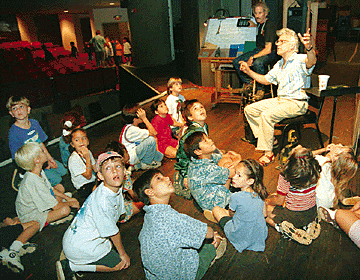
By Craig T. Kojima, Star-Bulletin
Assistant lighting director Sandy Sandelin, left, and lighting director
Peter Dean Beck give Lanikai students a lesson on stage lighting.


By Elisabeth A. Crean
Special to the Star-Bulletin

This year, the Hawaii Opera Theatre's "Mini Residency" has come to Lanikai Elementary. All 381 students will put on a condensed version of Giuseppe Verdi's "Aida." With a little help from teachers, parents and opera professionals, of course.
Set in the pageantry of ancient Egypt, "Aida" is a big opera. In fact, the number of kids participating in the Lanikai show equals the sum of the cast, crew and musicians for the grown-up version, opening tomorrow at the Blaisdell Concert Hall.
Of course, the adult version lacks the irresistible appeal of little ones dressed up as elephants, giraffes, suns and stars.
For the children, the program trains them in an art form many adults - their parents included - have never even seen. They are too young to have developed the negative stereotypes that keep people away from experiencing opera's magic.
For the HOT, the program deepens its roots in the community and furthers its educational mission. It also builds the audience of the future.
"We're hoping that by planting our own seed of 'opera is fun' in their brains, when they get to be adults, they'll become the patrons," said HOT production and education coordinator Stephanie Conching.
Under the tutelage of HOT's education and outreach manager, Erik Haines, the program is in its third year. In 1995, children at Palolo Elementary put on George Bizet's "Carmen." Last year, Pearl City Highlands Elementary did Gaetano Donizetti's "Daughter of the Regiment."
Highlights of the program are classroom visits by opera professionals and an exclusive backstage tour of the Blaisdell. Lanikai students also went there last night to attend a full-length performance of "Aida."
The program involves the students in every aspect of opera production, from the artistic to the administrative. In addition to singing, dancing and acting, the kids do everything from making props to sending out news releases. They learn that opera requires the collaboration of many people and disciplines.
A thick manual authored by Haines and Conching helps teachers to integrate the opera into classroom learning. Subjects like history and math, which may seem remote and boring in the abstract, come alive when the kids design and build their own costumes and sets.
Different grade levels take on various backstage responsibilities and onstage roles. For example, the kindergartners serve as house ushers before the performance and portray Nile animals during the opera's grand procession scene.
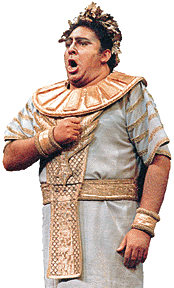
Carlos Moreno plays Radames
in Hawaii Opera Theatre's "Aida."
By Kathryn Bender,
Star-Bulletin
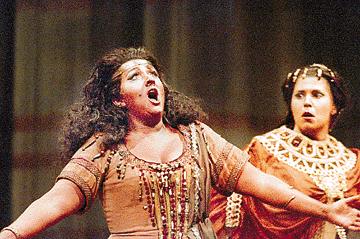
Adults from the HOT sing the three principal roles in the opera's love triangle: Egyptian princess Amneris, the enslaved Ethiopian princess Aida, and the man they both love, Egyptian army commander Radames.
After a choral and dance rehearsal led by music resource teacher Colette Young-Pohlman, the sixth-graders talked about their experiences so far.
Maxine Cobb-Adams summarized the general class sentiment about opera: "I think it's fun because it's a challenge."
What's the hardest part about putting on the opera?
"Memorizing the script," said Jayme Ide. Added Maxine, "For the singing you have to hit the low and high notes."
Verdi's work has some towering high notes, so Pohlman-Young allows them to drop down to a more comfortable octave when needed.
"The hardest part about the opera is learning the script and the dance, and trying to get everybody to work together so the opera can be good, and so everybody likes it," said Keely Cestare. Many opera directors, harried by clashing divas and egos, would wholeheartedly agree.
Is opera fun?
"It's fun because you get to be with professionals," said Kainoa Young. "It helps you if you want to be a pro opera singer when you get older."
"You get to express your feelings when you're singing, and singing is fun," said Keely.
Are the adults enjoying themselves as much as the kids are?
"It's good fun to try to figure out what will inspire them the most," said Conching. For Pohlman-Young, this is her first opera experience. "I really love it because it's a challenge to my ability as a teacher," she said. "It's opening a new door for me."
The hall was set up for Giacomo Puccini's "Tosca" at the time the students took the tour. HOT department heads used its production elements to introduce the children to five major disciplines.
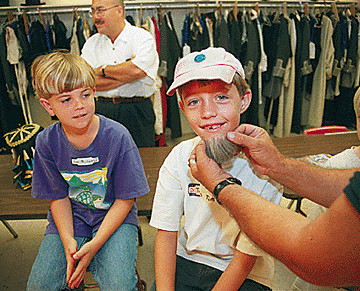
Wig and makeup designer Richard Stead showed off Baron Scarpia's formal white wig made from Tibetan yak hair, the same as George Washington's wig. Scarpia "uses his wig as a real psychological device," said Stead, to look like gentleman while committing evil acts.
Conching got the kids to deduce characters' personalities from their costumes. Tosca's dark red velvet gown with a white underskirt, one student guessed, might mean she's bad on the outside and good on the inside. Fabrics and styles also helped them assess wealth and social status.
Prop master Leslie Craig had the children try to figure out what a large religious statue was made from. Marble, stone or cement, they surmised from its appearance. Thin muslin fabric dipped in plaster of Paris, she told the amazed students. This drove home her point that props need to be lightweight and inexpensive.
Head carpenter Al Omo made a similar point about the sets themselves. To make quick scene changes, the crew needs to be able to move the pieces easily. He showed how the "flyman" rapidly lowers in fabric backdrops from the 77-foot-high ceiling.
Lighting designer Peter Dean Beck demonstrated how he "helps tell story with light." He displayed some of "Tosca's" 50 different lighting configurations, and passed around the colored gels and metal templates that go in front of individual lights. When he turned on all 300 lights at once, the children were genuinely awed by the intense heat generated.
As part of the Mini Residency program, HOT staffers visit the school as well. Stead has brought wigs to Lanikai already, and will demonstrate Egyptian makeup there soon.
Beck will talk more about lighting, and Conching will put on a stage workshop, teaching vocal projection and character development.
What: Verdi's "Aida"