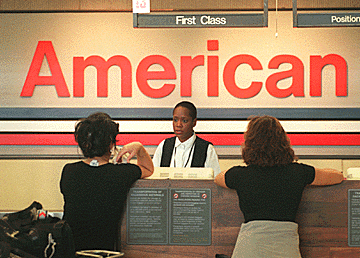
By Craig T. Kojima, Star-Bulletin
A ticket agent fields questions at the American Airlines Counter
at Honolulu International Airport.

Leilani Kuhns, working at American's Gate 18 at Honolulu Airport earlier this week, is one who would have to go home without pay.
"We hope it doesn't happen," she said. A few employees would be kept on to handle passengers' needs, but the whole operation would shut down after four days, Kuhns said.
"It's going to affect a lot of people, not just us," Kuhns said. A wide range of suppliers and service businesses depend on American Airlines for a share of their business.
Also to be affected are the thousands of people that American flies to and from Hawaii each week.
American, with its six Hawaii-mainland daily flights, has the capacity to fly about 3,200 people a day to and from the mainland. The airline says it will do its best to rebook its passengers on other airlines. Those who can't get seats will get full refunds, the airline said.
Local travel agents say they have already been booking seats on other airlines in case American does stop flying.
The other airlines have said they don't plan to put on extra flights to handle American's passengers on any route in the event of a strike.
But Hawaiian Airlines, which is about as big as American in the mainland-Hawaii market, said it has seats available in the near term.
"We are getting calls from travel agents and people booking to protect their trips," said Keoni Wagner, a Hawaiian spokesman.
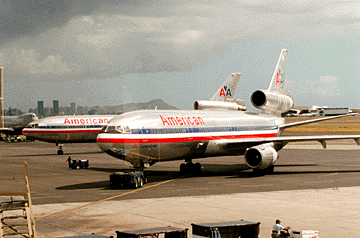
Since Hawaiian is a partner with American, leasing its DC-10 jets from American and cooperating in marketing and other activities, Hawaiian will do everything it can to help, he said.
Meanwhile, Continental Airlines said its mainland-Hawaii flights are already well booked.
"We would help by taking as many (American passengers) as we could," said Karla Villalon at Continental's headquarters in Houston. "But we would not, certainly, be able to take all of them."
Norman Reeder, United Airlines' managing director for Hawaii, said space is tight on some routes where United parallels American, specifically Honolulu-
Chicago and Maui-mainland flights. "But if you look at total Hawaii, there is enough lift in total capacity to carry American's passengers," Reeder said.
United, the biggest mainland-Hawaii carrier with more than a dozen round trips a day, wouldn't be able to handle all of American's passengers but could take a lot, Reeder said.
With two days of negotiations left before the 7 p.m. Friday strike deadline, the likelihood of the pilots walking appears strong, with the union and the airline reportedly still far apart on pay and other issues.
Last night, American said it was canceling most of its Friday night international flights to make sure its planes weren't left in other countries if the pilots walked out. The federal mediator overseeing the negotiations said they were proceeding slowly and "with increasing difficulty."
How a strike would affect Hawaii's No. 1 industry remains to be seen.
"Tour operators right now are trying to shift their business to other airlines. Providing they have the capacity, in the short term there will be little impact," said Paul Casey, president of the Hawaii Visitors and Convention Bureau.
"A lot of it can be shifted," said Casey, who was a senior airline executive before joining the HVCB. "But what tends to happen is people cancel their vacations," if they are booked on an airline that gets shut down by a strike.
A few will cancel, he said.
"I think there will be minimal disruption in the beginning, but if the strike goes on, the disruption will increase," Casey said.
In 1985, a pilots' walkout at United Airlines knocked out most of that carrier's Hawaii business for 29 days. United was forced to cut its 19 Hawaii flights a day down to only two. American says it won't have any flights.
However, the circumstances are different. In 1985, United had been carrying half of all of Hawaii's mainland tourist traffic. Tourist industry officials estimate that American has as much as 13 percent of that market.
American has been a major factor in the growth of Hawaii jet travel since winning trans-Pacific routes in 1969, when service was limited by government regulation.
American ran mainland-Hawaii-Australia-New Zealand routes from 1970 until it dropped out in 1974, financially unable to keep the routes going. The airline came back in 1980, without the Pacific extensions, and has been a major player here ever since.