Star-Bulletin
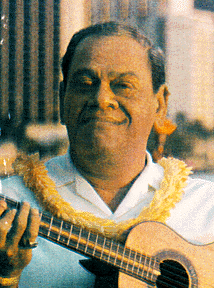
Kahauanu Lake and his trio reunite.

"The (vocal) keys aren't the same, but the spirit and the music is, and rehearsals have been great," Lake said over an early breakfast Friday morning.
Lake, known to many simply as "Mr. K," is presenting the two-hour reunion program as a benefit for the Hawaiian Music Hall of Fame and Museum. The K Lake Trio will be joined by Mahi Beamer, Emma Veary, Nina Keali'iwahamana, Bill Kaiwa, Genoa Keawe, Robert Cazimero, Kuliaikanu'u and the Pualeilani Concert Group in celebrating the contributions to Hawaiian music and culture made by last year's inductees: Mekia Kealaka'i, Albert "Sonny" Cunha, Haunani Kahalewai, Sol Ho'opi'i and Alvin Kaleolani Isaacs.
"Most (of the inductees) were both composers and artists. Mekia Kealaka'i was a protege of Henry Berger. He joined the Royal Hawaiian Band when he was 15, went to Europe, played in all the hot spots there and was considered in the 10 top flutists in the world," Lake said. "When he went to America, John Philip Souza asked him to join his band. He said he had to go home to Hawaii, and eventually became Bandmaster himself. So it's (based on) musicianship, writing and performers. We're taking it from Kalakaua and up to today."
One of the criteria is that induction is posthumous. Previous inductees are Na Lani Eha (The Royal Four): David Kalakaua, Lili'uokalani, Miriam Likelike and William Leleiohoku. Also chanter and prophet Keaulumoku, Heinrich "Henry" Berger, Charles E. King, Joseph Kekuku, Helen Desha Beamer, Victoria K. I'i Rodrigues, Lena Machado, Sol K. Bright, Alfred Apaka and Mary Kawena Pukui.
Lake emphasizes that the Hawaiian Music Hall of Fame and Museum is not a popularity contest, awards show program, or anybody's personal vehicle for self-promotion. Nor is it intended to be all things to all people in all branches of the music business. He and the other members of the advisory board - Irmgard Farden Aluli, Haunani Apoliona, Mahi Beamer, Nina Keali'iwahamana, Aaron Mahi, and archivist Harry B. Soria Jr. - are simply working to perpetuate Hawaiian music and to create a convenient repository of information on those whose contributions shaped its evolution.
"Hawaiians learned European notation and wrote music that is on a par with any music in the world. We've got to preserve (that music) so young Hawaiians will know that (Hawaiian composers) reached that zenith. Not that the rest is downhill, but they should be able to refer back to it and check out what it was like 50 or 100 years ago. We're hoping that the younger people will be motivated to carry on," he said.
Lake started playing music at the age of 4. The Kahauanu Lake Trio was together for 42 years. Since they parted on good terms "and we still speak to each other" occasional reunions aren't a problem, but Lake now concentrates on sharing his knowledge with younger musicians of all races.
"(Jawaiians) don't have a solid enough background in Hawaiian music, but a lot of people have no place to learn (about it). Kupuna are gone so where do we go? That's another reason for the Hall of Fame. It will be a repository of all the (Hawaiian) music that has been composed, written or even recorded by some of the composers. That way you can hear what their intent was. A lot of that has been lost today. Throw a Jamaican beat in there or whatever and you lose the whole intent of the composer. Keep your styling, keep your artistry your own, but be aware of the intent."
Lake's commitment to the preservation of Hawaiian culture while a member of the Board of Governors of the Hawai'i Academy of Records resulted in a significant change in the awards procedures. The Hoku Award for best use of Hawaiian language in an original song is now adjudicated by a panel of musicians fluent in Hawaiian rather than voted on by HARA members with little or no knowledge of the language. There had been some opposition to the change but Lake's logic was impeccable: How can someone who doesn't speak a language fluently make an informed judgment on how well a composer or lyricist has used it? He explains that the issue was usage of the Hawaiian language in that context, but that it isn't usage of the language that makes a song Hawaiian.
"People say 'I want to express my Hawaiianness but I don't know the language.' Do it in English. Hawaiians speak English too. People say 'But it's not the real Hawaiian.' Isn't it? How many Hawaiians speak only Hawaiian every day? It's not that I'm not for people who are purists, the (Hawaiian) language is beautiful, but is a song less beautiful if it is written in English and the kaona (hidden meaning) and the mana'o (thought) is there? If you can do both that's the best of both worlds, but a Hawaiian song can have English lyrics as long as you incorporate the Hawaiianness in it and the story line in it.
"I call Sonny Cunha the father of hapa-haole music but it (actually) started with the royal court. The European masters were brought over (and) the royal family music learned European notation and wrote music that came out Hawaiian. They (also) wrote songs with English lyrics or Spanish lyrics and so that was hapa-haole music."
What: The Kahauanu Lake Trio with Mahi Beamer, Emma Veary, Nina Keali'iwahamana, Bill Kaiwa, Genoa Keawe, Robert Cazimero, Kuliaikanu'u and the Pualeilani Concert Group led by Anuhea Brown and Irmgard Farden Aluli.