By Dennis Oda, Star-Bulletin
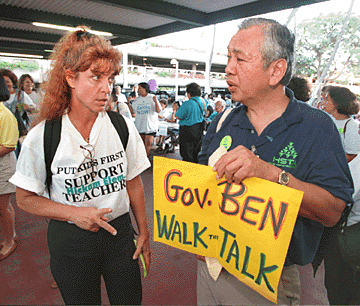
Laura Stanley tells Bob Hu she works two jobs - teaching
at Hickam Elementary and waitressing - to make ends meet.
They were at neal Blaisdell Center for the strike vote.

With the possibility of schools closing as soon as Feb. 18, anxious parents are beginning to look for day care, private child-care firms are gearing up to meet extra demand and high school seniors worry that a strike could delay their graduations.
Public school teachers are pondering the prospect of picket lines and no paychecks.
"I don't want to strike, I don't want to be out of my classroom, I love my job. But I really feel that the governor is forcing me to do this," Keolu Elementary School teacher Elly Tepper, a 26-year veteran, said after voting "yes" last night.
Of the about 11,700 Hawaii State Teachers Association members statewide, 10,343 voted. Of that number, 10,106, or 97.7 percent, agreed to call a strike if issues involving pay and working conditions are not resolved. Union leaders will meet tomorrow to set a strike date. Because they must give the state at least 10 days notice, Feb. 18 is the soonest a walk-out could begin.
"We regret that it has had to come to this. We are aware that a strike will be a disruption for our students and their families. However, there will be an even bigger disruption if the quality of our schools is allowed to continue its downward spiral," Teachers Association president June Motokawa said. "We will do whatever is necessary to reach a fair settlement."
Lead union negotiator Joan Husted said the overwhelming vote puts pressure not only on the governor to settle, but also on the union. "They've put their trust in us. They don't want to strike, but they will if they have to. We've got to come through for them."
Teachers have worked without a new contract since 1995. The biggest sticking point is pay raises. The union wants retroactive wage increases across the board, plus step increases, while the state's offer is not retroactive and is tied to lengthening the school year.
"We will give teachers a pay raise that is fair to them and taxpayers and is affordable to the state," Gov. Ben Cayetano said in reaction to the vote.
"We are doing our best to avoid a strike that would disrupt the education of our children."
Arlene Iwano, whose son is an eighth-grader at Moanalua Intermediate School, said the consensus among parents she knows is that teachers deserve a raise, but that the school year should be longer. The Department of Education said last year that Hawaii's school year - with 176 instructional days - was the shortest in the nation.
The prospect of a strike has created "a lot of anxiety, but there's also hope they could settle at the last minute," Iwano said. "My son can go to his grandparents, so my main concern is the interruption of the learning process. But for a lot of parents it's the more basic 'What am I going to do with my kids?' "
Don Anderson, president of the YMCA, and Ray Sanborn, president of Kama'aina Care, Inc., two of the state's largest child-care providers, both said they would expand all-day kids' programs if schools closed.
"But no matter what we do, or the Y does, there's no way we can accommodate everybody. We're talking about 180,000 kids," said Sanborn.
Pedro Haro, a junior at Lahainaluna High School and the student member of the Board of Education, said many students are sympathetic to teachers, but also have their own worries.
"They want to know if this will cancel their activities, like proms. And will graduation be delayed if we lose days and have to add them at the end. There's a lot of questions," he said.
Board of Education chairman Karen Knudsen said education officials would inform families as soon as possible about school disruptions. Department officials are busy making contingency plans they hope they'll never use. "We hope there will be a fair and equitable settlement for the teachers," she said.
Teachers Association members - mainly teachers, but also counselors, school librarians, registrars and others - now earn from about $24,000 to $50,000 a year, depending on academic credentials and years of experience. The average is $35,952, said Don Nugent, the education department's assistant superintendent for personnel. The total annual payroll for such staff is about $410 million, he said.
Union officials said both sides are on call, but no talks are scheduled.
"I think basically the governor is waiting for a signal from us, and I think what we're doing is giving him the signal that we are strong and unified," said Peter Nakashima, a computer instructor at Liholiho Elementary School.
"It's going to be very hard, but he's (Gov. Ben Cayetano) not giving us any choice."
With a 97.7 percent "yes" vote to call a strike, the challenge for the union now is to maintain that solidarity in the event of an actual walk-out. Nakashima and most other teachers interviewed last night said they doubted many teachers would cross picket lines. Many voted to authorize a strike despite living paycheck to paycheck.
"Financially, I'm not prepared. But I'm going to do it for the greater good, for the children and the future of education in Hawaii," said Nancy Major, a second-grade teacher at Waialae Elementary School. There's "the sense that it's the only choice we have right now because the education governor hasn't been listening to us."
Harlan Parker, a math and science teacher at King Intermediate, said he was confident the state would try harder to settle now that teachers are threatening to close schools.
"I cannot imagine thousands of young people running amok on the islands being something that public officials will want to deal with," he said.
The union wanted 3.7 percent across-the-board raises in 1995-96 and again in 1996-97, plus "step" increases each of those years averaging 3.31 percent, for a total increase of about 14 percent over two years. The state countered with no retroactive hike for 1995-96 or 1996-97, a 4 percent increase in 1997-98 and another 4 percent in 1998-99. The union is now working on a four-year counterproposal. PAY
The state offered to pay teachers 2.73 percent more to work five extra days in 1997-98, and another 2.66 percent for five more days in 1998-99. The total of 10 days would be a permanent extension of the school calendar. The union wants to put this issue aside until a union-Department of Education committee has considered the impacts and costs. LONGER SCHOOL YEAR
The union wants teachers to have three more personal leave days - taken out of sick leave - for a total of five. The state says two is enough. GENERIC LEAVE
The union wants teachers to be able to leave campus during their daily preparation periods. The state contends they're needed on campus to ensure student safety. PREPARATION PERIODS
State officials say their total pay offer would cost taxpayers' $78.5 million over four years; $45.7 million for the pay raises and $32.8 million to add the extra work days. They contend the union's request would cost $94.5 million over two years. The union's Joan Husted said last night the state had overcalculated the cost of the union request, although she could not say by how much. "We're costing it all out now to make sure both sides are using the same figures." Union officials also noted that the $32.8 million to add 10 school days was not the total cost to the state, because other staff besides teachers would also have to work longer. COSTS