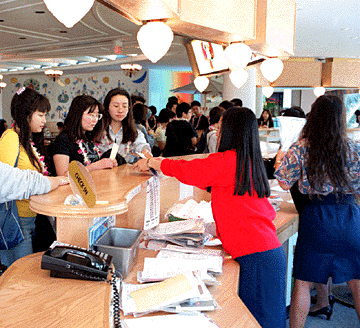
By Ken Sakamoto, Star-Bulletin
Japanese tourists are shown at Aloha Tower Marketplace.
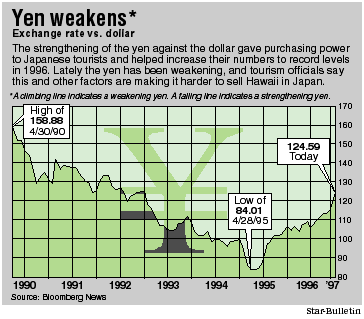
A drop in the value of the yen means the Japanese don't have
as much buying power here as they once did.

"With the devaluation of the yen, it comes to a 20 percent cost increase. We have not passed it on in Japan," said David McNeil, a spokesman for JTB Hawaii Inc., Japan Travel Bureau's local unit.
As the yen's buying power in Hawaii continues to fall - it has dropped 10 percent since November - and hotel room rates and air fares rise, companies like JTB are finding they have to work twice as hard just to maintain their level of business.
The situation is worrisome enough to cause Gov. Ben Cayetano to ask the Legislature to give an emergency allocation of $10 million to the Hawaii Visitors and Convention Bureau for marketing. The Legislature has yet to make a decision on the request.
HVCB President Paul Casey says he wants to spend the majority of the money in Japan. Toward that end, Casey and other HVCB executives are in Japan this week trying to find out the most effective ways to use it.
Meanwhile, industry consultants and Japanese tourism executives say Hawaii faces a tough challenge in Japan.
Executives at JTB and Jetour Hawaii Inc., another Japanese travel wholesaler, said they set early-1997 tour rates last fall. So they've had to absorb the increased costs due to the weaker yen and higher hotel rates and air fares since then.
Bookings are already flat, or down in some areas, according to industry watchers, but the real impact of the higher costs and weaker yen will come later.
Joseph Toy, director of hospitality consulting at Coopers & Lybrand, said the prices in Japan for Hawaii tours likely will rise around April, when most Japanese tour companies set prices for the rest of the year.
Jetour Hawaii President Patricia Yoshimoto added that, currently, the dip in the yen has more impact on optional spending, such as shopping, by Japanese tourists. Her company sees that reflected in the sightseeing trips and other travel and entertainment packages it sells to Japanese tourists after they arrive.
The fact that the Japanese don't get as many dollars for their stack of yen as they used to is changing the way some island businesses operate.
Roger Watson, general manager of E Noa Corp., said his company's Waikiki Trolley business, popular with the Japanese, has adjusted to meet changed spending habits. One example is a stop at the Sports Authority store on Ward Avenue, where the Japanese stretch their yen by buying discounted sports equipment.
Mike Carr, president of Polynesian Adventure Tours, stressed that local business depends on how much cash Japanese travelers have when they get here.
"There's no question that there's a lot of concern," he said.
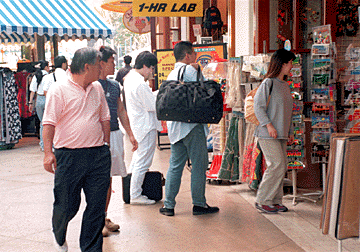
Peter Schall, Hilton Hotels area general manager-Hawaii, said Japanese have less spending money because the nation's domestic consumption tax recently went to 5 percent from 3 percent.
In addition, the slow economy in Japan has driven down prices there.
"Travel within the country becomes less expensive. A couple of years ago it was almost cheaper to come to Hawaii than to vacation in Japan," Schall said.
Destination resorts within Japan are marketing aggressively to persuade the Japanese to travel within their own country, he said.
Keith Vieira, vice president and director of marketing at ITT Sheraton Hawaii, acknowledged that local hotels are seeing a dip in business, including in rooms block-booked by Japanese wholesalers.
"We do have to face the reality. With the cost of outbound travel to Hawaii being higher ... we have to stimulate the demand, give them more reason to come," Vieira said.
Japanese are still traveling and will continue to do so, partly because of the government's policy of encouraging its citizens to travel overseas, said Toy of Coopers & Lybrand, an accounting and consulting firm.
Toy said the Japanese government, which had about 17 million of its citizens travel abroad last year, has set a goal of lifting that to 20 million by the year 2000.
And Yoshimoto of Jetour Hawaii adds that the Japanese will keep coming to Hawaii.
The state had a record of more than 2 million visitors from Japan last year, and business is likely to be around that level this year, she and other marketers said.
But the industry sees some hard selling ahead.
"What concerns me is we're losing our market share," Yoshimoto said.
"Japan is still sending all the people out," she said, but they are finding other places to go. "We can't sit and let that happen."