By George F. Lee, Star-Bulletin

Wahiawa General Hospital:
“Dead people get tested.
Live people don’t.”
Emergency room doctors must report suspected child abuse, knife and gunshot injuries - even bites by nonfamily dogs. But doctors could lose their medical licenses if they voluntarily report alcohol levels or drug screens of injured drivers, say Drs. Fred Holschuh of Hilo Medical Center, Andy Schwartz of Queen's Medical Center and Craig Thomas of Wahiawa General Hospital.
"If they make it to ER after a drunken-driving incident, their chances of getting arrested for DUI are almost nil," Schwartz said.
"Dead people get tested. Live people don't," Thomas said.
State law requires emergency personnel to follow ethical standards adopted by the Hawaii Medical Association and American Medical Association. Doctor-patient confidentiality must be protected unless the law says otherwise.
 "Isn't it comical?" said Holschuh. "A guy gets a (dog) bite on the buttock and we have to tell the cop. ... Yet, if a driver is in a car crash and obviously intoxicated, we can't go to a cop and say, 'This patient is drunk.'"
The three doctors, supported by Mothers Against Drunk Driving, have worked for years to get the law changed.
The Hawaii Medical Association, prodded by past President Holschuh, has endorsed the effort. But it is controversial, a medical association spokesperson said, noting that some doctors feel confidentiality should remain sacred.
The issue is being aired with bills introduced by House Health Chairman Alex Santiago and Senate Health Co-Chairman Andy Levin. The Senate bill has moved from Levin's committee to the Senate Judiciary Committee.
The three doctors point out that only 38 blood-alcohol tests were requested by Honolulu police in 1995-96.
The hospital-generated tests were done by the city Health Department's examination section, headed by Emily Chang.
She said the same number of tests was done in 1994-95.
"That knocked all our socks off," Thomas said.
"Higher-volume emergency rooms get that volume in a week. We certainly get that many in a week or two in Wahiawa."
As emergency workers, Schwartz said, "We see people all the time who clearly have been driving under the influence.
"A policeman will come and wants to know what the injuries are, but they don't make a case that this is DUI."
Police may request a blood sample if they have probable cause to believe the injured person was the driver. But they say that's often difficult to determine.
The person may already have been taken to the hospital when officers arrive at the scene, said Sgt. Clyde Yamashiro, in the Traffic Division's vehicular homicide section. And many times different officers do the follow-up investigation at the hospital, he said.
Concerned police are working with doctors, prosecutors and MADD to remedy the problems, he said.
"There is some vagueness in our procedures. We're trying to establish something more uniform throughout this department," he said.
Maj. Barbara Wong, commander of the Traffic Division, said determining probable cause shouldn't be a problem.
Usually somebody at the scene can identify the driver, she said. If the officer observes things indicating the person was under the influence before getting into the ambulance, a blood sample can be requested, Wong said. Also, if the officer getting the injury report at the hospital smells alcohol and confirms that person was the driver, a blood sample can be requested, she said.
"Our new policy will be clearer and easier to understand, and we'll train officers in the field in how to carry it out," Wong said.
Deputy Prosecutor Randy Lee, in the misdemeanor trials division, said, "The danger is we basically have a time bomb out there. A lot more dangerous people are on the road under the influence than what's reported."
Lee believes the number of drunken drivers escaping the system via emergency rooms could be minimized if police were more diligent about requesting blood-alcohol samples and doctors and nurses could report their alcohol findings.
Schwartz said there's a clamor for a blood-alcohol test even before a patient arrives at the hospital in high-profile cases, such as the Kapolei crash Jan. 7, in which three members of one family were killed. Their car was hit by a speeding driver with a blood-alcohol level three times the legal 0.08 percent limit, reports showed.
"It's the run-of-the-mill case where there may or not be any deaths involved that is being overlooked," Schwartz said.
Holschuh said he was encouraged by Portland, Ore., emergency nurse Carol Bonnono's success. It took seven years, but she got an Oregon bill allowing emergency health-care workers to release blood-alcohol information.
The American College of Emergency Physicians opposed the Bonnono bill, but 14 states have adopted laws similar to Oregon's, Holschuh said.
The idea isn't just to get alcohol- or drug-impaired drivers off the road, the Hawaii doctors stress, but to get them into treatment.
The final goal, Thomas said, "is to make drunk driving just something socially wrong."
Roz Luther, MADD education committee chairwoman and medical technologist, said she drew blood and did tests at Castle Hospital for Bucky Lake's trial.
The blood-alcohol content for Lake, a former Air Force airman, was 0.15 percent when his car hit another on June 19, 1988, near Sea Life Park, killing five people. Lake became the state's first DUI manslaughter conviction. A level of 0.10 was considered legally drunk then; now it's 0.08.
Now, however, only test results from the city-county laboratory and Tripler are accepted for court, Luther said. Many times drunken drivers aren't hurt badly enough to need blood tests, and many times there is probable cause and drivers still aren't being tested for alcohol, she said.
"We have these loopholes that are letting us have repeat offenders over and over again with little results. The average person who gets drunk has driven about 5,000 miles without being caught or stopped."
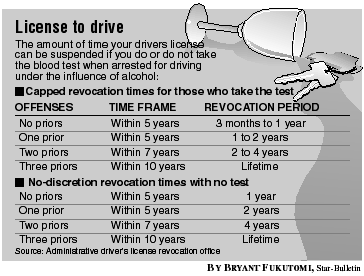
But a recent state Supreme Court opinion says a hearings officer can boost the revocation time to a year for those with no previous driving-under-the-influence offenses within five years.
Defense attorneys who handle DUI cases say they don't think the Legislature intended such a severe punishment.
"It's a bit of a bombshell," said Sam King Jr., a defense attorney, who also said the court's interpretation gives hearing officers "way too much discretion."
Earle Partington, another defense attorney, said he also was dumbfounded by the Jan. 30 opinion and predicted that the hearings officers would use the ruling to increase revocation times.
But Ron Sakata, chief adjudicator for the administrative driver's license revocation office, said the officers would stick to the minimums unless they presided over cases with extraordinary circumstances.
He also said the opinion, written by Associate Justice Steven Levinson, validated the state's position.
"We always felt we had discretion," he said.
"But we've never exercised it."
The opinion gives hearing officers discretion over first-time and repeat DUI offenders who take a test to determine if they are legally drunk.
But it also sets a cap on the revocation period, making sure their time without a license doesn't exceed the time for those who refused to take the test.
"It gives credit to those who take the test," Sakata said.
For example, a DUI offender with one prior offense who takes the test faces a revocation of one to two years.
The offender who didn't take the test faces a two-year revocation with no discretion.
Sakata said his office processed about 4,400 cases last year and about 80 percent led to license revocation.
He said most people take the breath or blood test and that most are first-time offenders.
The opinion stemmed from a case in which a man was appealing a lifetime revocation. Levinson upheld the revocation, but also interpreted the law regarding discretion.
Theresa Paulette of Mothers Against Drunk Driving agreed with giving discretion to hearings officers. "We always want a serious consequence for drunk drivers," she said.
Sakata, however, said his office hadn't deviated from the listed revocation periods in five years and doubted that future circumstances would invite it.
He also explained that his office usually doesn't get drunken-driving cases with fatalities.
In the opinion, Levinson said the law preserved the discretion of hearing officers, but in a new form.
He said the state Legislature substituted "may" for "shall" when discussing what the revocation time officers may impose.