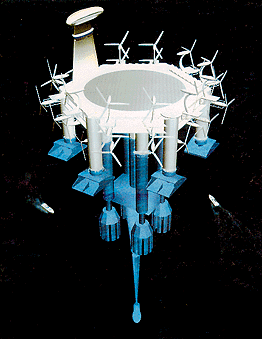
Artist's rendering
This rendering shows a Mitsubishi design for a
floating power station using ocean thermal, solar and
wind energy. State lawmakers want to know if such
a station would be feasible if located off the Big Island.

At the moment, this "floating power station" designed by the Mitsubishi Research Institute of Japan is just a dream. But some looking to the future say it could come true in deep, cold waters off the Big Island.
 Some state legislators also see more than a pipe dream. The House Committee on Energy and Environmental Protection on Saturday gave preliminary approval to a $50,000 appropriation to get the ball rolling. If finally approved, the money would bring together international experts on floating platforms, alternate energy, and others interested in such a first-of-its kind project.
Backers envision a platform about five miles off Keahole, where the Hawaii Natural Energy Institute for years has been tapping deep water for ocean thermal energy and other enterprises. They say the floating power plant would stretch dwindling oil resources while providing "clean" alternate energy with the help of ocean currents, wind, the sun, and deep, cold water.
"The landmass goes straight down in the Keahole area," said Dennis Toyomura, an architect who has been pushing for such a project in recent years. "All areas along there have a drop because of the volcano."
Backers say a 100,000-square-foot version of Mitsubishi's hexagonal platform could be built here for about $500 million. A circular pattern of photovoltaic cells would gather the suns rays. Big wind turbines would turn. Submerged portals would trap surging currents. And deep probes would deliver icy water from the deep - all generating electricity and sending it ashore with undersea cables or microwave transmitters.
Toyomura sees a scaled-down version for Hawaii. He and former Gov. George Ariyoshi in mid-1995 attended a symposium of the Japan Clean Energy Research Institute, a nonprofit organization interested in developing a floating power station. Toyomura said such a project would bring major business activity to Hawaii. And it would ease Hawaii's precarious dependency on imported oil for energy.
Dr. Patrick Takahashi, director of the Hawaii Natural Energy Institute, testified in favor of the bill noting Hawaii should take a leadership role while it can. He noted other proposals - a floating missile launch facility near Hawaii being eyed by Boeing Co. and a floating helicopter base off Okinawa jointly planned by the United States and Japan - could preempt Hawaii.
"The ocean is Hawaii's best resource," he said. "Tourism is great but we need to do more with the ocean."