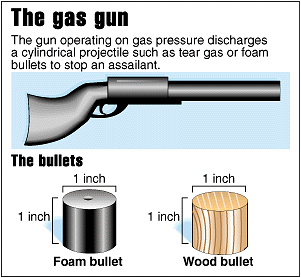

Parker was downed by one of three nonlethal rounds shot from a .37 mm "gas gun" -- commonly used to fire tear gas -- in an alley between GTE Hawaiian Tel and 1100 Alakea St.
Honolulu police acquired "low-lethality rounds," used in riot or crowd control, just last year and used them for the first time yesterday, said Capt. Kenneth Barker of the Specialized Services Division. After yesterday's success and, if they continue to prove successful, the rounds will play an integral part in future barricade, hostage or suicide situations, police said.
The first two rounds resembled rubber foam dowels - about an inch in diameter and slightly less than an inch thick. When those proved ineffective, the officer who fired the first two fired a third, a wooden plug similar in size and shape to the foam rounds.
Both types of rounds are designed to immobilize but not cause serious injury, although the wooden round does cause pain, Barker said.
The shots were fired from about 25 feet away, said Maj. Keith Pocock, head of the Specialized Services Division.
The extent of injury Parker sustained before he was taken to Queen's Hospital appeared to be a busted lip, although it was not clear whether it was caused by the rounds or from hitting the ground hard after being struck the third time.
Parker remained at Queen's overnight. Hospital officials, at the request of police, declined comment on his condition.
FBI officials, who said the injuries Parker sustained were not life-threatening, said they were pleased with the outcome and credited police's decision to use nonfatal rounds.
"I think Honolulu police exercised extreme care and caution in conducting this," said Robert Kauffman, supervising special agent of the FBI's organized crime drug program. "They allowed Mr. Parker to control the events and waited until he acted."
Parker was holed up in a recessed doorway in the back of the Voice Stream building at 1100 Alakea St. for nearly eight hours before he bolted toward a group of officers positioned on the Ewa end of the alley, Barker said.
Police earlier had said they would wait Parker out, rather than take him by force. "We can wait as long as it takes to resolve itself peacefully - that's our philosophy," Barker said.
Parker had been partially hidden from view of officers on the sixth-floor roof of the Hawaiian Tel building and officers on both ends of the alley that opens into Adams Lane and Alakea Street. Officers also were inside the Hawaiian Tel building, where a double door also opens out into the alley.
There was no other way out for Parker, who was surrounded by a 30-foot wall of the Voice Stream building and the six-floor wing of the Hawaiian Tel building. Police monitored his movements but had a limited view of him through the slightly curved alley. Sharpshooters and negotiators on the rooftop had to lean over the edge to catch a glimpse of him below.
Police had lowered a cellular phone within Parker's reach just before 7 a.m and negotiator Det. Margot Tang made repeated attempts using a bullhorn to coax Parker to pick up the phone. It wasn't until 9:35 a.m. that he retrieved the phone and began speaking to negotiators.
Police also played taped messages over the phone from Parker's wife and mother.
Thousands of morning rush-hour motorists were affected as police cordoned off several blocks to traffic and ordered three parking garages closed until the siege ended about 11:30 a.m. yesterday.
Police, the FBI and U.S. marshals had searched for Parker overnight after he disappeared following his conviction on three federal charges Wednesday. He was seen on Bishop Street about 10 p.m. Wednesday and then again by a security officer at 1100 Alakea just before 3:23 a.m. yesterday.
The government yesterday morning dismissed the fourth charge of money laundering filed against him. During negotiations, police informed him the charge had been dropped, FBI officials said.
During the siege, Parker carried a blazer that appeared to conceal something, police said. Each time he switched it to the other hand or stepped into the open, police attempted unsuccessfully to confirm whether something was hidden inside.
The security officer who called police after spotting Parker behind the building had indicated Parker was possibly carrying a firearm but could not be certain, police said.
Police suspected Parker may have been carrying a weapon - wrapped in the blazer - after clicking sounds were heard. When Parker bolted from his hiding place at 11:27 a.m., he had both hands in front of him holding the blazer. No weapon was found.