Honolulu Star-Bulletin Business
By Kathryn Bender, Star-Bulletin
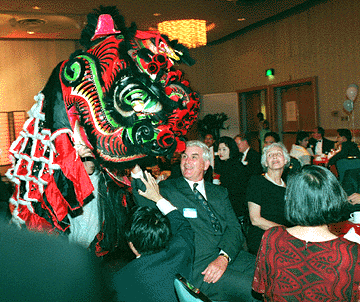
Lion dancers perform at a reception hosted by the Vietnamese-American Chamber of Commerce of Hawaii last night at the Ala Moana Hotel. The Tet celebration was part of the two-day "Riding the Asia Pacific Wave" conference.
U.S.-Vietnam
trade deal seen
Top officials from both countries
talk at a Honolulu meeting
By Susan Kreifels
Star-Bulletin
 High-level U.S. and Vietnamese officials, speaking at an unusual gathering in Honolulu, said they are optimistic that their two countries can soon reach a trade agreement, giving U.S. companies the support and security they want to invest there.
L. Desaix Anderson, charge d'affaires at the U.S. Embassy in Hanoi, yesterday said a draft agreement is scheduled to be finished by Vietnam's Tet, or New Year celebration, on Feb. 7 and that a final pact could be reached in several months.
"This is a very important and urgent task," said Anderson, the top U.S. official in Hanoi. "We found out we knew very little about Vietnam's structure. We've been isolated from each other for so long."
Nguyen Nhac, Vietnam's vice minister of planning and investment, said approving a trade agreement and being granted Most Favored Nation status with the United States was Vietnam's "highest priority" in the bilateral relationship. That status would cut duties, some reaching 30 percent, on Vietnamese products imported into the United States.
Nguyen and Anderson spoke yesterday at what organizers billed as an unusual and prestigious symposium of U.S. and Vietnamese officials discussing economic normalization. Virtually all other meetings on the topic have been held in Hanoi or Washington.
The symposium was part of a two-day conference on strategies for doing business in the Asia-Pacific region. Organized by the Inter-Pacific Bar Association, the "Riding the Asia Pacific Wave" conference at the Ala Moana Hotel drew 180 business people, attorneys and others interested in the region.
A quick trade pact would be good news for Hawaii businesses that have ventured into Vietnam. Puongpun Sananikone, president and chief executive of PAC MAR Inc., said more Hawaii businesses should consider investing there.
"Hawaii business is never too small to go to Vietnam," said Sananikone, chairman of the Vietnamese-American Chamber of Commerce of Hawaii. His consulting company helped develop the master plan for an export-processing zone in Vietnam. "Vietnam needs small and medium entities more than large ones in rural areas."
A trade agreement and Most Favored Nation status for Vietnam would lead to investment insurance for U.S. companies there as well as loans from the U.S. Export-Import Bank.
Such an agreement would make American companies feel more secure, said Ralph Portmore, executive vice president of Group 70 International, an architecture firm planning tourism developments in Dalat and Hue. "Trust is still needed," he said.
Anderson said remaining snags include intellectual property rights and opening markets.
"Many cases revolve around competition. That's new in Vietnam," he said, adding that Vietnam is grappling with the role of 6,000 state-owned enterprises.
Nguyen Xuan Oanh, former deputy prime minister of South Vietnam from 1964 to 1972 who stayed after the collapse of the south, said economic reform is difficult for Vietnam. "It's a 180-degree turn," he said. "When you open up a market economy there's so many things to do."
Still, Nguyen Xuan Phong, director of the Americas Department in the Ministry of Foreign Affairs, said the agreement could be in place within the year.
The United States dropped its trade embargo against Vietnam in 1994. It restored diplomatic relations in 1995 and since then has been talking with Vietnam about economic normalization.
Anderson said more than 400 U.S. companies are operating in Vietnam and have invested $1.3 billion.
Hawaii firms urged
to consider Pacific markets
By Susan Kreifels
Star-Bulletin
Hawaii businesses looking to expand should take advantage of ties to island consumers across the Western Pacific, said local business officials and consultants at a two-day economic conference.
"The Pacific islands are important markets for Hawaii," said Wali Osman, a vice president and Pacific-islands regional economist for the Bank of Hawaii. "The standard of living must go up there. We have what they need."
Osman spoke Monday at the "Riding the Asia Pacific Wave" economic conference, sponsored by the Inter-Pacific Bar Association at the Ala Moana Hotel.
Although the population of the Western Pacific islands is only 7 million, Osman said it's still a profitable market in which Hawaii has an advantage because of cultural and historic ties. The Bank of Hawaii operates on 13 Pacific islands.
Many of the islands are heavily influenced by America.
Guam and American Samoa are still U.S. flag territories. The Micronesian islands (except Guam), once part of a U.S. trust territory after the World War II, have forged new relationships with the United States. The Federated States of Micronesia, the Marshall Islands and Palau have compacts of free association. Saipan is part of the Commonwealth of the Northern Mariana Islands.
In the new relationships, the United States retains certain military and diplomatic control and the islands continue to receive U.S. funding.
But Osman said that as U.S. funding in the islands shrinks, private investment becomes more important, making it a good time for Hawaii businesses to expand there.
Speakers said Guam and Saipan offer tax incentives to investors and are more pro-business than Hawaii. Guam, with 1.3 million tourists last year, has completed the first phase of a new airport terminal; is expanding hotel rooms by 14 percent this year; approved $50 million of government money for improvement of the Tumon Bay hotel area; and is opening new attractions such as a factory outlet mall, Planet Hollywood and Hard Rock Cafe.
Angela Williams, director of the Pacific Business Center at the University of Hawaii, said there are opportunities in tourism, fisheries, exotic agriculture, and retail shopping across the Pacific.
But there are risks involved.
 Land ownership and discrepancies between introduced laws and traditional laws continue. In Saipan, for example, only citizens can own land. Attractive leases are available for up to 55 years, however, said former Hawaii Gov. John Waihee, now a partner in the law firm Verner, Liipfert, Bernhard, McPherson & Hand.
Local labor shortages persist. Outrigger Hotels & Resorts, Hawaii's largest hotel chain, is doing business in the Marshall Islands, Guam, Palau, Tahiti and the Cook Islands and training local help. But Perry Sorenson, Outrigger's chief operating officer, said many island residents prefer to work for the government rather than hotels. Bringing in foreign help is often difficult.
Industry is flourishing on Saipan, however, with the use of cheap imported labor from Asia, Waihee said.
Limited infrastructure. Hotels often have to come up with their own water and power.
Fear of outsiders. "There's still a fear that outsiders will take resources and money away," Williams said. "There is cultural bias."
© 1997 Honolulu Star-Bulletin
http://starbulletin.com