Honolulu Star-Bulletin Local News

By Dennis Oda, Star-Bulletin
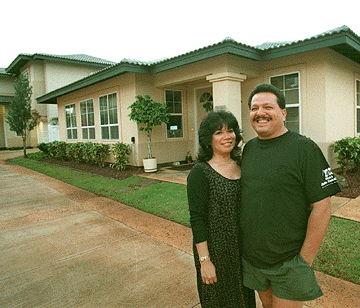
Margaret and Rick Trejo got a bargain
on their home in Kapolei.
For those willing to take the plunge,
there are housing deals to be had in Oahu’s
second city, but for others, the
slowdown is all bad
By Rob Perez
Star-Bulletin
 Rick Trejo got what he considers a great deal on a house.
The Kapolei resident says he and his wife, Margaret, paid $243,000 last year for a new Iwalani home that was priced at $279,000. In other words, the builder discounted the three-bedroom house nearly 13 percent to make the sale.
"We took advantage of the fact that the market sucks," Trejo said.
If only there were more people like the Trejos.
Home sales in the area, dubbed Oahu's second city, have slowed to a trickle. Some housing officials describe the market in Kapolei and the entire Leeward-Central Oahu region as disastrous. And most experts don't foresee a turnaround any time soon.
"It's big-time trouble in that whole area," said Ron Lim, Gov. Ben Cayetano's executive assistant for housing.
Oahu's housing slump, of course, is nothing new. The market is entering its seventh year of sluggishness, the longest slump ever to hit the local industry.
But recent signs suggest the Kapolei picture has worsened considerably since summer - disturbing not only for sellers in the area but for those trying to market properties elsewhere on Oahu.
Lower prices in the Leeward region lure many first-time buyers. If those homeowners aren't seeing their properties grow in value, they often lack the equity to be able to upgrade later into bigger or closer-to-town homes, reducing the pool of so-called move-up buyers.
"People may be stuck in these homes for a while," said Mike Sklarz, research director for Prudential Locations Inc.
The economic doldrums have created what many consider unprecedented buying opportunities. With an abundance of motivated sellers, bargains - at least by Hawaii standards - can be had. What's more, relatively low mortgage rates and lenders hungry for business are contributing to the favorable buying climate.
But that hasn't been enough to lift a general malaise blanketing the market, industry officials say. A steady drumbeat of disheartening economic news, underscored by four straight years of job losses in the state, have made people apprehensive about making major financial commitments.
Builders wonder when the gloom will end.
"We can't weather this much longer," said Stanford Carr, whose company is developing the Iwalani project.
"We're all in the same soup, and it's all tied to (lack of) job growth."

By Dennis Oda, Star-Bulletin
Becky Matsui, left, walks Nala, while Bobbie Waialae walks
Simba on the sidewalk near the Kapolei Recreation Center.
Why the stakes are high
In a typical market, the sales pace would be of primary concern to developers and homeowners trying to unload their dwellings.
But the stakes in Kapolei go well beyond that. The state has invested tens of millions of taxpayer dollars to construct roads, utilities and other improvements for the Villages of Kapolei, and some of that money still is at risk.
When sales are slow, the state, which loaned millions to developers for land acquisition and housing construction, may not get paid back as quickly. Worse, if a project fails, the government could be left with nothing but undeveloped lots.
"We're not immune to the risks," Lim said.
Events since this summer depict a market still on the decline:
 The two active builders in Kapolei, Watt Homes and Carr's Iwalani Development Partners, recently asked the Housing Finance and Development Corp., the state agency overseeing development, for loan extensions because of the sluggish sales pace. HFDC data shows the two builders collectively averaged less than four closings a month for single-family homes between March and November. The loan extensions were granted earlier this month.
Schuler Homes, one of the state's largest builders, abandoned plans to develop an 8,000-home community in East Kapolei.
Makai Village Partnership, which plans to construct more than 600 homes in Kapolei, recently had to revise its development proposal - approved by HFDC in April - to account for the deteriorating market. The developer lowered its monthly sales projections from 25 to 17, a figure some HFDC directors still questioned as overly optimistic.
The slow sales pace prompted the Kapolei homeowners' association to propose raising monthly fees from $25 to $35. The plan sparked a homeowner uprising that led to the ouster of the association president.

By Dennis Oda, Star-Bulletin
Neighborhood kids play basketball at Kapolei Recreation Center.
Government gets involved
The state-planned Villages of Kapolei, designed for 5,000 homes, currently has 2,250 - more than 800 short of what the state projected would be built by now. Fewer homes means the association collects less in fees.
The project was launched in the late 1980s by former Gov. John Waihee, who described it as one of his administration's greatest achievements.
Waihee envisioned the state acting as a catalyst to steer growth to West Oahu and bring affordable housing to the masses.
But the development has progressed far more slowly than envisioned. And as the downturn persists, some within the Cayetano administration are questioning the wisdom of the government's being in the housing development business.
"I think the lesson learned in all of this is maybe we shouldn't have been in it in the first place," Lim said.
The new-home market is not the only one hurting in Kapolei. Existing home sales also are taking a beating.
Case in point: An owner tried selling a four-bedroom, 2,141-square-foot house in Kumu Iki, Kapolei's first village, this summer for around $330,000. No takers. The asking price was lowered several times before the property sold. The sales price? Less than $275,000.
"You see that (discounting) happening quite a bit," said Carol Iseri, principal broker of Properties Unlimited.
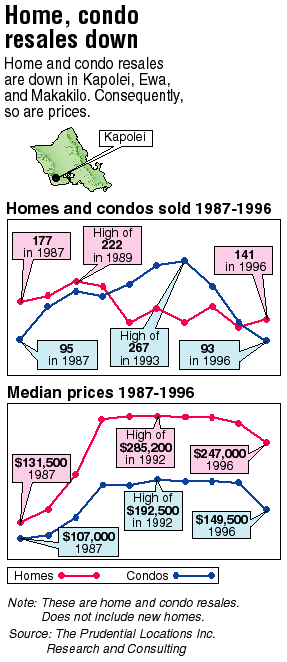
Prudential Locations data shows the median single-family price for existing homes in Kapolei has declined 17 percent since 1993. Comparable data is not available for new homes.
But what happens with resales tends to affect the new-home market. And discounts of 5 percent to 15 percent, including incentives, are not uncommon at Leeward projects, industry officials say.
Indeed, buyers in both the new- and existing-home markets are becoming especially savvy at comparison shopping, going from one seller to the next expecting significant concessions, builders say.
"They're going to squeeze you for every dollar they can," said Jon Yamaguchi, an appraiser and president of Yamaguchi & Yamaguchi Inc.
By Dennis Oda, Star-Bulletin
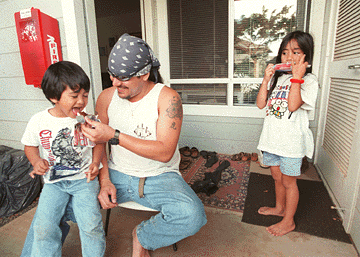
Tiger McAllister gives son Zay, 4, part of his ice cream,
while daughter Arika gets her own.
Affordability is critical
First-time buyers are particularly price sensitive because they often stretch their budgets to the limit. In many cases, they barely qualify for the low "teaser" mortgage rates that developers tout.
When those rates eventually go up, sometimes after only one year, problems can arise.
Several bankruptcy attorneys said the majority of homeowners they represent come from Kapolei and other Leeward areas. Job layoffs, work-hour reductions and divorces are common catalysts for the bankruptcies.
"If they're just squeezing by each month, when something goes, they're automatically in a financial crisis," said attorney Greg Dunn, who handles about 50 bankruptcy cases a month.
In such a price-sensitive market, affordability becomes critical.
That's where Kathy Inouye, president of Makai Village Partnership, says her company has an edge. She said Makai Village plans to focus on single-family detached homes in the $200,000 to $300,000 range, with an emphasis on those below $250,000 - an untapped segment of the Kapolei market.
The optimists in the industry say the market will soon stabilize and begin a modest rebound in the summer. Those less optimistic say prices at best will stop falling this year. They don't expect a turnaround until 1998.
Whatever forecast proves correct, Trejo, the Iwalani homeowner, seems unfazed by the prolonged downturn. He still believes he got a good deal and sees values rebounding as Kapolei matures and grows.
Signs of that growth continue to surface despite the weak economy. A new community center opened last year. Construction recently started on a state office building. A medical office complex is in the works.
"Everything around here looks nice," Trejo said. "I couldn't ask for a better community."
© 1997 Honolulu Star-Bulletin
http://starbulletin.com