From "The Birdwatcher's Guide to Hawaii"
A reader wondered if the Black-Crowned Night heron
is indigenous to Hawaii.
A reader wondered if the Black-Crowned Night heron
is indigenous to Hawaii.
Synchronicity, heck. Sometimes it's fate, sometimes it's coincidence, sometimes it's just plain stuff occurring pretty much the same time. You think? Yes, herons dwell here
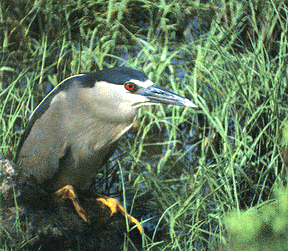
in HawaiiTake this query from Marlene Sueyoshi of Pearl City. She saw and photographed what appeared to be a heron eating fish in Moanalua Stream.
"Wat dat?" she wondered. "Sure looks like a heron, but since when do we have herons in Hawaii? Or have I been living in a cave?"
The same day we received a copy of "The Birdwatchers Guide to Hawaii," the new book from University of Hawaii Press (by Rick Soehren, 214 pages, $17.95) and there, in one of the color pictures, was Marlene's heron.
It's a Black-Crowned Night Heron, and it's indigenous to Hawaii. It's not endemic, because the local bird isn't different enough from its mainland cousins to merit that classification.
The heron hangs around wetland habitats, and in addition to Hawaii, can be found from Washington/Oregon to Chile/Argentina. It gets around.
On both male and female, the top of the head, the bill and the back are greenish-black; forehead, throat, sides of head and underparts are white (sometimes with a pale bluish-green, lilac or cream tint); the rump, wings and tail are ashy or bluish gray; the eyes are red; the legs are yellow. Wingspan can be almost four feet. Not a tiny, reclusive species.
The heron's trademark, three long narrow white feathers, trail from the back of the head like doo-rag braids. The actual phrase for these is "nuptial plumes." Sprinkle that into your next conversation.
There are other herons that visit here, but the Black-Crowned Night Heron is local, brah.
Now, as to the question of whether Marlene has been living in a cave, no comment. Except that she DOES write from Pearl City.
By Burl Burlingame