By Dennis Oda, Star-Bulletin
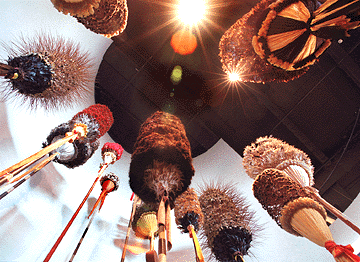
Kahilis, above, are a focal point of the display.


 museum is a library of reality, the place where the guaranteed goods are, the arena where a citizen can experience first-hand the beauty of an endangered moth, the sleek wonder of a voyaging canoe, the intricate artistry of ancient crafters, the images of forgotten ancestors and the sounds of modern culture. It's the physical stuff that defines us as thinking creatures.
If only some of this stuff weren't so dang heavy.
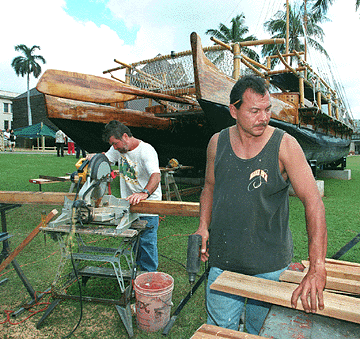
We watched Bishop Museum staff suspend Kamehameha V's fishing canoe from the ceiling of the Castle Memorial Building this week, and we're talking big, heavy, awkward, fragile, scary.
The massive canoe settled into its cradle, the supports groaned, and it was OK.
"How does she look?" Blasco asked museum collections manager Elizabeth Tatar.
"Looks fine," shrugged Tatar.
"Fine? Fine? After all that, you just say fine?" laughed Blasco.
"Well," said another curator. "The chains don't match. Do you have other colors?"
Such attention to detail. The canoe is part of Bishop Museum's biggest in-house-designed display to date, "Na Mea Makamae - Treasures of Hawaii," sponsored by Bank of Hawaii. It runs Saturday through May 4, and features the cream of the museum's world-class collection.
"A museum's collection is its core," says Tatar. "Many museums have less than 1 percent of its collection on display at any time, although that varies - a science-education museum might have no collection, and an art museum probably has most of its collection out - but in general, people think of museums as stereotypical dusty, musty places with old things packed away."
A museum's collection is actually a vital part of its educational and scientific mission, and as a natural-history and Pacific cultures museum, the Bishop's core is constantly researched by scientists and scholars trying to figure how and why the world ticks the way it does.
There's a standing joke among museum curators and conservators that the safest place for an artifact is hidden well away from the corrosive effects of human eyesight. There's something to that - people are hard on things, and museum displays have to balance the ideals of public access and artifact preservation.
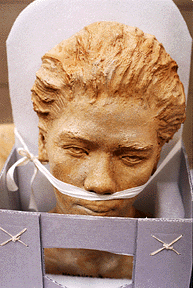
Most of the behind-the-scenes work in a museum consists of restoring, cataloging and cross-referencing artifacts and collections. (Use unbleached muslin to fold clothes into to preserve them. Use pencil to write on acid-free paper. Use formaldehyde only in the initial preparation of a fish specimen; use alcohol for long-term storage and make sure the data card indicates that the hole in the fish was caused by a spear and isn't a natural feature.)
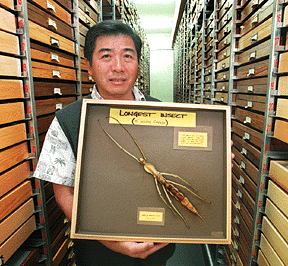
This kind of conservancy is a pile of work just in the museum's insect collection, thank you, which is something like 14 million examples (they think). Of these, about 16,000 are holotypes, the single specimen from which all subsequent descriptions of a species spring. At the museum, the insect holotypes are kept in a hardened bomb-shelter type of holodeck, which collections manager Gordon Nishida only half-jokingly says is protected against airplane crashes. Saving these things is a kind of holy mission.
Jack Randall, who has collected a good portion of the museum's 100,000-plus fish collection - including many holotypes - regrets only that fish need to be seen in their natural habitat to be appreciated. He feels photographs do that best, and, accordingly, the museum has tens of thousands of color pictures preserved for that purpose.
Stuff is coming out for public view for the first time in years, although the items have always been available for study. Kamehameha's famous all-yellow feather cape. Lili'uokalani's private diaries. Kalakaua's scrapbooks. A feather malo at least 500 years old. The largest insect in the collection, the smallest, the prettiest, and the ugliest. A basaltic rainbow of adzes and poi pounders. Computer programs designed by the museum. An ancient Hawaiian ball of string woven from olona, the strongest natural fiber in the world.
"Museums are just like anyone else - we treasure certain things, and we do because these things have stories to tell," said Tatar. "The Bishop Museum's story is the story of Hawaii, where we were and where we're going, what has changed and why it changed.
"You don't want to be the big attic, where stuff just winds up. But at the same time, you don't want to keep anything out, because you might not understand the interrelationship at the time.
"Man is very egocentric, but we're a very young species. and we don't understand our relationship to everything else," Tatar said. "Look at it this way: In a hundred years, or less, there will be nothing left that's naturally Hawaiian. All the species will be pan-Pacific. It'll be a very different place than it is today.
"Some don't care. A tree is a tree, whether it's ohia or monkeypod. Or look at haole koa, which came here in the last century and completely changed the environment of the islands. On Kahoolawe, the haole koa root system goes so deep it sucked up the water table, upset the (ecological) balance of the island, and started erosion. The goats and the bombing were just icing on the cake.
"Understanding that balance is the key to our survival. Humans have a tendency to want things homogenous, but diversity is a value that needs to be appreciated - we need unity with our diverse and complicated natural systems. Museums are where we begin understand that process, which is why museums are so important. We might not survive without them."
What: "Na Mea Makamae: Treasures of Hawai'i