
WHERE does Hawaii stand in achieving the goal of having all of America's K-12 schools hook up to the Information Superhighway? No. 1, that's where. Schools lead convoy
(Third of four columns)
onto info highwayWe are two or three years ahead of California, which has received national publicity.
In a year-ago report to President Clinton and Vice President Gore, Hawaii was cited as the lead example that the costs of a national hookup are manageable.
"In Hawaii," it said, "almost 90 percent of the public schools have connectivity to the Internet, using Oceanic Cablevision's ethernet-over-CATV connections or GTE's frame relay services." It now is 100 percent but connections have higher capability on Oahu than off Oahu.
The report continued: "Hawaii has been able to get many of its classrooms wired even though less than 1 percent of the annual (education) budget goes to technology."
Hawaii State Sen. Carol Fukunaga was the only state legislator serving on the 36-member national commission that recommended bold get-hooked-up goals after a two-year study. She was chosen presumably in part because of Hawaii's record of progress, which owes much to prodding from her and Sens. David Ige and Les Ihara.
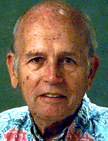
A key figure in connecting our schools has been Philip J. Bossert, project director for the Hawaii Education and Research Network, funded by the National Science Foundation, and a former assistant superintendent of education assigned to the task of hooking all of our schools onto the Information Superhighway, even across watery channels that separate our islands.
He is annoyed that more attention hasn't been paid to our success, proud of what's happened but one of the first to say we are far from fully capitalizing on what we have.
Wires go into at least the library or office of all our schools, but classroom use is spotty. Too many teachers still turn to chalk and the blackboard because they aren't comfortable with their new tool.
For children who have computers at home, Bossert says, it can be like driving to school in a flashy car but then switching to horseback in the classroom. Completing our classroom hookups and making school staffs and teachers more comfortable with the wonderful new technology obviously are high priority needs. But we are moving. Dole and Kailua Intermediate are among only 26 schools recognized by the U.S. Department of Education for their high-tech excellence. Two Hawaii public school programs - "Kid Science" and "Music Factory," which reach 15,000 students a day - have won national awards as "best K-12 distance learning programs."
What already has been done, Bossert says, permits students and teachers to chat with people in all parts of the world, to access libraries elsewhere, to work individually and whenever they want to, even to become publishers.
IS this a turn-on for bright students but a turn-off for slower ones? No, says Bossert. No, says Senator Fukunaga. No, says the national report. A New York public schools study showed it moved at-risk students well ahead of citywide averages in non-wired schools. The net can be a turn-on for everyone. Will too many turn to pornography? It happens, but there is so much more that's attractive, says Bossert.
Starchy Singapore, which wants to control the morals and political attitudes of its 3 million citizens, has opened itself to great risk by deciding to hook everybody up to the basically uncontrollable worldwide Information Superhighway. It sees the benefits as greater. It fights back with court actions against even out-of-country offenders.
We need to prod Hawaii's 244 public schools to move even farther than they have, but we have a tremendous lot to crow about already. We're No. 1!
This article is part three of four
Jan. 16: The Big Bang in communications
Jan. 21: High tech can be comfortable
Jan. 23: Schools lead convoy
Jan. 28: Next Tuesday