Honolulu Star-Bulletin Local News
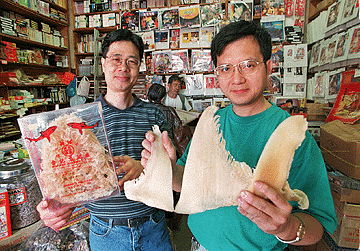
By Dennis Oda, Star-Bulletin
Sammy Au, left, holds "instant" shark fin composed mostly of
shark meat, which costs $29 for 7 ounces at the Bo Wah Trading Co.
in Chinatown. His brother Danny holds actual dried shark fin
that costs from $138 to $175 per pound.
Shark cartilage ads
spur talk of regulation
Researchers say their work has been
misinterpreted to sell cartilage as a cure
By Helen Altonn
Star-Bulletin
 A local beauty salon advertises "miraculous shark cartilage" to treat cancer, diabetes, eczema, psoriasis, cold sores, shingles and other diseases.
Yet, there's no scientific evidence to support claims that shark cartilage prevents any disease, say University of Hawaii marine scientists Chris Lowe and Gwen Goodman-Lowe.
Sharks worldwide are being killed for cartilage - selling for $60 a jar - because a Florida research study was "greatly misinterpreted," Lowe said.
Shark cartilage advocates claim the fish's protein strands may inhibit growth of new blood vessels around cancerous tumors, causing them to shrink and often die. The scientist who did the study, Carl Luer, said that wasn't his conclusion. He believes something in the shark's immune system protects them from cancer.
The Lowes are concerned because they don't want their research misconstrued by people searching for cancer cures. They've found that sharks suntan without developing skin cancer. But that doesn't mean it doesn't happen, Lowe emphasized. "It means we have to look more."
Jim Cook, who runs Pacific Ocean Producers and heads the Western Pacific Regional Fishery Management Council, said he doesn't believe a demand for shark cartilage is driving the market.
"It may drive some of the market, but the market for sharks is a market for meat, and for fins, and in some cases, liver, oil and other byproducts," he said.
The Lowes, graduate students in the University of Hawaii zoology department, are among scientists and environmentalists pressing for a regulated shark fishery.
"Anyone can buy and sell shark cartilage because there are no regulations, Lowe said. "It's dizzying to think of the number of shark fins passing through Hawaii. Several million dollars pass through Hawaii. . . . How many animals have to be caught and killed before it's a fishery?"
Shark populations were nearly wiped out before regulations were adopted to restrict shark fishing on the East Coast, he said.
Clint Fraley, special agent in the Fish and Wildlife Service Division of Law Enforcement, said it has no authority regarding sharks because they aren't an endangered species under federal laws. "Personally, I'm concerned about the population too . . . ," he said.
Cook said the council is looking into management of a shark fishery but the National Marine Fisheries Service says there's no reason to believe there is a problem. The National Marine Fisheries Service collects data on sharks taken incidentally by Hawaii longline tuna and swordfish boats.
Shark management advocates believe shark catch data in the vessels' logbooks aren't accurate.
But Pierre Kleiber, fishery biologist in charge of the shark project at the service's Honolulu Laboratory, said the logbook data appear consistent with what scientists observe when they go aboard the vessels.
The Center for Marine Conservation and the American Elasmobranch Society last fall urged the Fisheries Council to prohibit shark finning in the central and western Pacific.
The society pointed out that the number of sharks finned and discarded climbed from 9 percent in 1993, to 31 percent last year, based on logbooks.
Cook said sharks generally are dead before fins are removed and it would be wasteful not to utilize them. Sale of shark fins in the Western Pacific may exceed $30 million, which bolsters Pacific island economies, he said.
He said sharks may need to be managed and the council will take those actions when warranted by scientific and other data.
Pressures on the shark population for food have spurred management plans in parts of the Gulf, off the East Coast and parts of California, Cook said.
But Hawaii doesn't have many shark species good for food nearby, he said.
"What we do have is incidental take of sharks in tuna and swordfishing longlining because the prices of shark fins have risen so dramatically in the past couple of years."
The average price of shark fins in Hawaii has gone in two years from about $15 a pound to about $25 a pound, he said. (Retail prices vary.) A longline vessel out a few weeks on a tuna trip could average $1,000 on fins from an incidental shark catch, he said.
The fins are dried, loaded in containers in Honolulu and shipped to Hong Kong's high-demand market for fins for shark's fin soup, he said.
Hilda Diaz-Soltero, National Marine Fisheries Service southwest regional administrator, last fall informed shipping companies in Korea that some foreign fuel tankers frequenting Honolulu Harbor were believed involved in shark fin transshipment activities.
She warned that transfer of shark fins is illegal within the U.S. 200-mile exclusive economic zone around Hawaii without foreign fishing permits.
Jeff Polovina, chief of ecosystem and environment investigations at the service's Honolulu Laboratory, said crews are believed to be doing the shark finning and getting the revenue through trade with vessels supplying longliners.
He said the ships' owners aren't happy about it because people get injured finning sharks. Diaz-Soltero's warning "may put a damper on this," he said.
But the number of sharks taken in Hawaii fisheries is only a small percent of sharks harvested by foreign vessels in the Pacific, Polovina said.
© 1997 Honolulu Star-Bulletin
http://starbulletin.com