Newsmaker

Monday, January 13, 1997
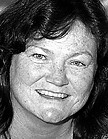
Name: Margaret "Peg" Sipple
Age: 42
Occupation: mental health nurse.
Education: University of Kansas.
Relaxation: reading astrology and New Age books.
Her aim is "to help people talk about their illness as an illness. We try to teach them it's not who they are, it's not their identity," said Sipple, a nurse with the Queen's Medical Center day treatment program for the mentally ill.
Sipple counsels and teaches people with depression, schizophrenia and other chronic mental illnesses. Her classes are on coping with illness, managing medication, preventing relapses, maintaining relationships with other people and healthy living.
The cheery, down-to-earth nurse received the Hawaii Nurses Association 1996 "Excellence in Practice" award. She was nominated by her co-workers for being "a tireless advocate xxx a true friend of those with mental illness and uncompromising that their treatment be fair and humane," said Ken Hansen, manager of Day Treatment Services.
Sipple has been in mental health nursing for 18 years, the last six in Hawaii. "When I came here, Hawaii ranked 51st in the nation in mental health care ... but at Queens, we are catching up very fast."
She grew up on the grounds of a Veterans Administration hospital where her father and mother both worked as nurses, which probably predisposed her to her profession.
"I love the mind, and how it works and how people communicate," said Sipple. "I am a very accepting person, but I am able to set limits on people" as is necessary in directing a class, she said.
She is certified as a practitioner in the "Healing Touch" program of the Holistic Nurses Association, which attempts to address a person's mental and spiritual needs as well as teaching physical practices to relieve stress and pain. She said the program has helped her face her own limits in this branch of medicine.
"You can't make changes for people, you can only give what you have to help them help themselves."
People who are learning to cope with their mental illness have a grieving process to work through, Sipple said. "At this point, they have lost a lot of their family support. Or some of the behaviors they have done aren't easy to talk about. And the medications have terrible side effects."
But there is "a sense of humor that patients seem to share about themselves" and that's one of the reasons she gives in answer to a question of why this branch of health care is so gratifying to her.