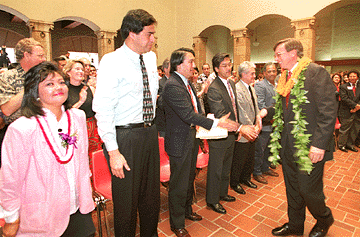
By Dennis Oda, Star-Bulletin
After Mayor Harris finished his state of the city address,
he stopped to shake hands with the City Council.

Two weeks ago, during my inaugural remarks, I talked about the significance of this period in our city's history.
This is a period of major transition that poses great challenges for both our city and our state. This is not a time for indecision. This is a time for action. We can no longer delay major choices that will affect our economy, our environment and our quality of life for decades to come. The status quo of the past 20 years is not an option.
During the past two months I've reshaped my cabinet. We have the right leadership and management team to take our city into the 21st century.
Our team has developed an action plan to meet our city's immediate and long-term needs. There's a great deal to be done, little room for error, and no place for those who aren't fully committed.
This is not business as usual, and this will not be government as usual. We're redesigning some of our departments and refocusing many of our programs. Today, city government is smaller by almost 500 positions than it was two years ago and our operating budget is less in real dollars than it was in 1994.
This afternoon I'll outline our action plan for the coming year to continue our three crusades--improving our quality of life, developing smarter government, and protecting our environment.
We've organized our quality of life efforts into six major categories: Public safety, the economy, land use policies, transportation, youth programs and dealing with the homeless.
Our number one priority is the fight against crime. And it's a fight we're winning.
Several days ago, U.S. News and World Report published their analysis of recent FBI crime statistics for all U.S. cities with populations of 250,000 or more. According to the magazine's analysis, our city ranked second best in the nation. The article attributed success to tougher enforcement and smarter grass-roots anti-crime campaigns. Our figures confirm the U.S. News analysis. Crime dropped by 10.7% on Oahu in the past year.
A major factor in this change has been the hard work of HPD and the direct involvement of hundreds of community groups. Neighborhood Board chairs, council members, and other community activists have been the spark plugs behind this effort -- notably Jon Yoshimura, whose personal help in Downtown and Chinatown has motivated others to get involved.
Grass-roots anti-crime programs are working in special housing areas like the Lani Huli elderly housing project. They're working in suburban settings like Kunia and Mililani. ANd they're working in rural areas like Kahaluu and Waimanalo.
Our prevention and intervention programs have made a difference for thousands of our young people. Last year HPD's PAL program involved thousands of kids in sports such as basketball, baseball and canoe paddling, and the PAGE program--Positive Alternative Gang Education--reached tens of thousands through dances, concerts and speaking engagements.
Our WorkHawaii program--run by the Department of Community and Social Resources--provided job training and job placement to hundreds more.
We worked with other agencies, like the Domestic Violence Clearinghouse and Legal Hotline with our Plan For Your Life program.
And we focused our resources into our police department by fully funding staffing and training programs as well as major equipment investments. By September we will have 141 new police cars on the road, 45 new motorcycles and 45 new three-wheel patrol vehicles. But just lowering the rate of crime is not enough. Any crime is unacceptable, especially if you, or someone close to you, is a victim. Our stand is zero tolerance on crime.
With this in mind, we have just conducted and completed a two-part anti-crime symposium. It brought together the resources of HPD, various corporation counsels, the honolulu prosecutor, judges, Keith Kaneshiro--who heads the state's Department of Public Safety--legislative staff, visitor industry representatives, mayors, and--most important--members of our grass-roots groups who have been on the front line against crime.
As a result of that effort, we finalized our safe streets package for presentation to this year's Legislature. It addresses four broad areas of attack to fix our failed criminal justice system.
To stop crime, we must first stop the revolving door on our state prison system. Therefore, our first initiative is for tougher sentencing. We want all criminals to serve at least 85% of their terms before they are eligible for parole. It's called truth in sentencing. We want judges to be required to give mandatory prison terms for people convicted of class A drug offenses. And we intend to go after criminals who manufacture illegal drugs through tough new laws.
Our package also addresses those people who continually commit misdemeanors and petty misdemeanors with no consequence. Our plan calls for mandatory sentences of 30 to 150 days for those who commit 4 or more of these crimes in a five-year period.
We're concerned about the rise in violent crime and multiple offenses by juveniles. Our package gives family court judges the power to waive jurisdiction of minors over the age of 14 who commit certain crimes, so that they can be tried as adults.
Prostitution is a blight on our community, and it harms our visitor industry. We propose a mandatory 30-day sentence for the prostitute and the john. Based on the experience of cities that have similar laws, I believe that this will be a major deterrent to street prostitution and the crime that accompanies it.
All of our efforts on the city level to fight crime will be for naught if the state continues to fail to meet its responsibilities to provide an adequate prison system. In fact, most of the crime problems we face today can be traced back to that failure. Therefore, we are again submitting a bill to provide funding for the construction of additional state prison space. This and our truth in sentencing bill are the two most important components in our legislative package.
We are also committed to community policing programs. These are some of the most cost-effective weapons against crime, and we're proposing a bill to fund them in all counties to make the program even more successful. It's a small investment with a very large return.
Emergency personnel statewide, including the police, also need the technological tools to do the job. Therefore, we will again be asking the state to live up to its commitment to provide its matching funds to complete the public safety telecommunications system that has been languishing for the last two years. Although the Legislature has twice appropriated the funds, the money has not been released. The Hawaii State Association of Counties, under the very capable leadership of our very own Rene Mansho, has been instrumental in garnering statewide support for our package these past two sessions.
In the city budget I'll be sending to the Council in six weeks, police funding will remain our top priority. We'll again provide HPD with the resources they need to fight crime. We'll get more cops on the beat by filling the vacancies in patrol, and to that end we'll pursue a plan to train six new recruit classes this year. We are exploring every creative option possible to attract more qualified applicants and to expand our training capability while still maintaining the quality of our force.
I'm also committed to providing the force with the state-of-the-art technology that it must have to fight crime in the 21st century. Therefore, I'll be budgeting funds to dramatically enhance the new 800 megahertz communications system by adding mobile data terminals--video computers in our police cars--so that data and information on criminals, stolen cars and property will be immediately available to the cop on the beat. In addition to providing our police officers with high-tech tools, the coming fiscal year will mark a dramatic enhancement in our facilities as well. We'll begin construction of the Kapolei regional police complex which will provide for 210 officers over three shifts and provide 50 holding cells.
Of course, enforcement alone won't solve our crime problem. It also takes prevention and intervention efforts. Therefore, this year we'll also build on the success of our youth intervention programs by bringing the full force of our parks department to bear on the problem.
We'll begin with a major redesign that will allow the parks department to focus on its core function-providing our citizens with adequate and well-maintained parks and major recreational programs.
The current organization and structure of the parks department is almost unmanageable with 10 diverse divisions--more than any other department--ranging from the zoo to water safety.
Therefore, to more efficiently provide these services, I'll be providing the Council with a reorganization plan to move the zoo and the golf course divisions to the Department of Auditoriums. In this way, enterprise-type facilities will all be housed within one department and will be able to be run in a more businesslike fashion.
This will also reduce the scope of the parks department to manageable proportions and allow us to focus on dramatically improving park maintenance and enhancing our recreation programs. No jobs will be lost with this shift.
These changes will also allow the Parks and Recreation Department to place more emphasis on the recreational needs of teens and young adults. We'll begin with several trial centers that will extend their hours and programs to meet the needs of this customer group. As we do this, we'll reach across department lines to augment the expertise in the parks department with specialists from community and social resources as well as HPD.
I also intend to offer more activities that appeal to teens and young adults. As an example, we'll develop facilities for in-line skating, roller hockey, and skateboarding, and schedule more dances in park facilities. Our successful Teen Zone program has been expanded from 8 to 12 park sites.
We are working with the State Office of Youth Services, the YMCA, Boys and Girls Club of Honolulu, Parents and Children Together, and Kokua Kalihi Valley on a program called TeenFest 97. It'll offer volleyball, water activities and conclude with a concert of teen performers and special guests.
Our city-wide teen dance scheduled for July 3rd is expected to host 2,000 young people. And we are seeking corporate sponsorship to create a Hawaiian performing arts troupe to introduce teens on the North Shore to the fundamentals of singing, dancing and performance skills.
Many of our programs will be held in partnership with corporate sponsors. One that we are looking at now is operated by American Box Car Racing International--a nonprofit organization.
We'll provide a site for a workshop, classroom and track, and they'll solicit the corporate sponsors.
This Fourth of July we will again offer our Family Day picnic at Ala Moana Beach Park, In association with the Boys and Girls Club of Honolulu.
And I've not forgotten our youngest citizens. We've been very successful in setting up child care centers in our parks, under a program conceived by Councilmember Andy Mirikitani. There is still a great need for affordable, quality childcare, so we'll expand our program in cooperation with Headstart.
Because our parks are vital in the nurturing of our children and in our fight against crime, the expansion of our recreational facilities must be a top priority. Therefore, we'll make major investments in refurbishing our recreation centers and play courts, and expanding our park system.
Next to crime, our second most important challenge is the economy--providing jobs and putting our people back to work.
As I said during my inaugural address, quality of life is good business because it not only benefits residents, but also attracts new enterprises. Our parks should be and can be both recreational and economic resources.
With our climate and location, we have a tremendous opportunity to broaden our economy and diversify tourism to the sports industries. In fact, we are about to enter the Olympic Quadrennium, in which the Pacific will be hosting both the Winter and Summer Olympic Games in the year 2000 in Japan and Australia.
In addition, soccer's World Cup will be held in Japan and Korea in 2002. Clearly Hawaii is in a favorable position to benefit from the sports focus that the Pacific will have over the next six years. To realize these opportunities, we need to develop world-class facilities that can attract the international sports community to train and compete and can also allow our young athletes to become competitive.
We have identified three sports with significant potential for hawaii. They are soccer, baseball and tennis. These sports are also the most popular among our young and those still active in competitive sports.
A complex of first class soccer fields has the potential to attract soccer teams from around the world for training and for regional, national and international tournaments. The ideal location for such a complex is the Waipio Peninsula. We have received a favorable recommendation from the Navy to make over 200 acres of land at the peninsula available to the city for this purpose. Our proposal is now awaiting final Department of Defense approval.
The site is adjacent to the city's aging Ted Makalena Golf Course. Because of major design flaws in its original construction back in 1971, the Makalena Golf Course has been subjected to continued salt intrusion that has killed much of the grass. To correct these flaws, a major reconstruction of the course costing millions of dollars would be required.
In lieu of this major expense and lost play to the golfers that it would necessitate, we'll be proposing that the Makalena Golf Course be relocated to our Central Oahu Sports Center at Waiola. This would not occur until the new course is completed so that the golfers would not experience any lost playing time.
We further propose that the Navy land be joined with the old Makalena Golf Course to provide a 350-acre site for the soccer complex and the development of other sporting activities.
We also have plans for an Oahu sports complex on the 270 acres at Waiola in Central Oahu. In addition to being the site for the new Makalena Golf Course, we are also proposing that the Waiola Sports Center be the location for a professional quality baseball training complex, a championship tennis facility and a multi-use community center with supporting playing fields.
Hawaii's youth have repeatedly excelled in baseball at the national tournaments as marked by the success of the Pearl City youth team this past summer. Honolulu has often been mentioned as a site for spring baseball training for teams from Japan, Korea and other parts of Asia. However, we lack a quality facility to attract these teams. At the Waiola Sports Center, we'll build a major baseball complex including practice and training fields to host the Winter League and to attract spring training teams. Of course, the facilities will also be available to our residents and children for practice, league play and tournaments.
The Waiola Sports Center would also be the location of a championship tennis complex featuring approximately 20 tennis courts, a stadium court and lesson facilities. This would attract national and international tennis tournaments and could be used to provide U.S.TA programs for teens and the physically challenged. The facility would also free up our community tennis courts for league and individual play on weekends.
I believe there is potential to develop, operate and maintain the Waipio Soccer Center and the Waiola Sports Complex through a public-private partnership. I envision the private sector assisting in the financing and the operation and maintenance of these facilities so that the city would not have to bear the ongoing operating costs. Naturally, this partnership would provide for public use of the center, and would also help to diversify our tourist industry and thus create additional jobs.
In February, I'll be establishing a public-private partnership task force to develop an RFP to proceed with this center. I'll be providing land acquisition, planning and preliminary engineering funds for their development in the coming CIP budget that we submit to the Council at the end of February.
A second focus of economic development for the city will continue to be the revitalization of Waikiki, the centerpiece of our economy.
We have just completed the foundation for major renewal of Waikiki with the passage of the Waikiki Special District Ordinance. It provides incentives for private investment in the area. Councilmember Mufi Hannemann has lent valuable assistance in passage of the development plan amendments.
In the past two years, the city has also made major investments in the safety and beauty of Waikiki. We are well on our way to restoring a Hawaiian sense of place with strolling musicians and the torch-lighting ceremony. Period lighting fixtures are in place. Thousands of trees and shrubs have been planted in Waikiki as part of our islandwide beautification program.
Today in Waikiki, more police operate from the station that we opened at the former site of the Canlis Restaurant. Bicycle police patrols cruise the streets, and we have developed strong ties with hotel security and TCP 110, the organization that assists our visitors from Japan.
This year, we'll be doing more. Security will be further improved by the addition of more lighting and the assignment of more police officers as our patrol vacancies are filled.
To reaffirm our commitment to the safety and security of our visitors, I have appointed retired Assistant Chief of Police Doug Aton as the new Director of the Office of Waikiki Development. Chief Aton will bring with him to the position a wide array of experience and skills to further enhance our visitor security efforts
For our economy to truly recover, we have to get our construction workers back to work. Government can help by accelerating the construction of much-needed infrastructure during bad economic times such as we are now experiencing. Therefore, this coming fiscal year, we'll be embarking on an aggressive construction program using an innovative combination of sewer bonds, revenue bonds, federal funds and general obligation bonds.
The construction budget that I will submit to Council in March will be approximately $400 million, with over $100 million going to wastewater reconstruction projects.
Our efforts to revive our economy extend beyond Waikiki's boundaries. We are proposing to change the role of the Department of Housing and Community Development to focus on community and economic development and continue to redirect our housing efforts to special needs.
Our Housing and Community Development Department will also oversee enterprise zones. Last year the governor approved three enterprise zones on Oahu.
One of them includes Waialua and Haleiwa--areas with the potential to develop new crops on former Waialua sugar fields. These are some of the highest-quality agricultural lands on Oahu. We're working on all fronts to develop a healthy, diversified economic base that can be sustained over the long term.
There are other measures that are also under way. Our finance department is doing a comprehensive review of its procedures. Our goal is to cut more of the red tape that makes it hard to start and run a business here. Our commitment is to do everything the city can to become more business friendly.
As you can see, our plans are ambitious. We are putting resources into construction, working to diversify agriculture, bringing money and expertise to bear on small business support - and pressing ahead to make the sports industry a part of a growing economy.
Land use is a key factor in everything that we do. As I said in my inaugural address, "We need homes for our families, but we can't sacrifice all of our open space. We need jobs for our people, but we can't bury our coastlines with hotels."
In line with that philosophy is the preservation of precious shoreline areas. No area is more deserving of preservation than the Ka Iwi Coast. Councilmember John Henry Felix has provided the leadership to save this coast, and with the help of Councilmember Steve Holmes and an ever-growing army of volunteers, we are closer than ever to preserving this important resource for future generations.
I believe we should move forward quickly, in concert with the state and federal government, to acquire golf course 5 and 6 and Queen's Beach and incorporate those lands into the Koko Head Regional Park. Our estimate is that these parcels are valued at approximately $30 million. Therefore, in the coming CIP budget, I'll include approximately $10 million as the city's share of the acquisition costs.
Traffic congestion remains a serious problem on Oahu. It costs us millions of dollars in wasted hours, robs people of time that could be spent with their families, and increases stress levels.
Our current plan is to expand the bus system, institute transportation system management measures, utilize "smart technology," and to direct growth to the second city.
The failure to go forward with a rail rapid transit system four years ago, coupled with the continued need for mobility means that a long-range transportation plan must be developed to take us into the 21st century.
The Department of Transportation Services will undertake two important initiatives in this regard. The first is a comprehensive and focused review of all travel lanes and intersections in the city to see where greater efficiency can be achieved. We'll also increase our use of advanced technology at the traffic control center and expand it island wide.
Our second initiative will be a community-based program to develop a long-range transportation plan for our island.
To achieve these ends, I have written Federal Transportation Administrator Gordon Linton, informing him of our intent to begin a concerted and comprehensive effort in these areas. I have also asked that we be included on the list of cities to receive future federal funds, and we're working closely with our congressional delegation to secure these funds.
Honolulu's primary transit system is and will remain TheBus. Future improvements will build upon our excellent and successful bus system. In anticipation of expanding our fleet to 650 buses, my proposed CIP budget includes engineering and construction funds for a bus maintenance facility in the Manana section of Pearl City.
This year the responsibility for managing TheBus and Handi-Van programs returns to our administration--a major accomplishment that would not have been possible without the foresight and political courage of Councilmember Donna Kim. Our third transportation initiative is a smooth transition--one that provides greater efficiency as well as increased customer service.
While homelessness is largely a state problem relating to state general assistance and a failed state mental health system, their failure to deal with this problem impacts the city on a daily basis. It clogs our parks, burdens our police force and makes our streets unlivable.
Therefore, in the absence of state solutions, we must act. This legislative session we'll lobby the Legislature to expand state mental health facilities and revamp general assistance laws.
In the coming CIP budget I'll include funds for the planning and engineering of a major homeless facility and service center. For the welfare of the homeless and for our own-we must confront this growing problem immediately and aggressively.
I believe in running government in much the same way that a business is operated. That means treating citizens as valued customers by providing them with quality products and services-quickly. That's been our policy for two-and-a-half years, and this year we're going to reinforce that philosophy again at every level in city government.
Since I became mayor, we have both preached and practiced smarter government. It's good common sense, good business, and good government. It's also the primary reason that we've been able to increase our customer service as we cut the size of government without layoffs.
Once again, however, we are faced with a rise in non-controllable costs and a decrease in income. As you have seen, we have relied on streamlining and innovative approaches to increase productivity. We're very fortunate to have a work force that is not afraid to suggest more efficient ways of doing things, and this year we'll tighten our belts even more.
First, I plan to reinstate a hiring freeze. We'll shift our manpower resources so that critical positions do not go unfilled, but I see few gains in our work force except in the area of public safety.
I promised the public that I wouldn't raise property taxes this year. Therefore, I'll soon submit a bill to the City Council to freeze property taxes at last year's amounts. This freeze will result in each taxpayer paying exactly what they did last year. While we won't raise taxes, we also can't afford to cut them. This freeze will also give us an opportunity to continue working with Council Budget Chair Duke Bainum to revamp our property tax system over the next year to make it more equitable.
We'll also look at re-engineering parts of the organization to equalize responsibilities among departments and still ensure quality management. You will see this as the parks department is re-engineered.
Many of these initiatives will also result in better customer service. We'll continue to streamline our land use and building permit procedures. While much has been accomplished, more can be done. A main thrust will be to streamline and simplify our land use laws and regulations. For this reason, we must have private sector expertise to lead the department. If we're to turn this economy around, we simply must make our government more efficient, less bureaucratic, more streamlined and more business friendly.
When our finance and land use procedures are revised, we'll be able to process more actions in less time with smaller staffs.
We are also forming inter-departmental teams to review permits. Instead of taking the permit to several places, we'll bring the staff to a central location for multi-agency review.
Technology will play a greater role. We can computerize some of our preventive maintenance scheduling to reduce breakdowns. Our GIS system will be available to more city agencies. We'll also put most of our forms on the Internet so that people with computers can get them without having to travel to a government office. We'll eventually be able to allow return of more information by fax or e-mail.
Customer service will be increased in other ways. We'll open a new central driver-licensing station in the old Gem building in Kapalama. The complex will be called "city square" and feature a satellite city hall and more parking.
We'll pursue accepting credit cards for payment and having automatic teller machines at satellite city halls. We'll also work on rescheduling hours of service to be more customer friendly.
We've pursued every opportunity to cut our costs and to provide value for our customers. While there may still be opportunities for savings in-house, I believe that there are major gains to be made by eliminating duplication between state and county services and realigning revenue sources to provide incentives for both government and the private sector.
Two days ago, I proposed the state transfer operations that duplicate county functions to the counties. Examples are maintenance of state roads and parks. I believe that it increases costs and decreases efficiency when a key responsibility is shared by two levels of government.
I also proposed that the counties assume full responsibility for some programs that the state now reimburses them for, such as ambulance service and traffic signal maintenance.
I believe that everyone will benefit if services and revenues are realigned. Therefore, I proposed that we receive a percentage of the general excise tax collected by the state and that the transient accommodations tax would be used solely to pay for costs associated with the visitor industry. The proposal is revenue-neutral but over time will save the taxpayers millions of dollars.
Now let me turn to our third crusade, the protection of our environment.
Water may well be the defining factor in our capacity for growth on oahu. It's a resource that must be carefully managed to ensure sufficient quality and quantity. Because of this, we'll develop an integrated resources management plan for both water and wastewater.
Revitalization of our wastewater system will continue. That will include master planning the distribution and reuse of effluent from our Honouliuli plant in the Ewa area. Later this year we'll begin construction of a pilot wastewater reuse plant in Ewa. In Kailua, we'll implement ultraviolet disinfection technology. The wastewater department will also develop a strategy to implement the Mamala Bay study.
Throughout the year and throughout the island, we'll continue a wide range of beautification efforts, including planting, stream and beach cleaning, and other conservation efforts.
Finally, I want to briefly discuss the development plans that embody our vision for this island. They originated with a broad-based approach with a great deal of community and individual involvement. We involved everyone in these plans for our future. The Ewa plan is being readied for final Council review early this year.
Four others: Central Oahu, East Honolulu, North Shore and the primary urban center are in various stages of preparation and public review. We have the opportunity to be bold, to be visionary, and to select the values and choices that will define our future.
Let me close by saying that these are very challenging times, but we are equal to the challenge. the city of honolulu has been blessed by the finest work force ever, and we owe them a great deal. We are starting a new administration with the finest executive team possible. we have experience, we have leadership, we share the same values, and we are committed to success-whatever it takes.
As stewards of this city, we are determined to make it the very best it can be as we approach the 21st century. The challenges ahead are formidable, but can be overcome if all of us in government, working together, are united by a common vision.
Late last year, the Waianae Coast was devastated by rains and flooding. Council Chair John DeSoto led the clean-up efforts, and city, state and federal workers toiled alongside volunteers and neighbors to get the job done.
That's the aloha spirit. That's the spirit of voluntarism and cooperation that has made this island great. That's the type of partnership that will help us make the right decisions and summon the resources to make the future even better.
We have a rare opportunity to shape and pass on a city that reflects the values of our kupuna and the hopes of our keiki.
With the Council and the mayor working together, we can create the climate for a strong, vital, sustainable economy.
With the Council and the mayor working together, we can keep our environment pristine.
And working together we can provide a better quality of life for those who follow.
Aloha and may god bless you.
Now, let's all get back to work.