The latest in
Home, sweet home
Photos By Dennis Oda, Star-Bulletin
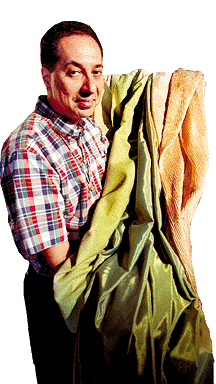
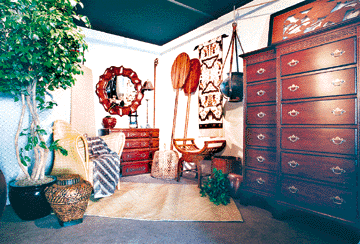
Brad Camara, above, of Mark Masuoka Designs, shows taupey green and yellow ocher, hot new neutrals accenting a pan-Pacific interior, below, with global and Hawaii styles.
For isle homes in 1997, the bywords are: remodel, spacious, lighter and brighter, as designers embellish international looks with a Pacific flair
By Catherine Kekoa Enomoto
Star-Bulletin
 A pan-Pacific home office in taupey green with splashes of eggplant - this is what designers are envisioning for the home in 1997.
The idea is to show one's sophisticated travel tastes, use one's home computer as a career option, and use color to lighten and brighten spaces for a sense of comfort and spaciousness.
Three other factors are influencing home design, building and interiors this new year - limited resources, tough commutes and an aging population.
First, limited resources of money, land, forests and water have a pervasive impact on design.
Dan Chun, president of the Honolulu chapter of the American Institute of Architects and a principal in Kauahikaua & Chun architects, said tough economic times make for some confusion.
"The times have a bit of an uncertain tone," Chun said. So "basically the trend for 1997 is, we are still trying to find our way. If there is a trend," he added, "it is that, basically, people are turning away from houses that display excessive consumption - even if the house is big."
Architect Will Beaton, senior vice president of The Myers Corporation, talked about his firm's design solutions to address the challenge of limited land and space, especially in the urban core.
"We're designing space so that it feels very spacious and roomy. We're doing a lot of things to accomplish that - the use of natural light.
"We're not separating rooms. We're allowing spaces to flow together; so there's not a feel that rooms are being cut up or divided. A home has much more of a roomy feel to it.
"There is the importance of color in design," Beaton added. "It impacts a sense of space. And, we're angling walls in certain areas, making rooms feel they're opening up instead of being small."
Edmund Aczon of Aczon Construction, president of the Building Industry Association of Hawaii, said his industry feels the impact of finite forest resources that drive up lumber prices. "All suppliers are shifting to metal framing because of the unpredictability of lumber prices and termite problems," he said.
Architect Richard Senelly of Earthplan noted crime prevention and environmental considerations. "The layout of subdivisions is changing. They're more old-fashioned, where streets are straight. There are no cul de sacs. Houses are closer to the street and more visible. The arrangement of a garage to a house is simple, so the house can be watched easily by patroling police vehicles.
"Because houses cost so much in terms of materials," Senelly said, "they're more efficient. There's less street frontage, less sidewalk, less length of water line per house.
"Subdivisions are more efficient (in that) there's less land per house, and therefore less wasted land, less sprawl, less land resources consumed. With smaller lots, there's less area to landscape and water. There's better insulation in design."
He concluded, "There's better use of scarce, nonrenewable resources, such as fossil fuel for air conditioning, and such as water, for pouring on the ground to have a nice lawn."
A second major factor influencing design trends is the tough commute workers face five days a week to and from work. Now, people want to stay home on the weekends, relax and enjoy their homes.
Brian Tappin, assistant store manager of Eagle Hardware & Garden, said, "I guess both husband and wife are working. At the end of the day they want to slide into a whirlpool, and relax after a crazy day of jockeying kids to and from school. A normal person's life is hectic, as opposed to 10 or 15 years ago."
Tappin said bigger kitchens and bathrooms are places to regroup from the commute: "We're seeing in houses now, bathrooms are two or three times the size. The tubs are bigger. There are Jacuzzis or whirlpools, bigger windows, skylights, more open area."
Brad Camara, vice president of Mark Masuoka Designs Inc., drew a comparison between Hawaii Regional Cuisine and interior-design trends toward homey and familiar, yet stylish.
"It's really very similar to Roy's (Restaurant)," he said. "Like things offered by Roy's or Indigo Restaurant, they use local ingredients, such as guava. They'll take something from another country, like curry from India, flavor it with things locally from Hawaii."
Likewise, "The furniture industry, and especially interior design, is taking things from different parts of the world and giving them a Hawaiian and Pacific look," Camara said.
Darrell Verdeck, vice president of marketing, sales and merchandising at Home World, agreed the trend's homey at Home World: "I'm seeing more of a country casual look with brighter colors of the islands, just because it looks comfortable, homey, nice, and easy to live with."
Dave Puder of Kahala Construction added that open, airy renovations of windows and sliding doors are being translated into low-maintenance and durable vinyl-framed windows and sliding doors, and fiberglass wood-finish doors, at a reasonable $200 to $350 each in cost.
Finally, Nancy Peacock, a licensed architect and certified interior designer, noted that the population is getting older and less tolerant of heat caused by more concrete and less ozone layer.
"Concern for cooling houses is a big trend," she said. "We're putting in more and bigger operable windows - they're not fixed plate-glass windows. They can be opened and closed."
She's also circulating those pan-Pacific breezes via ceiling fans and louvered interior doors, insulating walls and ceilings against the heat, and localizing air conditioning in small areas or rooms vs. air conditioning the whole house.
What's hot for homes in 1997
A builder/designer's dozen of 1997 trends:
1. Age of Renovation: Almost unanimously, architects, contractors, interior designers and retailers agree that home building is down, home remodeling is up. This trend expresses itself in updated kitchens, bathrooms and family rooms, in that order. Also, people are overhauling the entire property, to enhance security and their relationship with their private outdoors.
2. Structure over fringe: People are opting for substantive changes, such as reconfiguring room and storage spaces, and gutting electrical and plumbing systems vs. just superficial modifications like fancier furnishings and fixtures.
3. Walls of Jericho: They're coming down - the walls, that is. Everywhere walls are giving way so that rooms and "view corridors" can open up.
4. Store more: Storage closets are growing 3 feet deep and more, and up to the ceiling, to make way for purchases at "big box retailers," such as Wal-Mart and Costco. Also, adjustable shelving and sliding shelves are de rigueur.
5. Hawaiian sense of place: Outdoors is coming indoors through use of clear glass windows and sliding glass doors in place of opaque louvers.
6. Cooling off: Look for more, bigger and operable windows; louvered inside doors; and localized air conditioning in one room, such as a family room, study or master suite.
7. Nooks and crannies: In contrast to the grandiose spaces and vaulted ceilings of the 1960s and 1970s, cozy, intimate nooks in public areas lend a "sense of the human." These crannies can be a bay window, reading corner or tea cove.
8. Rub a dub dub: Splish, splash in bathtubs and bathrooms two or three times their former incarnations - with three or four shower-massage heads per tub. Also, sink down into a soothing whirlpool bath or furo.
9. Metal framing: The technology changes daily and contractors are scaling the learning curve on hurricane-resistant metal framing for houses.
10. Pan-Pacific: Furnishing with unique pieces from one's travels - especially to Third World countries around the Pacific, such as Bali - is the "height of taste"; then, intersperse Hawaiiana pieces. Or do the reverse: Furnish with Hawaiiana pieces, then intersperse accessories from one's travels - such as Indonesian batiks.
11. Home office: Home computers have paved the way for a whole range of stylish home office furnishings.
12. Hautes couleurs: Taupey green (light green with warm gray tones) and yellow ocher (golden yellow) are hot new neutrals, replacing brown, black and beige. Drop in splashes of bold colors, such as eggplant (purple).
13. Country casual: A stay-at-home-on-the-weekend mind-set is expressed in a number of ways, all spelling comfortable, restful, practical. The manifestations can be overstuffed chairs in "watercolor" pastels, pine occasional tables with drawers, and hand-woven, heavy-duty area rugs.
© 1997 Honolulu Star-Bulletin
http://starbulletin.com