Honolulu Star-Bulletin Local News
In a scarred land, the healing has begun
By Joan Conrow, special to the Star-Bulletin
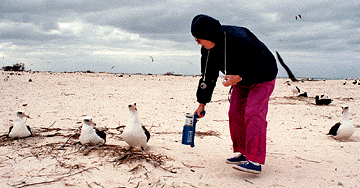
Oceanic Society volunteer Doris Carson marks nests of albatross after they have been counted on Midway Atoll.
Midway Atoll has been used and abused, but a $43 million cleanup promises new life
By Joan Conrow
Star-Bulletin
 SAND ISLAND, Midway Atoll -- Although it's one of the most remote places on Earth, Midway Atoll has not escaped the ravages of human junk and pollution.
Albatross chicks, their bellies filled with floating plastic sea trash that their parents mistake for squid, die of dehydration because they cannot eat enough food to produce the fluids they need.
Jet fuel leaked from underground storage tanks taints much of the atoll's groundwater. Old buildings contain asbestos and lead paint, while utility transformers harbor toxic PCBs. And in some places, the banned pesticide DDT and other chemicals have leached into the soil.
Still, some 2 million sea birds continue to nest and raise their young on Midway, prompting federal officials to believe the naval air field can be cleaned up and find new life as a wildlife refuge.
"The conditions of these islands are a measure of health of the whole north Pacific area," said Kenneth Niethammer, who manages the U.S. Fish and Wildlife Service's Midway refuge. "The Earth has the ability to heal itself if we stop doing to it what we are."
Midway Atoll's landscape of shifting sand dunes and beach-hugging native plants has changed dramatically since 1903, when workers with the Commercial Pacific Cable Co. brought in tons of topsoil, ironwoods and other exotic vegetation. Pan American World Airways later built facilities for its Flying Clipper seaplane operation, along with a 45-room hotel and swimming pool.
Alterations accelerated when the U.S. Navy took over, dredging a channel through the reef in 1938 and constructing an air station and submarine bases on Sand and Eastern islands. Intense World War II battles and years of military use took a heavy toll, and federal contractors faced a daunting task as they prepared to clean up the atoll prior to the Navy's June 30, 1997, departure.
"We didn't know what to expect when we started this (cleanup) process," said John Naughton, a biologist with the National Marine Fisheries Service. "We didn't know what was dumped. We spent a year just identifying the potential contaminants."
Refuge manager Niethammer said that although the scope of the cleanup was largely dictated by human health concerns and environmental laws, the Navy has "gone further and responded to wildlife concerns."
Naughton agreed.
"I've been extremely pleased with their actions, and we're actually up there on the scene, keeping an eye on things, so we know it's not just lip service."
Most of the work has been done by OHM Corp., a Navy contractor that began cleaning up Midway in 1994, said Kevin Miller, who coordinates the firm's activities there. Its biggest job has been removing jet fuel from the atoll's groundwater, which lies 5 to 8 feet below the surface. Although island residents use catchment systems, the brackish groundwater is being cleaned to protect wildlife and the ocean from pollution.
OHM developed a Fluid Injection Vapor Extraction system for such projects, Miller said, and for the past nine months has been running the world's largest such system on Midway. Fluids are extracted from 300 wells drilled around the island and run through tanks, where the vapor is burned off and the fuel is collected. The water is then purified and returned to the ground through one of 200 injection wells.
More than 33,000 gallons of jet fuel - and a much higher quantity of vapor - already have been recovered and used to power the two 16-cylinder generators that run the system around the clock.
"The beauty of this is that it's a totally closed system," Miller said. "No leftover fuel will have to be shipped off."
 The firm brought in the first mobile laboratory to be certified by the Navy so it can monitor water samples and quickly test for the presence of pesticides and other chemicals, Miller said.
OHM crews also have removed more than 100 underground jet fuel tanks, including two with a capacity of 2 million gallons each, and they've excavated some 7,000 yards of soil contaminated with petroleum, Miller said.
About half of that soil may be reclassified as clean under newly revised Environmental Protection Agency standards, Miller said, while the rest may be used in road repairs, shipped off-island or run through a pug mill, where it is mixed with cement to trap the contaminants and then added to the landfill.
That process, known as stabilization, already has been used on Midway to dispose of soil containing DDT, asbestos and lead-based paint residues. Although the process is approved by the EPA, Naughton said he and other scientists worry that the materials may one day break down and leach into the water.
"We need some kind of long-term monitoring," Naughton said, "but we're still working on that. Time will tell, but I feel very encouraged."
OHM has conducted the marine salvage efforts as well, removing more than 68 vehicles and 300 batteries from the lagoon. Navy divers detonated 23 gas cylinders in the harbor, while other contractors have sampled water quality and sediment and analyzed algae and reef fish tissue in search of toxic wastes that may have entered the food chain.
So far, Naughton and Niethammer said, tests show that initial concerns about extensive marine pollution have not been borne out.
"It's looking pretty good," Naughton said. "I think we'll be in good shape by the time of the pullout. I just hope we don't run into anything from out in left field."
Lt. Bill Shoemaker, officer in charge of Midway, said the Navy also will repair roads and seawalls, remove stockpiled debris and materials, cap landfills and complete other housekeeping tasks before it leaves.
Sea birds and monk seals already are responding. As areas are cleared of brush and buildings, albatrosses move in and make nests. Monk seals lounge on beaches closed to humans.
"Once man has made his imprint here, it's gonna be changed," said Bob Diele, an outdoor recreation planner with the Midway refuge. "We're just trying to tip the balance more in favor of the wildlife."
Antennas and overhead wires have been removed, saving birds from having their wings sheared and plunging to their deaths. Outdoor lights that disorient night-flying bonin petrels will be lowered or shielded.
Black plastic has been installed around areas still being cleaned to protect birds from contaminants in the soil, and old landfills have been covered with 4 feet of sand to make them attractive nesting sites for burrowing birds.
The Fish and Wildlife Service plans to remove more of the ironwood trees that snare albatrosses in flight and still faces the awesome task of eradicating acres of invasive weeds. It also will continue to fight the rats that prey on ground-nesting birds. The rodents have been eliminated from Eastern and Spit islands, but the battle continues on Midway.
Fish and Wildlife spokeswoman Barbara Maxfield said the agency anticipates that improving wildlife habitat and revegetating areas with native plants will be a long process.
"We don't have all the answers, either," she said.
Agency partner Midway Phoenix Corp., which handles tourism and infrastructure, has its own challenges. The firm must maintain new fuel storage tanks, construct a trash incinerator and build a septic system to replace the current practice of releasing untreated sewage into the lagoon.
Those projects are expensive and difficult, given Midway's remote location, said Mike Gautreaux, the firm's island manager.
"We call it the Midway way. Everything is hard."
The Fish and Wildlife Service doesn't intend to remove all traces of the atoll's human history. Historic buildings and military memorials and artifacts will remain alongside buildings that serve visitors.
"Midway will never be taken back to what it was before man got here," Niethammer said. "But this is an example of humans cleaning up and giving back to the wildlife. And with the world's population expanding, there are not many places like that."
© 1997 Honolulu Star-Bulletin
http://starbulletin.com