
Residents lacked access to a full acute care hospital, and patients had to travel more than an hour to Kona or Hilo for treatment. This distance, beyond what doctors call the critical "Golden Hour," was too often the difference between life and death.
Through community cooperation, the North Hawaii Community Hospital board of directors raised $12.5 million dollars, matching a state grant, then raised an additional $5 million to open the new hospital last May.
But community interest didn't stop there. The hospital, which is designed to have 50 beds, has a volunteer crew of 125 Waimea residents doing just about everything except direct patient care.
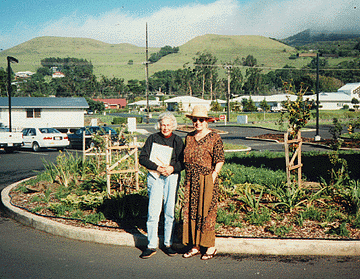
Others work outdoors. Two of the leaders in the landscaping are energetic women who have been known since childhood by their nicknames. Chacha Kohler is president of the Waimea Outdoor Circle and Tooty Hager heads the landscaping crew. Tooty and Chacha may sound like a macarena team, but they are a formidable pair.
"When the hospital was recruiting volunteers, I said 'Fine,' but I told them that any volunteering I did would be outside," Hager said. She coordinated the planting of the entrance garden, which was designed by Pegi Scully, a landscape designer married to the hospital's Dr. Niall Scully.
"The original plan was to use nothing but native plants," Hager said, "but it didn't work. We are too high at 2,500 feet and too cold for any of the lowland natives. But we have used as many as we could of the upland plants."
Kohler said they had an extra problem with maintaining the garden until recently. "Waimea was in the middle of a drought, and we weren't permitted to water the grass. Drip irrigation was allowed for the borders and we could keep the trees alive, but the grass has gone to weeds. With the heavy rains of the last couple of weeks, we think the kikuyu grass will take over."
Heavy labor was provided by the North Hawaii Lions Clubs of Hamakua, Kohala and Waimea, the Waimea High School Warriors football team and Hawaii Preparatory Academy's community service program. The volunteers planted trees, moved rocks, laid tile and cement borders.
Because of the volunteers, the project has spent only $1,100 of the $1,500 donated by the Waimea Outdoor Circle. "We not only got free labor, but many of the plants were donated," Hager said. The landscaping mainly uses plants that flower in white or shades of blue.
Liriope, a member of the lily family, is clumped between the taller plants. When not in flower it looks like giant mondo grass. Its small lavender flowers grow on spikes, and the plant would make an attractive ground cover in cooler parts of Oahu. It requires well-drained soil and frequent watering.
Agapanthus is also planted in clumps and blooms in bright blue, funnel shaped flowers from the center of a rosette of narrow leaves. This is frequently used in Manoa and Nuuanu valleys where the rainfall is heavier than in lower areas.
False heather, a shrub that grows to about 2 feet, is used in the borders. It bears many tiny stemless leaves and equally tiny white to purple flowers.
There are also stands of rosemary, a plant that shouldn't be confined to the herb garden. It grows to 3 or 4 feet with narrow aromatic leaves and small clusters of light lavender flowers. It will endure hot sun and poor soil, but it must have good drainage.
Slow-growing false sandalwood trees grow along the driveway. These natives are frequently seen on the slopes of Mauna Kea and Mauna Loa, with wood scented like true sandalwood.
The overall landscaping plan was designed by Callie O'Neal, and every hospital room looks out into a garden, giving the hospital a non-threatening, non-institutional feeling. Most importantly, the hospital has given the community the reassurance that emergency medical help is finally close at hand.