By Lee Catterall, Star-Bulletin
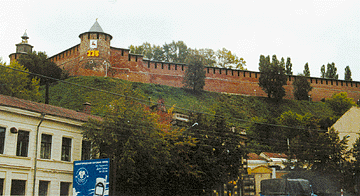
The 11-tower Kremlin remains the dominant feature of the
city of Nizhny Novgorod, founded 775 years ago.

Russia's third-largest city was off-limits to Westerners and most Russians through the Soviet period because of its heavy manufacturing and scientific activity. Much of that industry has been converted to civilian production.
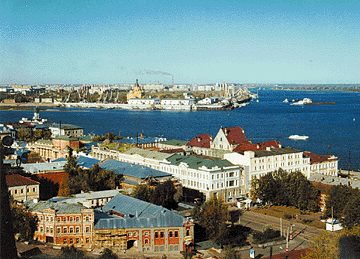
Situated 275 miles east of Moscow at the confluence of the Volga and Oka rivers, Nizhny Novgorod - "lower new town" in Russian - was ideal for both military protection and commerce at its founding in 1221. The two symbols of those activities remain its centerpieces.
Nizhny's massive Kremlin, built of stone in the early 16th century to replace a wooden, moat-enclosed fortress, is the city's focal point, looming more than 200 feet above the half-mile-wide Volga, as well as being the seat of government for both the city and the Nizhny Novgorod Oblask, or region.
The Nizhegorodskaya Yarmarka, the world's largest trade fair a century ago, attracting merchants from across Europe and Asia, was shut down in the late 1920s. Now it is alive again on the banks of the Oka, privately owned and operated and attracting foreign trade to the region. The trade fair's revival is regarded as vital to Nizhny Novgorod's resurgence, thrusting the city into the world market.
|
| |
|
Pavel Tchitchyagov Nizhni Novgorod gubernatorial aide:  If you start reforms anywhere in the world, you will hear grumbling by the public. | |
|
|
Nowhere in Russia had a city been so shut off from the rest of the world, and nowhere in the country has the market economy been cultivated so successfully in the five years since the fall of Communism.
"In a way, that is the reason," explains Pavel Tchitchyagov, chief economic aide to the governor of Nizhny Novgorod Oblask. "The progress was faster because we were lower, because we were so far behind." The reckless stampede that occurred in Moscow and St. Petersburg with the arrival of the market economy was absent in Nizhny Novgorod, perhaps because of dimmer expectations.
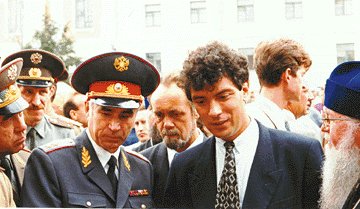
Gov. Boris Nemtsov is universally credited with guiding the region carefully but resolutely toward market reform. In alliance with Mayor Ivan Skylarov and with some help from President Boris Yeltsin - who agreed to tax incentives for conversion of plants from military to civilian production - the 30-something governor, a physicist by profession, was able to shield Nizhny Novgorod from economic disaster following the sharp reduction in military industrial orders that had sustained the city for decades.
Proceeds from the auctioning of government-owned businesses, which went on the block in January 1993, were deposited in social security systems.
Organized crime has been less present in Nizhny Novgorod that in other cities. While the lack of a market infrastructure allowed pyramid investment schemes to thrive in the early days of the economic transformation - most notably at Volgograd - Tchi-tchyagov says Nizhny Novgorod was largely spared from the craze that drained many Russians of their savings.
Protection money from businesses, known here as "roofing" - "You must have the roof under which you can operate" - also has developed less in Nizhny Novgorod than elsewhere, he adds. "At the moment, this protection money is mostly used in smaller businesses, at the level of stalls and kiosks and bazaars. It is not in big businesses and plants anymore," Tchitchyagov said. A special police unit was created to rid the city of organized-crime activity.
Galino Sherbo, editorial writer for Birzha, a five-year-old financial weekly that has grown into Nizhny Novgorod's largest-circulation newspaper, attributes the most rapid privatization in Russia to the fact that it was done gradually, from the bottom up.
"They were not rushing things," Sherbo says. "They started on smaller things like food stores or peddlers or street sellers of little items. Then they turned to privatization of trucks and lorries, to be owned by the drivers. Then they turned to bigger stores and warehouses and to services such as hairdressers and bathing houses and that sort of thing. Only then did they turn to converting plants and factories into shareholding companies.
"Of course, there were tradeoffs," she adds. "Not everyone was satisfied with what was going on, because the shops and stores were restructured during that process. For example, they started selling shoes and then they started selling God knows what, so people did not like that. But in the long run it was offset by the experience and measures that were taken to avoid harmful results. There was a period when it was not very pleasant."
Also, for many Russians, the whole idea of private enterprise doesn't set well, following 70 years during which such activity was illegal.
"There's a lot of grumbling going on," says Tchitchyagov. "This is natural, because if you start reforms anywhere in the world, you will hear grumbling by the public."
"A lot of people are still distressed," Sherbo adds. "And that's what everybody who comes here from overseas notices in Russia, that people are not happy on their faces. But inside we feel much better now, even if it's not reflected on our faces. And this must go ahead."