
But native Hawaiians want assurances that future recreation does not come at the expense of their past and as a disturbance of ancestral burials.
"There have been far too many occasions when native Hawaiian burials have been disturbed," said Dana Naone Hall, a member of Hui Malama Pono, a group involved in native Hawaiian issues.
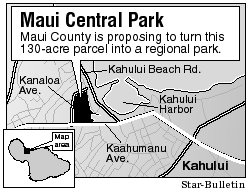 While the group does not object to construction of most of the park, it is fighting any plans to develop the sand dunes within it, pending additional archaeological review.
Some environmentalists are also worried about a rare native Hawaiian plant called "Nama sandwicensis" growing on the dunes and want the county to restore and maintain the dune system, with help from the nearby Maui Botanical Gardens.
"This is a wonderful opportunity to designate them for conservation and restoration by incorporating them into the Maui Botanical Gardens," said Linda Nelson, president of the Native Hawaiian Plant Society.
The dunes, about 40 acres, are located mainly along the Kahului side of Kanaloa Avenue.
Hall said studies of the dunes have been inadequate and native Hawaiians don't want a repeat of the 1986 hotel excavation at Honokahua in west Maui, where hundreds of remains were uncovered before construction was stopped.
"The likelihood that it was used as a burial area is fairly high," Hall said. "Traditionally, sand dunes are known places of burial for pre-contact people."
County Managing Director Richard Haake said fragments of human remains were found in the area that now houses the Maui Arts and Cultural Center. But Haake said numerous other studies have uncovered no native Hawaiian burials elsewhere in the park.
Haake said the administration of Mayor Linda Crockett Lingle will review the criticisms by Hui Malama and hopes to arrive at a "satisfactory decision for all parties as soon as possible."
This month, the Maui Planning Commission approved a shoreline permit for the county to proceed with developing most of the park, except for the dunes.
The county and Hui Malama are expected to participate in a court-like contested-case hearing about the sand dunes before the commission.
While the county disagrees with the group's claim and feels existing archaeological surveys are adequate, the need for a regional park remains undisputed.
About 30 percent of Maui County's population is located in the Kahului-Wailuku region and more housing projects are being developed, increasing the demand for recreational space, county officials said.
Under the plan, about 90 of the 130 acres would be developed with major projects including five ball fields, a two-lane road crossing the park, 250 total parking spaces at five locations and a path.
The county has reserved space for a keiki zoo; the horseshoe pitching facility at its existing location; and a skateboarding facility, which will be relocated from Kanaloa Avenue and Kahului Beach Road to the Central Maui Youth Center.
Facilities already within the park include the YMCA and Maui Arts and Cultural Center.
"While the contested case centers on the dune area, we think it's great that we will be able to move forward on the rest of the project," Haake said. "It shows that everyone believes this is a much needed recreation project for Central Maui."