
Buy-bust and reverse buy-bust operations targeting sellers and buyers, respectively, provide only short-term relief.
"The problem is demand," Kalihi police Maj. Stephen Watarai said. "There'll always be dealers as long as there are people willing to buy.
 "From our perspective," he added, "I don't know who's worse, the buyers who support these guys or the sellers themselves."
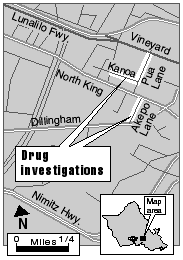
Kalihi's Crime Reduction Unit conducted two operations recently on Kanoa Street.
A Nov. 22 operation netted five dealers and 14 buyers while three dealers and 17 buyers were arrested on Dec. 6 at the same site.
Police also seized 16 vehicles for forfeiture from the two operations.
In each case, police swept the area of dealers prior to setting up the reverse sting targeting buyers. Undercover officers then spent about six hours posing as sellers.
The buyers are arrested immediately after taking possession of the illegal drugs. All transactions are videotaped by police.
"We want to send the message out that if you buy drugs in Kalihi, you're going to get arrested," Watarai said.
"We don't just target sellers."
Sgt. Teddy Chun of Kalihi's Crime Reduction Unit says the conviction rate is 100 percent.
"We've never lost one against buyers," Chun said. "Most of them plead out."
Among those arrested for purchasing drugs in the latest reverse sting operation were a security officer and two custodians, employed at separate public high schools; an 18-year-old University of Hawaii student, a UH grad student, a tree trimmer, a fish cutter and a laborer.
"Of the 31 buyers we arrested, 16 were unemployed," Watarai said. "For 15 of them, it was their first arrest."
Two of three dealers arrested on Dec. 6 had also been arrested Nov. 22, Watarai noted.
"It's a clear example of the revolving door and it shows there's no consequence," Watarai said. "We make the arrests, send them through the system and they're back out on the streets.
"More severe penalties and swifter (court) action has to be part of the solution," he added. "In some countries, like Singapore, you can be sentenced to death for dealing in drugs."
Through ongoing surveillance and past operations, Kalihi police have seen a trend developing in the drive-through drug markets of Kanoa Street, Pua Lane and Akepo Lane.
"In months where weekend welfare checks come in, we see more activity," Watarai said.
That was the primary reason for the second operation Dec. 6.
Two of the buyers arrested that day purchased drugs with food stamps, Watarai said.
"Under the new federal welfare law, if they're convicted of a felony, they're not going to be eligible for assistance," Watarai added. "They should be asking themselves if the risk is worth it."