By Kathryn Bender, Star-Bulletin
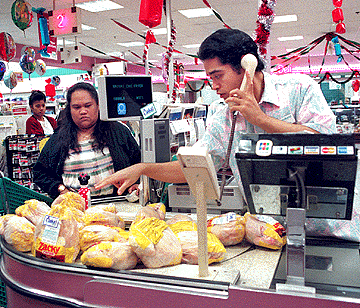
Arlene Bergantinos watches as Foodland cashier
Randall Rodrigues rings up the family bill.
Food prices are down.
 Call it the "competition effect" or just welcome relief.
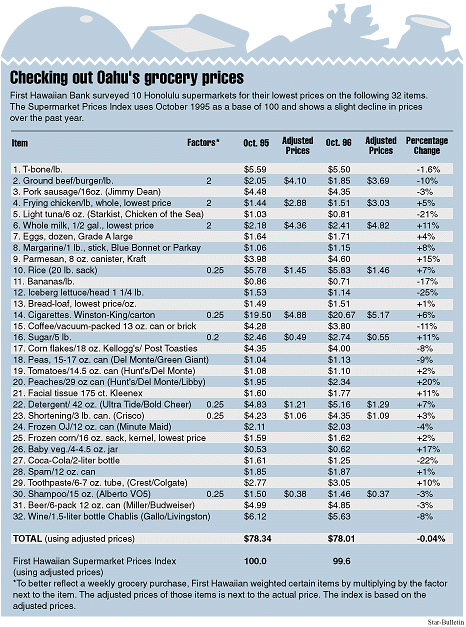
But Honolulu grocery prices, among the highest in the nation, have declined slightly during the past year, according to First Hawaiian Bank's Supermarket Prices Index, compiled exclusively for the Star-Bulletin.
The bank put together a grocery list of 32 items and surveyed 10 local supermarkets to come up with a gauge of the direction of prices. Using the October 1995 survey as a base of 100, the bank's latest survey puts the index at 99.6 for October 1996.
In other words, inflation at the supermarket checkout has been kept in check.
"My outlook on inflation . . . and I do think this (index) conforms to the same expectation - is that prices in Hawaii will remain relatively flat for the foreseeable future," said Leroy Laney, First Hawaiian's senior vice president and chief economist.
Laney stressed that the bank's survey should not be compared with the U.S. Department of Labor's Consumer Price Index, which twice a year takes a much broader look at the city's inflation picture. The CPI looks at groceries, housing, transportation, health and other costs.
However, Laney said, the CPI has some "widely recognized flaws" and he believes that it overstates Honolulu inflation.
"I think (First Hawaiian's survey) strongly suggests that the rate of inflation (in Honolulu) is a little bit less - perhaps a good bit less - than the 2.2 percent CPI for the first half of 1996," Laney said.
The CPI has been in the news recently after a group of economists last month issued a report saying the index overstates inflation by 1.1 percentage point and should be amended to better reflect the inflation rate. However, that's a hot-button issue in Washington, since increases in Social Security and other benefits are pegged to the CPI.
Laney said criticism of the CPI includes that it always monitors the same items and therefore does not reflect changes in the marketplace, such as the higher quality of merchandise or new technology.
Although the bank's survey only looks at groceries, Laney said the price of housing - a huge factor in Hawaii's high cost of living - also has been flat or falling recently.
As for the Supermarket Prices Index, Laney said the bank tried to put together a good cross-section of a weekly grocery list.
"Most people consume most of the items over a period of a week," he said.
The bank weighted some of the items to better reflect a typical weekly marketbasket. For example, items that likely would take longer than a week to consume, such as a carton of cigarettes or a 5 lb. bag of sugar, were given less weight, while staples, such as a half-gallon of milk or 1 lb. of ground beef, were given more weight.
"We did make a bit of a value judgment that people drink more milk in a week. . . . (But) we tried not to make too many assumptions. We're just trying to give an indication of the direction of prices," Laney said.
Discount clubs -- such as Sam's Club and Price/Costco - were not included because, according to Laney, surveys like these need consistency, and discount clubs' inventories change often.
Still, he said, that does not mean the clubs' impact is not being measured in the survey.
"I think this is one of the big reasons that we're seeing declining food prices: the competition effect," he said.
Ron Hellstrom, chief operating officer at Foodland Supermarkets Ltd., agreed with that assessment.
"The competition environment here has been such that nobody has wanted to take on any major price increases," he said.
There have been some increases during the past year, he said, many of them due to the higher price of grain. The bank's index reflects that in the price of milk, which has risen due to the higher cost of grain to feed dairy cattle. In October, the lowest price for a half-gallon of whole milk in Honolulu was averaging about $2.41, up 11 percent from $2.18 gallon in October 1995.
However, Hellstrom said, Foodland has seen most prices remain level and some even fall in the past year.
"It's still very costly to live here," he was quick to add. In national surveys, Honolulu always ranks at the top for grocery prices, about 25 to 30 percent higher than Tampa-
St. Petersburg, Fla., typically the least expensive market, he said.
For the immediate future of Honolulu grocery prices, Roger Godfrey, Hawaii division president for food wholesaler Fleming Cos. Inc., said he expects more of the same. He said Fleming's corporate offices in Oklahoma City are predicting minimal inflation nationwide for 1997.
"Because of the competitive situation here, we might offset any inflation, if there is any at all (in 1997)," Godfrey said.