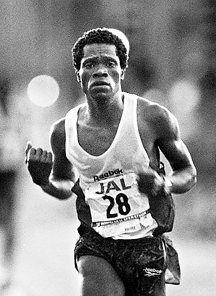
By Kathryn Bender, Star-Bulletin
Josiah Thungwane's handlers have done a poor job.
When three-time Honolulu champion Ibrahim Hussein of Kenya scored multiple victories in the higher profile Boston and New York City marathons, he quickly disappeared from the Hawaii scene.
When Kenya's Cosmas Ndeti, a two-time runner-up in the Honolulu Marathon, won multiple Boston Marathon titles, he too became extinct in this state.
So, Barahal knew the score as soon as 1995 Honolulu champion Josiah Thungwane crossed the marathon finish line in Atlanta last August to become the first black South African to capture an Olympic gold medal.
"I was obviously thrilled for him," Barahal said. "But knowing the marathon marketplace as I do, and given the nature of our race, I knew it was going to put him in a price range we couldn't afford."
Marathoners such as Thungwane can command a six-figure pay day just to show up for a race.
But there has been more chaos than caviar and champagne in Thungwane's life since the Olympics.
In South Africa, where apartheid politics caused the country's athletes to be banned from Olympic competition for 28 years, ending in 1992, the mara-thon gold medal took on enormous importance. Therein lies Thungwane's current problem.
"Not since Jesse Owens won four gold medals in Berlin in 1936 had a more powerful racial statement been made on an Olympic track," wrote Leigh Montville in an Oct. 21 Sports Illustrated story.
"He pretty much became public property," said Tony Long-hurst, who had Thungwane as a client from 1991 through the Olympic win. "Josiah's a great ambassador, and through his sport a lot can be achieved toward integrating the population. It was important for him to be seen by his people."
But Longhurst and Barahal yesterday said they are disturbed about the South African sports federation's recent handling of Thungwane's career and its rapid deterioration.
Athletics South Africa, the country's sports federation, got hold of Thungwane's career after the Olympics and has managed it poorly. Almost 31/2 months after winning gold, the 25-year-old Thungwane, who works for a coal mining operation, has realized hardly any of the fortune that usually befalls a gold medalist.
He still bears the scar of a bullet that grazed his chin when he tried to escape a road hijacking in his impoverished township just a few months after his Honolulu win.
Life has not improved dramatically for him, as it should have.
And, worst of all, his conditioning is also off.
"Four to five weeks of press conferences, interviews, parties, being paraded through different towns - that took its toll after the Olympics and the results were obvious in Fukuoka," Longhurst said.
The agent was referring to last weekend's invitation-only Fukuoka International Marathon, where the Olympic champion dropped out of an elite field at 15 miles.
Knowing what was happening , Barahal predicted disaster.
(Bong Ju Lee, the 1993 Honolulu champion who won the silver medal in the Olympic marathon this year, did not change his training routine after Atlanta. As a result, he won the Fukuoka championship.)
"The feedback was that he was not in very good shape," Barahal said.
Barahal said he feared that such a performance would lead directors of the world's most lucrative races to believe that the Olympic win was just a fluke.
"He doesn't have a long line of stellar races," Barahal said (he won Honolulu in 2:16:08 and the Olympics in 2:12:36). "We thought of him as (Honolulu Marathon) family, so we reached out and wanted to bring him back into the family," he said. "I would never advise an athlete to run Honolulu if it's not in his best interests. But in this case, there would have been less of a problem for him if he did not perform at the top level."
But Barahal was unable to work out anything with the South African federation, his only link to Thungwane.
"There's irony in the fact that the man who came out of the apartheid system to win the Olympic marathon goes home and the celebration is so extensive that he can't run anymore," said 1972 Olympic marathon gold medalist Frank Shorter.
But Barahal said there's a danger that Thungwane will never realize his potential.
"He came out of nowhere and he can go back to nowhere pretty fast," he said.
The women's and men's elite races in Saturday's third Waikiki Mile will begin at 4:15 p.m. and 4:30 p.m., respectively, at the corner of Kapahulu and Kalakaua avenues.The children's phase will begin at 2:30 p.m.