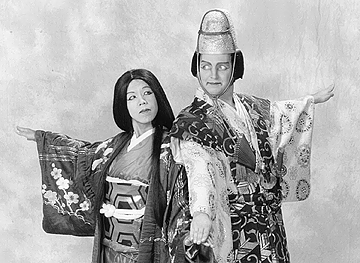
Kennedy Theatre
R. Kevin Doyle, right, and Naoko Maeshiba reach a romantic
agreement as Koko and Katsura in "Kabuki Mikado."
In the former, Gilbert & Sullivan's beautiful operetta has been "adapted" by director James R. Brandon and four of his students. The committee altered the plot, rewrote lyrics, and loaded the dialogue with local slang and references to contemporary cultural icons. They also wrenched the show out of its late Victorian context by grafting on kabuki performance techniques.
The resulting hybrid seems rather closer to kabuki than Victorian theater but isn't much of an introduction to either. Last year's superb staging of "Sukeroku: The Flower Of Edo," also directed by Brandon at Kennedy Theatre, was more substantial and much more impressive.
No one can say though that he and his accomplices take themselves too seriously. "A man who thought he could improve on Gilbert & Sullivan" is among those listed when Norihide Bungo (David Mintz), Hidenori Bingo (Matthew Chang) and the Lord High Executioner (R. Kevin Doyle) discuss people the world could do without.
A similar reference to the allegedly shameful condition of the Asian Collection in Hamilton Library got the biggest laugh of all on opening night.
Mintz, Chang and Doyle prove hilarious in major comic roles. Naoko Maeshiba (Lady Katsura) tops them all. She is by far the most convincing as a kabuki performer - forceful, graceful and precise. She has equal talent as a comic actress and a strong singing voice as well; she and Doyle mesh as a comic team.
Mintz, Chang, Doyle and Maeshiba give the production most of its substance. Multi-talented Alexandra Grill adds a clear voice and promising comic skills as the pragmatic but airheaded Oharu.
Neil McKay's deconstruction of the original melodies for performance on an assortment of European and Asian instruments works quite well. Creative input from Ricardo D. Trimillos (Musical Direction), Onoe Kikunobu (Choreography), John Parkinson (Senic/Lighting Design), Sandra Finney (Costumes/Wigs) and Mark Boyd (Technical Direction) add in making this mongrel show an interesting theatrical experience.
Schechner dumped Euripides' script and went for a more sexually charged atmosphere by utilizing nudity and inviting the audience to participate in an on-stage orgy.
The orgy concept reflected the late '60s attitude that "free love" was empowering - particularly for women.
What proved to be a short-lived experiment in audience participation even back then has not been revived now that sex can be fatal. The nudity has also been omitted in Arjona's missive to the AIDS Generation. What passes for a bacchanalian orgy is choreographed by Lisa A. Nilsen with about as much graphic sexuality as a pre-teen girls' slumber party.
Nilsen triumphs dramatically in the title role. She sneers, smirks, rants and mugs effectively in portraying a vicious and vindictive "hero" who destroys foes and followers alike.
View the red leotard-clad Nilsen as personifying the dangers of unfettered sexuality in the '90s and this rewrite of a rewrite amounts to something. It's all late-night sound and fury otherwise.
What: "Kabuki Mikado"
When: 8 p.m. Friday, Saturday and Dec. 4 through 7; 2 p.m. Dec. 8
Where: Kennedy Theatre
Cost: $10 or $12
Call: 956-7655
What: "Dionysus 96: The Bacchae of Euripides"
When: 11 p.m. Fridays and Saturdays through Dec. 7
Where: Kennedy Theatre
Cost: $5 general; discounts available
Call: 956-7655