
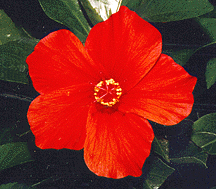
The bright red Hibiscus kokio is enjoying
new popularity, thanks to landscapers.
It has been the landscapers of the resort hotels, recognizing the hibiscus' low maintenance and signature tropical look, who have restored the flower to the local scene. There are suddenly far more choices of hibiscus varieties in the garden shops and at benefit plant sales.
At its sale tomorrow, Lyon Arboretum is featuring the red native Hibiscus kokio. Its flowers are about 3 inches in diameter and they bloom off and on throughout the year. The plant has shiny dark green leaves, and it makes a fine hedge or bush, and will grow well in a container.
Liz Huppman, research associate at the arboretum, recommends Hibiscus kokio as a fast growing plant that will tolerate a variety of local climates. It blooms best in full sun and requires frequent watering in drier areas. Huppman says it is the easiest of all the native hibiscus plants to cultivate.
The one requirement is good drainage, and some garden manuals suggest first digging a hole about 18 inches wide and deep, and filling it with water. Come back in an hour and the water should have drained into the surrounding soil. If it hasn't, either improve the drainage by adding organic matter or plant the hibiscus in a container.
When doing the actual planting, dig a hole three times as large as the container the plant was in. Mix the dirt you dug out with mulch for drainage, and put enough back into the hole to hold up the plant.
Water daily for the first two months, and then two or three times a week, depending upon the rainfall where you live. But don't overwater or the buds will fall off and you'll never have flowers. Hibiscus likes full sun, but will amiably churn out blossoms on a half-day of sun. Less than that, though, and it may not cooperate. Hibiscus hedges respond well to pruning because new growth comes from the area cut back. Don't fertilize when the plant is in flower, or all the growth will go into the leaves.
Another of Huppman's plant recommendations is something so unusual that it hasn't got a familiar name. Ask for the plant that has leaves like a bromiliad and flowers like a dendrobium orchid. Or if you want to stop traffic, ask one of the salespeople for the Cochliostema odoratissimum. They'll know either way. The flowers are lavender and are very fragrant, and the plant needs at least partial shade.
Another plant not yet found at most garden shops is the anthurium superbum (that's SUPERB-um, not super-bum), and it has purplish black leaves that grow to 3 feet long and a foot wide. It probably belongs outside because it doesn't look house-trained. The one at the arboretum is very large, and may still be a puppy, plant-wise.
Dean Okimoto, owner of Nalu Farms, will be bringing hundreds of herb plants, representing almost 60 different varieties. Among the lesser known ones are feverfew, hyssop and pennyroyal.
Feverfew, as its name suggests, was used as a medicinal herb in colonial days to bring down fevers. Now it is used as a potted plant or very effectively as
planting between stepping stones in a garden. It is related to chamomile, best known as the source of the tea fed to Peter Rabbit after his run-in with Mr. McGregor. The tea is flavor-challenged, but feverfew is a pretty little plant with flowers like tiny yellow and white chrysanthemums.
Hyssop has dark green, aromatic leaves and many dark blue flower spikes. It does best in full sun but will tolerate partial shade. The flowers are edible and show up in nouvelle cuisine salads.
Pennyroyal is a member of the mint family. It creeps, so it makes a good ground cover, and gives off a wonderful minty aroma when stepped on. Okimoto says that it repels fleas, and it is a good choice for a dog yard.
Wally's Greenhouse in Waianae is digging out from under the storm that flooded its laboratory, but fortunately left a good selection of species orchids. The Laelia ancets, which is not in flower, and the cypripedium, which is, will be of great interest to collectors of these orchids. Species orchids are those which have been gathered from the wild and are themselves not hybrids.
What: Lyon Arboretum Holiday Plant and Craft Sale
Where: Lyon Arboretum, with free shuttle service from the intersections of Manoa Road with Poelua Street, Nipo Street and Paradise Park
When: 9 a.m. to noon tomorrow
Admission: Free
Call: 988-7378
What: Cactus and Succulent Plant Show and Sale
Where: Ward Warehouse amphitheater stage
When: 10 a.m. to 5 p.m. tomorrow and 10 a.m. to 2 p.m. Sunday, with workshops on cultivation at 1:30 p.m. tomorrow and 11 a.m. Sunday
Admission: Free
Call: 591-8411