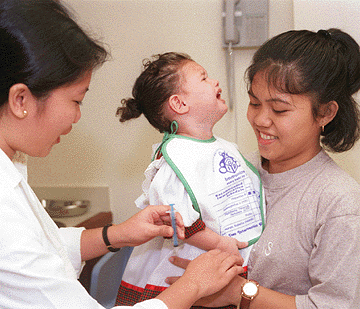
Star-Bulletin file photo
Parents are encouraged to make sure their children are
up to date on immunizations.
This is also flu season, although activities have tapered off after an early outbreak of cases, said Dr. Richard L. Vogt, the epidemiologist who heads the state Health Department's Communicable Disease Division.
Parents and physicians are encouraged to review children's records to make sure they're up to date on shots. Two are needed. Many children haven't received the second dose because it wasn't required for school entry until 1993, Vogt pointed out.
The outbreak began on Maui with three cases in one family setting off an immunization campaign in September at Kalama Intermediate School in Makawao.
Three Hawaii Pacific University women students on Oahu then were diagnosed with measles, triggering a vaccination campaign at HPU's two major campuses. Scattered cases also were reported in the community.
Children and young adults are affected - the oldest 49, the youngest 8 months, Vogt said. Measles can cause severe illness - worse than flu - and occasionally death, he said.
Schools have been alerted and are reviewing students' immunization records, he said. Universities also have been encouraged to require measles vaccinations, he said.
Fewer public clinics are being run for vaccinations, Vogt said, "because the goal is to get a child back into a medical home. Vaccination clinics only work a piece of the puzzle. It's really appropriate to make sure a child is receiving comprehensive care, which immunizations are part of."
Hawaii has the highest rate of chronic hepatitis B infection in the nation - 2 percent to 3 percent of the population,Vogt said. Acute cases, believed underreported, average about 20 annually, he said.
He cited three major ways of getting the infection: From an infected mother to a newborn; from an infected family member in a household; from sexual or needle-sharing activities after a child enters the teen years.
Immigrants bring the disease here from Asia, where hepatitis B is an epidemic, Vogt said. An infected pregnant woman may give it to her child after birth here.
The state has an effective perinatal program, Vogt said, with all pregnant women screened and newborns given vaccines before leaving the hospital.
There's also a program to deal with high-risk household situations, he said. The just-launched school program is aimed at reaching the third risky group.
People with hepatitis B risk liver infection and perhaps liver failure, Vogt said. "St. Francis (Medical Center) has a whole ward of individuals who have required or need liver transplants as a result of hepatitis B and other problems. It is a preventable illness."
The Health Department has proposed adding hepatitis B vaccinations to those required for school entrance to guard against polio, diptheria-tetanus and measles-mumps-rubella.
The current vaccine covers that strain and immunizations are recommended now, particularly for high-risk groups, Vogt said. They include people 65 or older, residents of nursing homes or other chronic care facilities, people with chronic diseases, heart or lung problems, including asthmatic children, and those in contact with these groups.
One reason for the increase is improved surveillance, Vogt said.
Infected rat urine is the primary cause of leptospirosis, a bacterial infection that causes illness similar to influenza illness but worse, Vogt said.
Serious cases may result in meningitis, rashes, anemia and hemorrhaging, Vogt said. Liver or kidney failure also may occur, he said.
The germ generally is contacted from freshwater streams, gardens, pets or occupations such as taro farming.
One Kauai taro farmer had leptospirosis three times in five years.
Comparing this year's cases with 1990-1994 cases, the Health Department said:
 Kauai's infection rate is twice the normal rate historically.
More Caucasians and more women have been affected.
Illnesses have been more severe, with more hospitalizations.