
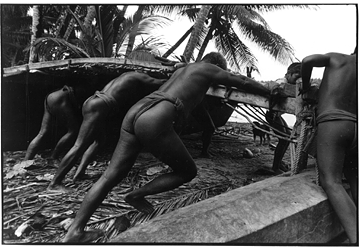
Crew members of a Micronesian vogaging canoe
strain to launch their craft in this photo taken by
Carl Viti, a Honolulu Advertiser photographer who was
killed by a hit-and-run driver Sunday in Wahiawa.
TOKYO - News of the death of Carl Viti, the Honolulu Advertiser photographer, shocked all of us who knew him. Carl was the consummate outdoorsman, as comfortable on a surfboard as he was behind the camera. Photographer came to teach, stayed to learn
In a simpler era, Carl Viti brought a good eye and trusting nature to Micronesia
Most people in Hawaii will remember Carl for his work as a news photographer at The Advertiser. He was an excellent shooter.
But some of us, who knew Carl before he came to Hawaii in the early 1980s, will remember him more for his work in Micronesia. In fact, in those islands, Carl Viti will be remembered as one of the finest photographers to work in the region.
Carl went to Micronesia with the Peace Corps in the late 1960s. As with many American programs in those islands, the Peace Corps program was a mixed success.
The United States administered the former Japanese Mandated Islands from the end of World War II until the mid-1980s. There was much to criticize in the U.S. administration of those islands. Often, there was more good will and good intentions than quantifiable success.
That was the case with the Peace Corps, particularly for those first groups that went to the islands with massive amounts of good intention, but sometimes relatively few professional skills.
What is more interesting about that period, I think, is the effect the Micronesians had on the volunteers. That was where the long-lasting impact of the early experiment could best be measured.
A number of the volunteers stayed on in the islands. Some joined the Trust Territory administration. Others went into business for themselves.
A handful, men and women like Carl Viti, found their spiritual home on those small, isolated islands in the western Pacific.
The photographer I remember is the one who, in the early 1970s, was accepted as a crew member aboard a Micronesian voyaging canoe that sailed from the outer islands of Yap to the Northern Marianas, retracing an ancient trading route. One of the senior men on that remarkable voyage was Mau Pialug, the traditional navigator who taught Nainoa Thompson how to guide the Hokule'a years later.
Carl's photos from that era capture a special place and time. One of my favorites is of men launching a voyaging canoe from the beach. The huge canoe hull is on a bed of coconut fronds. The men, dressed in their traditional thu, or loin cloth, are leaning into the canoe. All you can see of them is their strong backs, muscular legs and thick arms.
There is another photograph from that era that I also treasure.
It shows a young woman from the outer islands of Yap, sitting on a floor of palm fronds. She's weaving a traditional wrapped skirt on a simple loom. She's bent over the loom, wearing a striped lava-lava similar to the one she's weaving.
The photograph could have been taken 100 years before, except for two things. In the dark corner, behind the young woman, sits a plastic basin and a pair of rubber diving fins. The photograph symbolizes, to me, the Micronesia that was found outside the urban centers at the time.
Micronesians are used to foreigners being in their midst. The Spanish ruled the islands for hundreds of years, until the Germans wrested control from them. At the end of World War I, the Japanese were given the islands as a spoil of war.
U.S. forces fought their way across Micronesia, from the Marshall Islands to Saipan, in some of the bloodiest Pacific battles during World War II.
Foreigners are nothing new or unusual. And Micronesians have become adept at deflecting the interests of outsiders, with a warm smile or a nod of the head. Often, the result is what you see isn't necessarily what's there.
That wasn't the case with Carl Viti's photographs, however. And that is what makes them so special.
In numerous photographs, Carl caught the dignity and considerable pride of the peoples of those islands. He was able to do that, I think, because he earned their trust.
IN those days, in particular, there was little of the material wealth that you can now find in the capitals of the Marshall Islands, the Federated States of Micronesia, Palau or the Northern Marianas. It was a more simple time, a period where tradition was still strong, when money and material things hadn't become the measure of a person's status.
This is not to idealize that time, for there was also much to criticize. But there was a sense of optimism, hope and a trust in traditions that are difficult to find today. Carl was able to capture that essence of the islands because he was accepted as an equal. Few other photographs of that era reflect the same sense of dignity or pride that his work does.
And in another way, Carl reflected the best of the often-criticized American experience in Micronesia. He came to teach, he stayed to learn and, in the process, he gave something back to the people who gave him so much.
That's the Carl Viti I will remember.
Floyd Takeuchi, a former Star-Bulletin assistant city editor, is a television and radio anchor with Bloomberg Business News in Tokyo. He was born and raised in Micronesia, and worked with Carl Viti at the Pacific Daily News on Guam and at the Honolulu Advertiser.