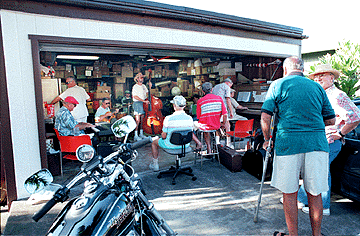
The neighbors roll in on bikes and office chairs on Saturdays,
filling Art Karwacki's Kailua garage, where an assortment
of musicians gather to jam on jazz.
The neighbors roll in on bikes and office chairs on Saturdays,
filling Art Karwacki's Kailua garage, where an assortment
of musicians gather to jam on jazz.
Cox is trying to decide whether to unload his keyboard from the car.
He shrugs, sets down his drink, goes to get it.
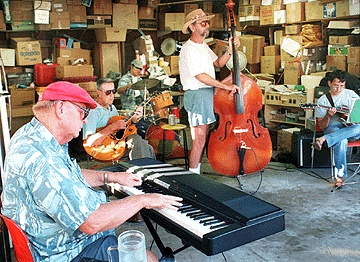
Bill Cox on keyboards, Sam Simpson on guitar, Willie Villongram on
drums, Rod Moore playing stand-up bass and Dale Machado on guitar.
 Art Karwacki --
the garage owner --
on sax.
"What key is this? C?" wonders Karwacki, a pharmacist, swinging the neck of his saxophone. "Sounds like C. Hell, I'll play it in C."
"I only play in C or F," announces Dave Thorne, a cartoonist who's busy assaulting an upright piano in the corner. "Any other key, you can just forget it, buddy." He doesn't let his deafness get in the way of his ivory-rambling.
The band doesn't have a name, a set list, a publicist, an agenda, a line-up. It's the ultimate garage band, a group of guys who gather every Saturday afternoon to play music.
"I was in Art's Kailua pharmacy once, and he asked if I played music," said Thorne. "I said, sort of, and he said, 'C'mon up!' That was, oh, 15 years ago?
"It changes a lot. Sometimes there are three of four guys here, sometimes a dozen. Sometimes we really do well. Sometimes not. But it's always fun."

When not swinging
golf clubs, Sam Simpson
wields a Gibson.
Karwacki begins calling out leads. "Piano!" he hollers, and Thorne bangs away for awhile. "Guitar!" Karwacki bellows, and Machado swallows hard, his fingers spidering up and down the frets, squeezing out juicy notes. He's very focused.
Karwacki smiles, snaps his fingers. "Cool, man!" he says, and Machado is part of the band. He grins.
The tune now is "Black and So Blue."
"Take it home," says Thorne.
Hank Parker, a retired Air Force test pilot, is coaxing silvery riffs from a cornet. His eyes are closed. "Let it fly. Let it fly," he says, the melody soaring through cloudy canyons of near-cacophony. Parker shelved his cornet during his military career - playing tunes wasn't something a guy with the Right Stuff did.
Fred and Joan Harris live across the street. "They're great," says Fred. "Free entertainment every weekend."
"We actually look forward to it every Saturday, and we've been here eight years," says Joan. "They're a nice little jazz band. If they were a loud rock band, we might have a different opinion."
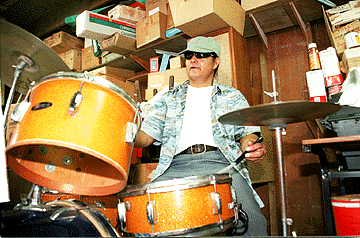
Willie Villongram plays drums for Art Karwacki's
garage jazz band with no name.
The band takes a stab at "The Girl From Ipanema."
"Where's the tuba?" wonders Pete Ceccarelli, a doctor and keyboard player.
"Tuba's in the hospital. Needs a valve job," mutters Cox, and adds "I swear, 'Girl From Ipanema' has got to be the sorriest song ever written," except that the adjective wasn't "sorry." As leader of the Over the Hill Jazz Band, he's the closest thing to a professional musician in the group.
The other guitarist is Sam Simpson, also retired Air Force - "Some sorta crop duster, and tone-deaf as hell," growls Ceccarelli. "Smile! You SOB!" - the stand-up bassist is Rod Moore, a youngish fellow who had an aortic-episode scare a while ago; the drummer is Willie Villongram, who also enjoys the occasional blues harmonica detour; Tom Sumner plays clarinet, he's also a retired pilot; others come and go. It's hard to keep track.
The band is playing "Up a Lazy River." Ceccarelli has borrowed Cox's electric keyboards, plopping down painfully - he's due for hip surgery soon - and rolling his fingers over the keys.
"I wanna visit whatever whorehouse you learned to play piano in," says Cox.
"I, sir, have never played a whorehouse," announces Ceccarelli. "Whorehouses are high-class establishments."
 Cartoonist Dave Thorne
is deaf but sincere
about music.
"But I'm sure you've played my instrument before," insists Cox.
"I'm sure you've played YOUR instrument before," said Ceccarelli. "But hey, hey, hey, this is a mixed group, not something out of Greek myth."
Villongram, who attends Honolulu Community College, grew up in the French Quarter of New Orleans, "just a little guy running around listening to these great musicians. I love Dixie music."
"Up a Lazy River" slows to a trickle. "Never did like that song, and now I hate it," said Simpson. He also had hung up his instrument for a couple of decades - "What am I gonna play? Rock?" he sneers - and tuned it up to play with Karwacki's crew. "So I play here and there, and if I don't feel like playing guitar, it sits in the closest and I play golf," said Simpson.
Ceccarelli is giving Cox's keyboards a workout. "Go man go!" blurts Karwacki.
"What is this? A Yamaha?," says Ceccarelli. "I've got a grand piano, an upright, an organ and now I want a Yamaha. What will I do with my organ?"
"If you don't know at your age..." mutters Cox.
The songs roll on. "Jada." "How High the Moon." "Sunny Side of the Street." "The Lost Patrol." Machado tries a swampy blues, Karwacki and Sumner rally in sweet rhythm.
"Hey, someone pick a tempo," protests Karwacki. "We're all in this together."
And so it goes. Old guys in a garage, playing the melodies that thread their lives, the notes sparking memories, the times they lived, the fond companions gone glimmering away as the deep purple falls.
Machado has to leave early, but swears he'll be back. Soon. "This - THIS," he said, smiling, gesturing toward Art Karwacki's garage, "is what music is all about."