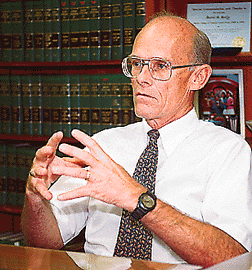
Daniel Heely will be a federal administrative law
judge in New York. Photo by Ken Sakamoto, Star-Bulletin
Daniel Heely will be a federal administrative law
judge in New York. Photo by Ken Sakamoto, Star-Bulletin
By Helen Altonn
Star-Bulletin
Heely, 51, has gone to hundreds of schools to tell children what would happen if they were arrested and involved with the criminal justice system - "what that would do to their own dreams of becoming whatever they want to be in their lives."
"If it has helped save one child having to be arrested and come to the court system, it's been worthwhile," he said.
Heely, leaving Oct. 25 to become a federal administrative law judge in New York, says Hawaii's children are one of his major concerns.
Teaching peaceful ways of resolving conflicts should begin in preschool, he says.
Heely says it's difficult for him and his wife, the former Patricia Kaonohi, to leave their six children, ages 21 to 31, and four grandchildren, all in Hawaii.
The family is very close, but he and his wife feel this is a chance to help their children as they're starting careers and looking to buy homes.
Heely says he didn't go to law school or become a judge for money or prestige but to help make Hawaii a better place.
"I try to remind myself every day I'm a public servant and I have a duty to do my best to help our justice system remain as high quality as it is and help the community have faith and confidence in our courts."
But his family sacrificed so he could stay on the bench rather than go into more lucrative private practice, he says. "This is my time to help repay them."
Starting salary in his new Social Security Administration post is $75,000 a year, but it can go up to $120,000 in a few years, compared with his present $86,780.
"We've lost a very, very good judge," says Honolulu Prosecutor Keith Kaneshiro. "He's very talented and well respected. He's a fair judge, but firm, with an excellent judicial temperament. He takes control of his courtroom."
Heely led efforts to wipe out a huge backlog of domestic violence cases while Family Court senior judge and did an excellent job as administrator of courts, Kanshiro said.
Ellen Godbey Carson, Hawaii Bar Association president, also said Heely "is a wonderful judge" who will be greatly missed by the bar.
"He just gives so much energy helping to create a better justice system for all of us. It's just a huge loss to have someone of his caliber leave the state."
Born in Illinois, Heely was working as an usher in a theater in Evanston when he met Kaonohi, who was attending a teachers college.
By the time, Kaonohi graduated in 1964, the two were in love. He met her and her family in Oakland and came with them to Hawaii on his first plane trip.
The "kid from the corn fields of Illinois" said he'll never forget walking off the plane "and seeing God's beauty right in front of me."
His wife, a schoolteacher, worked hard to help him earn a bachelor's degree in philosophy at the University of Hawaii and a law degree at the University of Minnesota, he said. It took six years to get his UH degree because he worked nights at Pan American Airways.
After several years in private practice, Heely was appointed in 1978 to head the Office of Disciplinary Counsel of the Hawaii Supreme Court. Then in his early 30s, he earned respect for his ability and determination to clean up the law profession.
Later, he was on the Board of Bar Examiners, overseeing preparation and administration of the bar exam.
He's high both on Hawaii's lawyers and judges. "It's still a small enough bar so lawyers and judges make their reputations very quickly and the quality of lawyering I've seen in our courts has generally been excellent."
He said the public "can really be very proud of its entire Judiciary."
Heely was appointed as a Honolulu Family Court district judge in 1982 and has been a circuit judge since 1985. He has been assigned many times to the Intermediate Court of Appeals and Hawaii Supreme Court.
In 1988, Heely took over Family Court senior judge in addition to responsibilities as the Circuit Court's criminal division administrator.
In the past year, he has been a civil motions judge, trying to resolve as many pretrial motions as possible to avoid issues going to trial. It's a "very intense" assignment requiring a lot of preparation - "pounds and pounds of documents" to read every night, he said.
Heely declined to discuss specific cases but said they're increasingly complex. In civil court, he said, "We're seeing issues coming to court no one envisioned a few years ago."
In one of Heely's recent cases, he ruled the state must pay the Office of Hawaiian Affairs 20 percent of the revenue derived from former government and crown lands of the Hawaiian kingdom that the federal government turned over to the state to aid native Hawaiians.
Among other precedent-setting decisions, Heely ruled six years ago for the first time in Hawaii that Hawaii's constitutional right to privacy gives people the right to refuse unwanted medical treatment such as a feeding tube.
"I think a judge has to dedicate himself or herself to remaining open-minded and having an eagerness to learn because a lot of issues that come before us now are matters we didn't even study in law school," he says.
"It's just part of our developing society and new interests that are being recognized and brought to court." For example, he noted issues related to sexual harassment and technology, such as right to die or right to life cases.
He says Hawaii judges "really have an opportunity to help shape our society in a positive manner and to help develop the law so it is responsive to the needs of society."
Heely said he's most grateful for his years in Family Court, "being able to help a child get out of an abusive home into a safe place to live, of being able to help a family learn nonviolent ways of raising children and solving problems nd perhaps saving some lives in the process ... "
The Heelys have never been to Syracuse, N.Y. "The thing I know for sure is the average annual snowfall is 112 inches and the average price of a house is $100,000."
But they're keeping their Kailua home. Their dream is to return to Hawaii, he said.