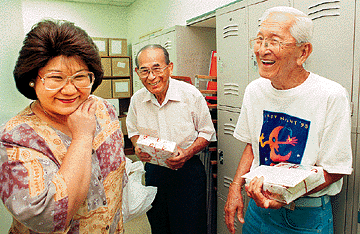
Chris Imamura, lef, project coordinator for the Honolulu-Asia
Aging Study, enjoys a moment with Shoji Fujishima, 83,
center, and Junichi Muranaka, 85.
Photo by Dennis Oda, Star-Bulletin
Chris Imamura, lef, project coordinator for the Honolulu-Asia
Aging Study, enjoys a moment with Shoji Fujishima, 83,
center, and Junichi Muranaka, 85.
Photo by Dennis Oda, Star-Bulletin
"We're really going to knock the world on its ear in several ways," says Dr. Lon White, leader of the Honolulu-Asia Aging Study, based at Kuakini Medical Center.
The team already has made significant discoveries related to blood pressure levels at midlife, Alzheimer's and Parkinson's diseases and memory in advanced years.
And that's only a start, White says, pointing out that scientists are just beginning to harvest data collected over 30 years.
"The uniqueness of this really is truly a national treasure," he says. There is nothing like it anywhere else."
Of the initial volunteers, 3,690 are living and only four are missing. The youngest of the volunteers is 75. All but a few are on Oahu and most are still involved.
The men were recruited in 1965 for the Honolulu Heart Program, studying heart disease and stroke. They were born from 1900 through 1919 and identified through the World War II Selective Service registration file.
Hiroshima, Japan and San Francisco participated to compare differences in illness patterns with migration. Then San Francisco dropped out and Seattle and Taiwan joined.
The program was expanded to include a Hawaii-Japan Cancer Study. As the group aged, emphasis turned to diseases associated with aging.
"There is no question it will be one of the most important epidemiological studies of aging in the world," says Dr. David Morens, University of Hawaii public health professor.
He began studying diseases of aging 10 years ago with graduate students, then got a grant piggybacking on the heart program to investigate Parkinson's disease.
His group has found that uric acid, vitamin E in diet and even smoking, for all its health hazards, may protect against Parkinson's.
He convinced institute officials and the Department of Veterans Affairs "this was an opportunity that would never come again." Funding was approved for a study on aging, which White designed and came here in 1990 to direct.
Coming up, he said, are important findings on risk factors for vascular dementia - caused by stroke - and dietary factors in Alzheimer's and Parkinson's diseases, which appear to have some overlap.
Dr. David Curb, principal investigator for the heart and aging studies, said the downside of graying America is that a large percentage of people suffer some dementia or loss of mental capacity.
This is "one of the things most of us fear the most - not being able to control our lives," he said.
Zeroing in on the disease, the Kuakini group has learned that environmental factors are involved as well as genetic factors.
"That's really good news," White said. "It says if you understand them, you ought to be able to influence them."
White said dementia afflicts up to 4 million Americans annually and costs up to $180 billion a year.
In the next 30 years, he said, "The number will at least double, if not triple, without major changes. It will be the largest single drain on the economy, aside from defense, which is not to mention the devastating effects on families and individuals."
An autopsy is the only sure way to distinguish between vascular dementia and Alzheimer's, the scientists said. So an autopsy study was added to the program.
About 20 percent of the participants agree to the autopsies, said Dr. Helen Petrovitch, co-principal investigator and aging and dementia research team leader.
Petrovitch and Dr. G. Webster Ross, representing the Honolulu Veterans Administration, also are working with researchers studying changes in the brain in autopsies of Catholic nuns in Kentucky.
White said about 600 magnetic resonance images of the brain also have been done for Hawaii's volunteers. The findings are integrated with data about the men's lives, such as diet, occupation and education, to detect patterns.
Ross said the effects of war also will be examined, since about 20 percent of the volunteers fought in World War II, mostly in France and Italy with the 100th Battalion and 442nd Regimental Combat Team.
Among facets they're examining is the ability to write and speak English and Japanese and whether that affects the way the brain functions with aging.
Curb said many of the men, now over 80 years old, spoke English for 50 years. But in the last exams, he said, "suddenly we had to have Japanese interpreters." About 20 percent weren't comfortable with English, he said. "Some linguists think it was regression back to their original language."
A second cycle of examinations for the aging study has ended. Another cycle will begin next year focusing on neurological and Parkinson's diseases.
White said a question frequently asked is whether the findings are peculiar to the Japanese culture. His reply: "Almost everything we find benefits everybody. Most phenomena we're looking at is human phenomena, human disease."