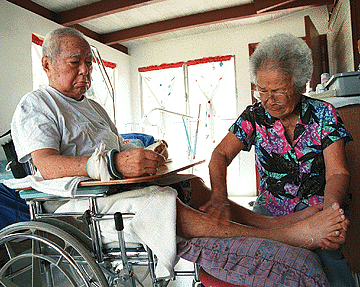
Charles Kawano receives physical therapy from wife Hazel.
Photo by Ken Ige, Star-Bulletin
Charles Kawano receives physical therapy from wife Hazel.
Photo by Ken Ige, Star-Bulletin
By Helen Altonn
Star-Bulletin
"Frequently, not as frequently maybe as it used to be, you go into a nursing home and see people who could be cared for in a less expensive setting," says Honolulu gerontologist Gary Johnson.
The average cost per day in a nursing home here in 1992 was $128, compared with $66.48 on the mainland, according to the American Association of Retired Persons.
But the laws, costs and lack of resources discourage many families who want to keep elderly parents at home, says Mildred Ramsey, administrator of Child and Family Service's Honolulu Gerontology Program.
The only option for many is to place a parent in an institution, with taxpayers footing the bill through Medicaid. Medicaid patients occupy about 95 percent of the state's 3,600 nursing beds, Ramsey said.
"If they aren't (on Medicaid) at first, they will be in a few months."
The high costs of nursing care quickly drain savings or force people to dispose of their assets so they can seek government assistance.
Resources are excellent in some areas but they're generally fragmented and expensive, he said.
For well-off clients, he said, "There is a whole world of things we can do." The only choice for others may be institutional care.
Other kinds of financial help and alternatives while people are relatively healthy "could take the burden off of long-term care," Johnson said.
Some of his patients are interested in assisted living, but they're dying waiting for such facilities to be built here, or are moving to states that offer it, he said.
Assisted living facilities provide basic care services, such as bathing, eating, grooming and medication.
Hawaii's first such project, The Ponds at Punaluu, is under construction, after four years of seeking necessary approvals.
Johnson and others are working with the elderly to advocate some system or tax credit to help caregiving families.
Hawaii's Medicaid costs total about $315 million annually, with about half going to nursing homes, according to the state Department of Human Services.
"Think what the state could save by reimbursing caregivers," Johnson said.
One of Honolulu Gerontology's programs saves the state about $4 million annually by keeping people out of institutions, Ramsey said. "They improve in the program and it takes them off the backs of their families."
Other programs to assist caregivers have similar results, she said.
"But they keep cutting back on our budgets and the kinds of things that can keep these people in the community...
"People should not have to end their lives in a nursing home," Ramsey said.
"They need to be in more humane settings. We're pushing for new, less expensive and more humane methods of housing, like assisted living and care homes, and letting more acute patients go into nursing homes."
About 400 people register each year in the agency's Health Maintenance Program, she said.
About 17 die each year and only about three go into long term care, she said.
Hawaii has the lowest percentage of nursing home beds in the country relative to the age 65 and over population, said Lynda Johnson, Hawaii Long Term Care Association executive.
Nursing beds always are needed for 24-hour care, but alternatives are needed before that level, she said.
She favors the options Oregon has, such as payments or tax relief for caregiving families.
Tax credit bills are introduced here annually without success, partly because it's difficult to give legislators specific figures on the amount of money involved.
Marilyn Seely, Executive Office on Aging director, said she's seeking a national grant to form caregiver organizations to pool resources and work for changes in laws and for caregiving incentives.
The office is sponsoring entrepreneurship classes at community colleges to encourage people to establish day care, group home or in-home services, she said.
Home health agencies have doubled in the last few years but some traditional agencies folded because they couldn't compete, Seely said. The agencies charge for home service, usually for a minimum of four hours.
St. Francis Medical Center obtained a grant to continue the training four times a year on Oahu, said Chuck Lyden, director of the hospital's community health centers.
"There is a complete lack of knowledge about what it means to be a caregiver," Lyden said.
Family problems often occur because one person - usually a single woman - ends up with the responsibility, he said. It's an impossible task for one person but people either don't know about resources or they're too proud to seek help, he said, "and they completely burn out."
Lyden said it's important for the whole family to address the need. He urges caregivers to develop relationships with neighbors, friends, church groups or support groups - "anyone, because it's not something you can do on your own."
St. Francis is looking into establishing a Home Helpers Program where people could call for help with light housekeeping, bathing and other caregiver needs, he said.
Stella Satake, Hawaii State president of AARP, agrees more resources are needed here, "even for private pay-for-service areas."
Satake said AARP is trying to develop help among its 114,000 Hawaii members with a program called "Connections for Living."
The idea is to get volunteers to find families that need help and provide them with information and access to services.
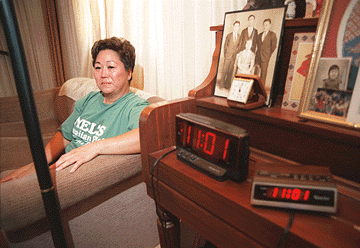
Karen Koles sleeps on a couch near her father's bedroom with three alarm clocks so she can wake up every two hours to care for him.
Photo by Ken Ige, Star-Bulletin
They had to make a lot of changes in their homes and lives to care for him, but they don't regret it.
Kawano, 85, said she considers it a privilege to care for her husband of 61 years. Daughter Karen Koles, 51, says, "I think I'm a lot closer to him than I ever was."
The Kawanos lived on Molokai until the 87-year-old man's stroke. She's a retired teacher and he was Aloha Airlines' station manager for many years.
After his hospitalization in Honolulu, the couple lived 2-1/2 years in the Manoa home of their daughter, Carolene Neely, and her two teen-age sons.
"The whole level of stress went up for everyone," said Koles, a Kalihi-Kai Elementary School teacher. She also stayed at her sister's and went to her Hawaii Kai home once a week to water plants and check the mail.
"It got to the point where we wondered if we were being fair to the kids," she said. But her nephews, now 6-footers, learned to care for their grandpa and "to be very patient with elders," she said.
When it became too inconvenient at her sister's, Koles modified her home for her parents. She enclosed her patio with glass and air-conditioned it to create a comfortable, sunny room for her father's hospital bed and other paraphernalia.
He can't sit up unsupported and it takes a team to roll him over, Koles said. A hydraulic lift is used to transfer him from the bed to a wheelchair for at least two hours a day. "If he shifts his weight, we're dead," Koles said. "Twice we had to call the fire department."
Kawano puts him through exercises and cares for him during the day. If she has to go out, her husband's sister takes over.
Koles has the night shift. She sets three alarms so she can change his diapers every two hours. "That's my payback for all the times he changed my diapers," she said. "I can get up, do a diaper change, and be back asleep in three minutes. And vitamins help."
Her sister arrives at least twice a week at about 10:30 p.m so she can get five to six hours of solid sleep.
She said her father isn't taken anywhere in a car. "The doctors come out to us." They have home health services, including nursing and bathing, three times a week.
Her father has lived on liquid food through a tube in his stomach for 4-1/2 years, Koles said. "We pray the tube won't clog." Occasionally, he's given a taste of ice cream or yogurt.
She said social workers at the Rehabilitation Hospital of the Pacific pointed them toward resources when they took her father home. "But most of what we learned, we learned the hard way. We cried a lot."
She said a lot of information is available only by word of mouth and it's "more reliable than any booklet we have." Written material usually is outdated, especially with programs reduced or wiped out by budget cuts, she said.
The family learned that Medicare will cover a lot of things, such as a hospital bed, if prescribed by a doctor. "If we had to pay everything out of pocket, we'd be in the poorhouse," Koles said.
Since becoming a caregiver, Koles has had only three quick neighbor island trips for school-related activities. Mainland travel is "out of the question."
She and her mother are trying to help other caregivers through a support group that meets the last Saturday of every month at her school. When they hear other people's stories, Koles said, they realize their situation "isn't that bad after all." The group is looking to the University of Hawaii Elder Care Project to push for independent contractor status for caregiver aides, Koles said. "If mom was unable to help, we probably would have to put him (her dad) in a care facility." However, her father is easy to care for, she said. "Role reversal was one of the most difficult things at first."
Though he's not mentally sharp, he is responsive. She drills him orally, asking, "Where is Charley Kawano?" He looks around and points to himself. Until about a year ago, he would answer Kauai when asked where he was born and would tell his parents' names. "But we would have to do a lot of prompting. He was cute. He would say, 'I've told you that already.'"
Once he said "thank you" for something she did, Koles said. "I suspect he does a lot more thinking in there than we give him credit for.
"The other day he was sharp. We grab our blessings when we can."