Honolulu Star-Bulletin Local News
TAKING CARE: A FAMILY AFFAIR
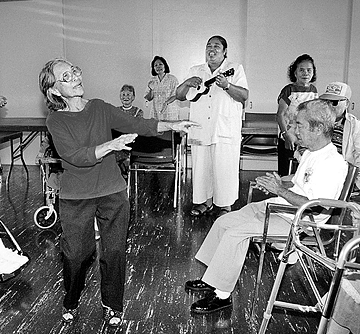
Kay Medeiros, 85, dances hula at Aged to Perfection,
a day care home for the elderly.
Photo by Ken Sakamoto, Star-Bulletin
'It's part of
our island culture'
Stress and exhaustion are the inevitable
result of the endless responsibility
Part one of a three-part series
By Helen Altonn
Star-Bulletin
An elementary school teacher gets up every two hours at night to change her bedridden father's diapers.
A retired Air Force officer is confined at home caring for his father after a stroke, his plans to be a special education teacher scrapped.
These are just two of thousands of islanders who have upended their lives to care for ill and elderly family members at home.
They struggle with stress and exhaustion, often alone with caregiving responsibilities around-the-clock. And they deal with myriad problems, among them:
 Not knowing where to go for help because of fragmented resources.
Lack of information on what caregiving involves.
Lack of incentives - such as tax credits - to encourage home care.
Complex laws governing hiring of helpers in the home.
High costs of employing aides.
Shortage of options between home and nursing care, such as assisted living.
Mildred Ramsey, administrator of Child and Family Service's Honolulu Gerontology Program, knows the trauma of being a caregiver. She kept her father for one year after he had a stroke, changing his bedding twice a night because he was incontinent.
"In the daytime, I was just crying," said Ramsey, a pioneer in Hawaii programs for the elderly. "When sleep pattern is interrupted, it affects mental health.
"You can't just say 'I don't want to do this anymore for a couple of days.' You've got no break. You've got this responsibility hanging over your head."
The 'sandwich generation'
Ramsey and others in the field estimate at least 15,000 family caregivers in the islands - a number that's growing with the aging population.
Talk used to be about the "sandwich generation" - a 60-year-old caring for an 80-year-old parent, noted Stella Satake, AARP Hawaii State president. Now it's a "triple sandwich generation," she said, since parents, children and grandchildren often are affected now.
Diane Murayama, head of Catholic Charities' Elderly Services, said children are having to return from the mainland to care for older family members.
"We have a situation now - a couple with three or four children, giving up a very good job on the mainland with a big firm," Murayama said. "They're coming back to take care of their mother and help their father out. These are big decisions to make. It's part of our island culture."
Karen Miyake, Honolulu Area Agency on Aging acting director, said it's estimated that 80 percent of older people are cared for by family members nationally. The number may be even higher here because people live longer, she said.
It's a tough row to hoe
Miyake said her office is receiving an increasing number of calls from prospective caregivers. "They want information unheard of 10 years ago.
"There is a lot more concern by children of caregivers."
Most referrals involve working parents as the number of employed women continues to grow, she said.
"Working caregivers are really finding it tough - one, to afford the cost of 8 to 10 hours of care, the other to find those people willing to spend 8 to 10 hours a day," Miyake said. "It's really hard and it puts a strain on family life."
"If you're taking care of kids, even teen-agers, and taking care of parents and a husband - can you imagine what it's like for a caregiver?"
She believes onerous paperwork involved in complying with laws and high costs of hiring help through agencies result in a lot of under-the-table caregiving. "The laws are set up to protect people but sometimes they hinder you."
Satake, who also heads the Kokua Council for Senior Citizens, said AARP supports a long-term care program that allows people to stay at home as long as possible. But no headway was made in the last legislative session, she said.
Whittling on red tape
The State Legislature did authorize a single-entry system to make it easier for people to get services for the elderly. It's being designed by a committee with more than 30 members organized by the state Department of Human Services.
Ramsey, a committee member, said people seeking help would have one main number to call and generally would go to one place to be linked with services. Clients would be assessed once, and not have to repeat their stories for every program. Service agencies would be computerized and tap into a central information bank, reducing overlap and expenses.
Pat Schneider, a human services official, said, "It may mean people at least are not inappropriately in institutions."
But don't look for immediate changes. "We're talking about revamping the entire system, she said. "States that have done that have taken years."
Schneider said there is a movement toward strengthening home and community care to avoid putting the elderly in institutions.
But with heavy budget cuts in recent years, the state is "resource poor," said Marilyn Seely, Executive Office on Aging director. "Everybody hates to advertise services in our (aging) network. You just add to your wait list ... We can revamp the system; we can say we have this marvelous entry point, but entry into what?"
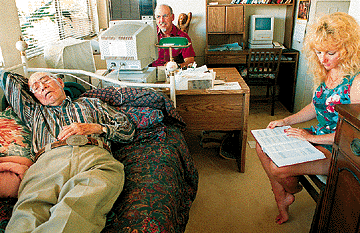
J.W. Berkey, at the computer, has a couch or bed in each room of the home so his father, Harry, can be near. At right is daughter Trenda.
Photo by Kathryn Bender, Star-Bulletin
A man's decision
to take his father into his home
eventually led to divorce
By Helen Altonn
Star-Bulletin
Bringing his father here after a stroke in Oklahoma led to a divorce and a shift from teacher to caregiver for J.W. Berkey, 60.
Still, the former Air Force lieutenant colonel feels "very blessed."
His daughter, Trenda, 33, moved in with him three years ago to help. "She is a great blessing, and my dad doing as well as he is, that's a great blessing, too," Berkey said.
When he retired from the Air Force in 1987, Berkey decided to add a teaching certificate to his business and computer science degrees and teach special education children.
He had to leave school when his father became ill in 1991 but completed work for his certificate. The training and understanding of children's disabilities helped prepare him for his father, he said.
After going to Oklahoma and arranging to bring his father here, he said, his
wife, a gerontological nurse whom he married in 1987, didn't want to care for him. "That eventually led to a divorce ... "
Harry Berkey, who will be 90 in December, formerly manufactured nutcrackers and owned several department stores. He had lived alone since his wife died in 1985.
Except for installing a few grab bars in his Mililani home, Berkey said, he just had to make things convenient for his father.
"Wherever I'm working, he wants to sit or lie down next to me, so we got couches and daybeds where he can go from place to place."
His father had a second stroke after coming here, Berkey said. "To look at him, he's great, but he can't think or express himself well." They communicate mostly through sign language, he said.
"He says 'I love you' 40,000 times a day."
He said his father knows who he is but usually calls him by his younger brother's name. He also has an older brother.
They don't help "financially, emotionally or psychologically," said Trenda, one of Berkey's two daughters by his first wife, who died of cancer. A former Continental Airlines flight attendant, she's pursuing a masters degree in social work at the University of Hawaii.
If not for her, Berkey said, he'd have no social life. "Just having her around here is so wonderful."
He said he's learned to do everything for his father. He even bakes bread. "And we're into low-cal, so I enjoy the challenge of trying to make low-fat food taste good."
Berkey snatches moments of freedom, going to the store or getting out after putting his father to bed at 8 p.m. In five years, he said, he hasn't been away from him more than four or five hours.
He tried putting him in a day care program, which he said didn't work. "He's a lovely, sweet, very dear man but he doesn't want to be put in with a bunch of old people."
And he won't accept anyone helping in the house, Berkey said. He said he took his dad almost everywhere he went until he became incontinent.
He said his support group helps him cope, "to understand I'm not alone." Some families have much worse situations, he said.
Trenda said she and her dad get along well, but it's been "a transition" living in the family home after her own apartment.
"It's hard living with someone having degenerative things happen because of age. I look at him (grandfather) and say, 'Oh my God, if I live long enough, that is me.' That is something we're not facing on an everyday basis - that we can live beyond our faculties. It's scary."
And she worries about her father. They walk five miles every morning but he gave up tennis, she said. "He doesn't want to have any hobbies that keep him from the main thing, which is taking care of his dad.
"I really love my grandfather; he's such a sweet man," Trenda said. But he can be manipulative if she has company, she said, and he gets jealous if she's talking or working with her dad and "tries to get in the middle of it ...
"My dad will yell at my grandfather because he's irritating him, and my dad yelling at my grandfather really irritates me." She and her dad coined a term for that: "intergenerational irritation."
But she said, "I tell dad, 'Not everybody gets a chance to raise your parent.'"
TOMORROW:
Supporting family caregivers could save
the state a lot of money.