For a few, however, a different quarry might come into view. A sighting. A UFO.
The only thing is, what appears as an unidentified flying object to the spotter, Peckham recognizes immediately.
It's usually a plane, planet, comet or satellite.
"That's human nature," said the amateur astronomer, president of the Hawaiian Astronomical Society. "The desire to believe is so strong that it can create that thing in front of your eyes."
Yet Peckham - who like all scientists and skeptics explains his position on UFOs by saying "I don't disbelieve" - contends that humans need to believe in UFOs and extraterrestrials. "It's one of those things that fires the imagination. It's fun to be scared. It's fun to believe there's something amazing out there that's going to make us feel alive."
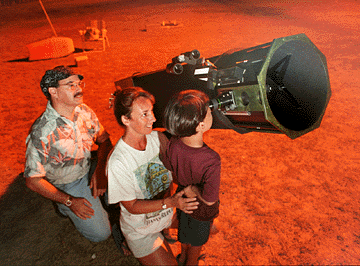
Barry Peckham of the Hawaiian Astronomical Society stands behind Gail Tomita and her son Kevin, 6, as he peeks at Saturn through Peckham's 15- inch mirror telescope at Kahala Beach.
By Dennis Oda, Star-Bulletin
And no wonder. A look at the tube reveals such alien comedy as "Third Rock From the Sun," "reality" programming such as "Sightings," as well as more sinister fare in "Dark Skies."
It's no fluke that the year's top big-screen draw was summer's "Independence Day," in which aliens from outer space attacked Earth. The film has earned $293 million to date and broken box office records around the world. We are not alone when it comes to interest in ETs.
"The earth has shrunk so much. It would be gratifying to think there's life out there," said Rita Knipe, a Jungian analyst and author of "The Water of Life: A Jungian Journey Through Hawaiian Myth," published by the University Press.
She describes earth as if it were an island in the vast ocean of space. "On an island we can feel small and isolated if we don't embrace other things. Outer space is where our exploration is continuing."
It was famed psychiatrist Carl G. Jung himself, who earlier this century described flying saucers as "a modern myth of things seen in the sky."
"In early times, when people were troubled they looked to the sky, and saw angels," said Dr. Toby Owen, a professor of astronomy at the University of Hawaii-Manoa. "In a technological age, they see spaceships."
"People are prone to think of a 'myth' as a falsehood," Knipe said, "But that isn't the way Jung dealt with myths, and it's not the way I deal with myths.
"We need to treat such things with a great deal of respect. We need to respect that people really do see UFOs. When you get into peoples' belief systems, you're not talking about superstition anymore.
"The sightings, the experiences, are subjectively true, even if they're not objectively true. We don't have to answer the question of whether UFOs are objectively real, but we can certainly try to understand what it means subjectively."
To many, ETs seem to represent hope in a time when the Earth seems to be running out of resources.
Dave, a part-time singer and theater director who wanted to be known only by his first name, is among those who believe a more advanced civilization could help us out of our 20th Century doldrums.
All the havoc wreaked on the world today - floods, terrorism, war - he said, seem to be a test, and the outcome will determine the planet's future.
"All these parallel events," he said, "seem to be leading to some kind of second coming - whether it's Christ or extraterrestrials - something will unify us in some way.
"I see wars and terrorism as cause and effect. But we can only separate so much until we come together like a rubber band," he said, spreading his arms before clapping his hands together.
"We might have to have ETs and wars, but the end result will be some kind of unification. I don't think the events leading up to unification have to be violent, but that's the way we chose."
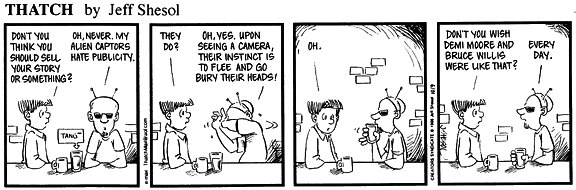
It seems belief in aliens has beome more accepted and the topic of popular culture hits like the comic strip "Thatch," TV show, "'Third Rock from the Sun" and movie "Independence Day."
That's a question also asked by Lola Hart, a Waimalu Elementary School librarian with an interest in Pacific Island history and culture. It is through this interest that she became absorbed by the tale of creation and the similarities between stories told throughout the Pacific.
Every group of islands has its version of a sky father and earth mother like Hawaii's Wakea and Papa. And one has to wonder if that sky father truly came from the sky, she said.
"I'm open-minded because librarians tend to want to go out and get every bit of information, rather than deciding we know everything.
"I don't think there's anyone who has all the information at this point, so I'm still searching. It's this kind of talk that always starts me thinking, 'What if?'
"I'd like to think there's someone or something with a greater power who can get us out of this mess in the nick of time."
Hart's interest in ETs stems from her questions about the origins of such great monuments as the pyramids and the temples at Machu Picchu. She questions whether early man really had the ability to create these monuments without help from above.
Author Knipe applauds such challenges to collective assumptions. History is full of examples of common assumptions later proven wrong. Hence a flat world became round. The Earth was discovered to orbit the sun rather than vice versa. And leeching did not turn out to be the best cure for what ails you.
"I don't think man would have evolved to be much smarter than other animals just through evolution," Hart said, suspecting "a little help" from other beings.
It is a sentiment echoed by members of the Raelian Movement, a group started in 1973 by French journalist Claude Vorilhon, after his alleged encounter with alien beings. Today he goes by the name Rael and his society has chapters in 85 countries.
For Jean Francois Aymonier, an electrical engineer from France who has traveled widely to speak about Rael, the alien connection was easier to accept than the notion of God or mere science.
"Science would have us believing we were created out of a primordial soup, that one molecule was responsible for creating all life on earth and that all the plants, animals that fly, were created by random evolution," Aymonier said. "For me, with a scientific background, it was very hard to swallow."
For Aymonier, the Raelians brought the message that just as scientists have unraveled some of the mysteries of creation and DNA, the Elohim - as they call extraterrestrials - possessed advanced knowledge that allowed them to create life on Earth.
Kai Kalama started the Hawaii Raelian chapter after hearing Rael speak in Hawaii last April. His message is that mankind has a choice between destruction and peace and will survive only if they choose peace.
"He brought a message I was happy to hear," Kalama said. "It answered many questions for me. Fifteen to 20 years ago, it was crazy to talk about these things. It was not something to think of. People laughed at you.
"Today I think we understand we live on a very small particle and there are a hundred billion stars in the galaxy with a hundred billion possibilities for life to exist elsewhere."
Astronomy buff Peckham said the notion of benevolent aliens is wishful thinking. "I think it would be as disastrous to see one as it was for the Hawaiians to see Captain Cook sailing up.
"It means death and disease are coming. It's a pattern that's repeated itself throughout history. Whenever a less advanced culture is discovered, it's been run over by the more advanced culture. Why should it be any different for people from other planets?"
He added that we would most likely be visited by artificial intelligence, rather than living beings. "We'd probably see robots that can take journeys of 75,000 years, because that's what it takes to get here from the nearest star, and they'd be less likely to be sympathetic than living creatures."
The notion of alien beings as saviors or destroyers is typical, says Knipe. "As we enter a new age - the age of Aquarius, the new millenium - there are all sorts of changes and upheavals that are to be expected, so it's no surprise that a need for change is rising in the human psyche."
But she said, "Change is difficult for all of us. It's interesting that these sightings are coming at a time when we understand we have to take the fate of our Earth, our planet more seriously.
"We don't know everything," Knipe said, "But there's something in us that's knowing - an ancient, wise teacher. I find that thought very hopeful. I don't have to know all the answers today. If I listen, something will come from within.
"Whether or not there are actual UFOs, it is important to understand them as psychological phenomenon and explore what it means to you if you see a UFO or dream about a UFO."
Fred Sterling, founder of Honolulu's Inward Healing Center, which has hosted talks by those who channel alien entities, takes a more pragmatic stance.
"I believe there's something out there," he says, "but to quote a friend, 'When a spaceship comes down and lands on Beretania Street, and a little green man steps out and waves at me, then I'll really believe. But between now and then, I'll just believe they're out there.'
"And the difference between believing and knowing is just that simple."