
By Lois Taylor
Friday, September 20, 1996
Lois Taylor, whose gardening column
usually runs in this space, has the day off.
Ever Green returns next week.
Lois Taylor, whose gardening column
usually runs in this space, has the day off.
Ever Green returns next week.
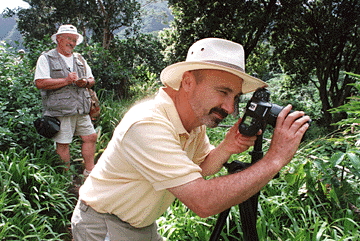
Geoffrey Burnie photographs flora at Lyon Arboretum,
while his assistant Roger Harris takes notes.
By Dennis Oda, Star-Bulletin
Burnie, who was visiting here last week, is gardening editor of the Australian edition of Better Homes and Gardens magazine and is a garden photographer and horticulturist. The Australian magazine, Burnie said, devotes more space to gardening and less to crafts and interior design than its U.S. counterpart.
"When I became garden editor in 1986, I realized that while the former editor had a huge photo library, he was more interested in colors and individual plants. I had the big picture in gardening, so I got started taking my own. I bought a good camera and practiced a lot."
He now provides most of the photos for his writing. While Burnie's articles have to apply to all of Australia's climates, from cool temperate to tropical, his own preference is for tropical plants. "The interior of Australia is very dry, but most of the population is around the edges. That means there are fewer extremes of temperature, and big difference is in the amount of rainfall.
"People living there seem to think that Australia is cooler than it really is, and they struggle to grow little English gardens," he said. "It doesn't work. The heat knocks them out, but people tend to go ahead and replant."
Tropicals, in many areas, would be more appropriate. Burnie suggests that you think of a garden as a living system, that you don't install it all at once like furniture in a new house. "You have to visualize what the garden will look like in 10 years," Burnie said.
"That lovely little tree from the garden shop will be 80 feet tall, and you have to know about this," he said. "Plants, after all, are totally predictable. It's just like buying kitchen counters, except that they grow bigger.
"People buy plants without thinking. You wouldn't say to yourself, 'I must have that knob,' and then buy it and forever wonder where to put it."
Gardening, he said, is about the single most popular pastime in Australia. "But when you walk down a suburban street, you'd never guess. There are some pathetic attempts at landscaping by people who haven't thought through a real plan."
His own garden, located on a headland above Manly Bay near Sydney, is largely planted in Australian natives. "The soil is fairly sandy, so I am limited in the choice of exotic plants. It is windy, and there is no land between my property and the northwest coast of Antarctica."
Burnie recommends group plantings in a home garden, avoiding "a little of this and a little of that." The reason is simplicity, he said. "You should know something about each plant in your garden - fertilizer, water, sun, insect control - and the more plants you have, the more you have to learn. And as you learn, you can add more plants."
This goes back to his statement that he loves gardens but he isn't wild about gardening. "I will garden, but it is the finished result that is the goal, not the process itself. Too many garden writers make it out to be terribly hard work, but I don't think it has to be. It's a matter of the right plant in the right place."
The first place to look is in a neighbor's yard. What grows well there should grow well for you since you share the same soil and climate. "So plant a bank of it. If it gets boring, pull it out and plant something else. You don't want to give your life to garden maintenance," he said.
A backyard, Burnie says, should be like a structure, with hedges as walls, and different areas for separate purposes. First, define your problems. In his case, they were arctic winds and a lack of privacy. Burnie uses hedges as windbreaks and to screen out a nearby house.
Think about the uses of your garden. "Do I want to have lunch in my garden? Then I need a shady area at noon. Make your garden into rooms. Habitable, sensible outdoor space comes only with studying the building materials - the plants - you are using."
The non-native plants in Burnie's garden are often introductions from South Africa, particularly bulbs. While a few of them might do well here, he said he was reluctant to recommend them because in our climate they could multiply at a fierce rate and become weeds.
Burnie travels with his assistant, Roger Harris, and they appear to be the contemporary Sherlock Holmes and Dr. Watson. Burnie does the deduction, deciding what to photograph and how, and Harris keeps meticulous records of plant material and camera settings.
Burnie uses a Nikkon F-98 camera, and gives this advice to garden photographers:
 Avoid bright sun where there is deep shade. Film can't handle the two at once. You can photograph a scene in full sun or full shade, but not at the same time.
Photograph early in the morning or late in the afternoon when the light is soft and diffused, or at midday if there is a light cloud cover.
Before you snap the photo, look through the view finder and ask yourself, "What is this picture about?" If you can't find an answer, it won't be a good picture.
When you are walking through your garden and you see something that makes you think, "That's a good picture," distill what it is that caught your attention, and photograph just that.
Photography is like gardening, Burnie says. Figure out first what you want the result to be, and then create it.