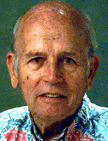
But that is only part of it. He oversees a myriad of Catholic operations that make the Catholic Church the strongest and best private social force in Hawaii - by far. I say this as an agnostic who disagrees strongly with the church on a few matters such as birth control and abortion.
The full extent of the church's operations was always before my eyes but I always saw the trees instead of the forest until Bishop DiLorenzo presented the big picture in a Plaza Club breakfast talk. We have since talked further about it.
Look at the record and at page 104 of the Oahu telephone directory:
 The largest private school system in the state - 36 schools. It enrolls 11,500 students, Catholic and non-Catholic, teaches values, spends less per student than the public schools, gets better results and has an administrative staff of only five.
The largest private social agency in the state, Catholic Charities. It also helps all comers. Its many aspects include family services, transitional housing for the needy, a home for unmarried expectant mothers, elderly services and immigrant services.
Ethnic ministries that help newcomers preserve their culture.
Social ministries on all islands, including a prison ministry and a Big Island food bank.
Outreach centers in all 69 of its parishes that provide food kitchens, homeless assistance and clothing.
Semi-autonomous, but still under the bishop's oversight, are institutions operated by national Catholic orders formed to support specific good works:
The St. Francis Medical Center and health-care systems with two major hospitals on Oahu. The St. Francis order brought the first hospice to Hawaii in 1979 and operates our largest hospice system.
Chaminade University and St. Louis High School.
Damien Memorial High in Kalihi.
Sacred Hearts Academy in Kaimuki, a beautiful complex operated by the order that sent Father Damien from Belgium to work with leprosy patients on Molokai more than a century ago.
Retirement homes for priests, brothers and nuns.
How much land does the church own? What is it worth? The bishop says only Hawaiian Trust knows and they won't tell me. Very little of the land is income-producing. The bishop has placed a semi-moratorium on church building and sale of property. If property were sold, it would be to produce income.
The diocese headquarters staff of about 80 is financed by investment income and collection plate contributions from the parishes. Pay is low by community equivalents. Catholic Charities has varied funding. Tuitions and charitable trust scholarship income help finance the schools.
The political core of the church is the Hawaii Catholic Conference, a small group of church activity leaders headed by the bishop. It has arms for both education and lobbying. The bishop frowns on "in your face" tactics in advocating Catholic positions but still wants them put forward clearly and strongly.
He is Philadelphia-born and assigned here from Scranton, as were two of his predecessors, Bishops Scanlan and Ferrario.
Of the extent of his domain, he commented: "We are one of Hawaii's best-kept secrets."Also, I'd add, the biggest private contributor to community well-being.