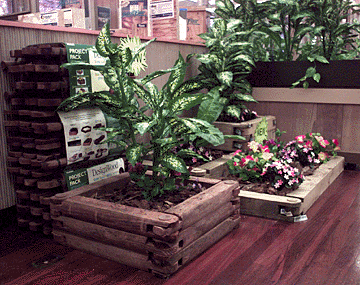
With DesignWood's "instant" home landscaping system,
piecing together rustic-looking planters is a snap.
By Dean Sensui, Star-Bulletin
With DesignWood's "instant" home landscaping system,
piecing together rustic-looking planters is a snap.
By Dean Sensui, Star-Bulletin
Then there's another drawback. Put a plant in the wrong place, and you can move it later. Put a 100-pound rock in the wrong place, and you've got a potential backache.
Even using traditional landscape timbers or used railroad ties takes time to saw and drill and set it in place. All the while you need to keep your fingers crossed if you want to end up with the magazine-perfect landscape look you've envisioned.
Well, help is here.
DesignWood's "instant" home landscaping system is a series of pre-cut, pre-drilled Southern Yellow Pine timbers, available in Home and Professional grades, and in various lengths and widths determined by intended use.
The system's secret is simple: The timbers interlock with a joint-pin connection - so there's no need for spikes or nails. The system allows you to design about any shape you want for borders, planters, benches, a raised garden bed, walkway, even a sand box.
Just imagine giant Lincoln Logs and you get the idea of how easy it is to assemble your landscape design. The only sawing required is on the joint-pins which link the timbers; hammering is necessary only to drive the joint-pins into the joints or into the ground.
Another plus is that one side of the DesignWood timber is flat; the other is rounded, giving your project two different looks. It makes for a great alternative to stone, interlocking concrete systems or the above-mentioned railroad ties.
DesignWood's "Home" line can be used for what the manufacturers call "limited structural applications": That means edging, planters and storage. This grade comes in individual 2-foot and 3-foot timbers, about $4 and $6, respectively, and in 12-piece Project Packs, about $64.
The Professional Grade system can be used for "major structures" like retaining walls (up to 24 inches high) inlaid steps and walls abutting water. The "Pro" line is available in 4-by-4-foot and 6-by-6-foot widths, and in 2-, 4-, 6- and 8-foot lengths, about $6 to $23 respectively. Both grades are pressure treated to prevent rot and termite infestation.
To make landscape projects even easier to build for amateur home fixers, DesignWood packaging lists several plans for planters, tree rings, decorative edging, benches, and a sand box, including the number of pieces required.
How much? Well, a 2-by-2-foot square planter, five layers high is about $125; a 4-by-4-foot two-level planter, about $160; a 6-by-6-foot two-layer raised garden, about $145.
With used railroad ties - available only in 6-inch-by-8-inch-by-8-foot dimensions, about $34 each - the cost of the raised garden would be about $204. And some drilling, perhaps sawing, would be required.
Another good thing about the DesignWood system is that after your "raised" garden or new lawn is established, you can take the timbers apart and move it to another part of the yard.
Is your deck a wreck? You can quickly resurface damaged concrete patios and walkways with DesignWood's 2-by-2-foot "Flexible Decking Panels, about $12. They're assembled with flexible PVC tubing and flex to fit many contours, making them good choices for walkways, stepping stones, ground level patios, green house floors, even doormats.
The DesignWood system can be purchased at MidPac Lumber, Eagle Hardware & Garden, Star Super Market in Moiliili and HPM Building Supply in Hilo.