Photos by Craig T. Kojima & George F. Lee,
Photo Illustration by Dean Sensui, Star-Bulletin
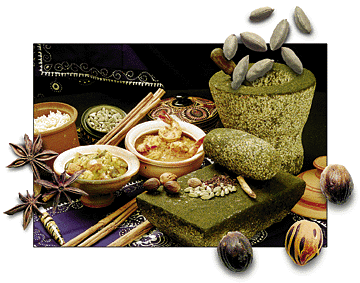
Grinding spices the old-fashioned Sri Lankan way meant setting up a weighty mortar and pestle or grinding stone, right. These days, a coffee grinder does the trick with less muscle involved. Left and center are Kusuma Cooray's Vegetable and Shrimp Curries made with seasonings available in pre-blended packets.
Click on the photo to see a large (166k) version.
Spice & sensibility
The right blends can wax exotic
and eloquent without the mumbo jumbo
of haphazard mixing
By Nadine Kam
Star-Bulletin
Cooks in need of inspiration need look no further than the spice rack. Already, spices have sparked a revolution in the way cosmetics are named. No longer are lipsticks and nail colors generically dubbed "red" or "coral." Now they are paprika, nutmeg, saffron.
Just as the words manage to transform the ordinary into the exotic, so do the flavors of these diverse plant parts. With a sprinkling of rich mocha-colored nutmeg and a dash of the ochre powder, turmeric, one may feel like a sorcerer about to cast a magical spell on those who may partake in the resulting blend.

Chiles
Also known as Capsicum annum, range from mildly sweet to fiery hot depending on the amount of the chemical irritant capsaicin contained in them. With more than 200 varieties available, they can be as tiny as a pea, as are tepin chiles, shown, or as large as an eggplant. Chiles work as a palate stimulant.
While herbs are the green parts of plants, spices represent everything else. As author Julie Sahni writes in her recent book "Savoring Spices and Herbs" (Morrow, $25), these other plant parts include rhizomes (ginger), barks (cinnamon), fruits (chiles), seeds (anise, cumin), buds (cloves), berries (juniper) and flower stigmas (saffron).
Many spices contain properties that have a restorative effect on the human body. For example, coriander, the seed of cilantro or Chinese parsley, is rich in Vitamin C. Turmeric is an anti-inflammatory, anti-aging agent. "Potatoes don't brown when you put turmeric on it," says Hubyba Mohamed, who grew up in the coastal city of Colombo, Sri Lanka, and who has found a market for spices she imports from her homeland. She can be found from 7 to 11 a.m. most Saturdays at the Piikoi Open Market at Piikoi and Waimanu streets, offering these spices at 75 cents to about $4 per packet, depending on weight.
A glimpse of the spices is enough to make a person want to rip open the packets and start experimenting. Resist. Tossing a hodgepodge of spices together without any kind of map will generally result in, at worst, a confused jumble of flavors. There is a balance to strive for. And at least one pairing of food and spice could be lethal.

Fenugreek
Bitter, slightly sweet seeds of an aromatic plant native to Asia and southern Europe are used to flavor curry powders, spice blends and teas. They bring out the delicate flavors of shrimp and salads.
Mohamed's husband, Hassam, a forensic chemist for the Honolulu Police Department, explains that there is a certain yam in Sri Lanka that contains a sodium salt that by itself is not dangerous. But mixed with sodium cyanide contained in ginger, the combination results in potentially lethal sodium cyanide. But relax, the couple has not spotted the yam (which they only know by the generic name, manioc) in Hawaii.
In spite of her spice-filled culinary heritage, the study of them are a recent passion for Hubyba. "Growing up, we always saw people making and drying spices, and as children we were involved in little things, like the roasting," she says. "It was only when I came here and read the literature that I became more interested. Now I'm all the time learning."
Newcomers into the world of spices often start by making curries. The basis for curries are coriander, cumin and fennel, says Kusuma Cooray, noted isle chef and Kapiolani Community College assistant professor of Food Service and Hospitality Education, who also hails from Sri Lanka. To the basic blend, one may add pinches of various other spices, according to preference.
Generally, she says more aromatic spices such as nutmeg, cloves and cinnamon are used to enhance beef. More delicate spices such as fenugreek would be used on shrimp.
Spices can be purchased in whole or powder forms. Fanatics buy them whole and grind them at home to get the fullest flavor possible.

Cloves
Their warm, rich flavor goes well with sweet and savory foods, such as baked hams and German spiced breads. Buds of the tree Eugenia aromatica from Indonesia, cloves are a strong spice and should be used sparingly.
"I have a Sri Lankan kitchen at home, with a grinding stone and mortar and pestle made of granite. I put it to good use," Cooray says. But that use is not for cooking. Instead, the implements often serve as props for class demonstrations. For ease of day-to-day cooking, she relies on a coffee grinder, which she says works equally well.
To simplify the process even further, she has developed "Chef Cooray's Readymix," eight curry blends for beef, chicken, shrimp and vegetables, in hot and mild versions based on her own family recipes and those of her husband Ranjit Cooray, education specialist at the Lyon Arboretum.
The quarter-ounce packets sell for $2.25 each in the gourmet foods section at Liberty House-Ala Moana, and eliminate the need to stock a vast array of spices that may cost $4 to $6 for each 2-ounce commercial grocery bottle. (They run about $5 to $12 a pound, or about 20 to 50 cents per ounce from stores such as Down to Earth in Moiliili and The Source in Kailua.)
Simply combine one of Cooray's curry powder packets with ingredients listed on the back of the package to create an impressive dish that serves four, in less than 30 minutes. The hardest task in preparing a vegetable curry is chopping the vegetables.

Coriander
The yellowish-brown seeds are from the herb cilantro, or Chinese parsley. Ground coriander has an emulsifying property making it suitable to thicken soups, stews or any gravy-based dish.
Still, for those who insist on preparing spices the old-fashioned way, Hubyba Mohammed says to wash the whole spices first to get rid of unwanted hulls and twigs. After the spices are washed and dried, they must be roasted to bring out their flavor. This can be done by heating a single layer in a frying pan on medium heat. After 5 to 6 minutes of heating, the spices will harden and will be ready to be ground or stored.
One cannot rely on smell to gauge roasting time, she says. "Spices like coriander won't give much of a smell, because the smell only comes out when you grind it."
The roasted, ground spices can be stored in an airtight container, and although spice jars tend to hang around for years, Hubyba says she would keep them no longer than six weeks.
"Sometimes, I'm at Farmer's Market and someone will come up to me and brag 'I bought this huge jar of spices at Costco,' and I'm thinking, 'OK, that's fine but why do you want to do that? In three months, the essential oils will be gone, all the aroma is gone and the flavor is gone."
Once a dish is made, Hubyba has only one rule. "In Sri Lanka we have a saying that if you cook today, you eat today.
"Day-old curry seems to be well-seasoned and tastes pretty good, but I have this thing about wanting things fresh," she says. "I think, with refrigeration, people to tend to eat some things day after day. I don't like to do that."
And in carrying the sensual experience of cooking with spices to the fullest, in Sri Lanka, curries are eaten with the hands.
Spice up your life
What: Kusuma Cooray will be giving free demonstrations of her spice blends at noon at Liberty House
When: Oct. 12, "Tasty Vegetarian Dishes;" Nov. 9, "Adding 'Spice' to the Thanksgiving menu;" Dec. 14, "Fragrances;" spice dishes for the Christmas table
What: Ranjit Cooray's "Spices, Spices and More Spices," a class introducing a variety of fresh and dried spices used in European and Asian cooking.
When: Sept. 28, 9:30 to 11:45 a.m.
Where: Lyon Arboretum
Cost: $15.50 for the single session; class is limited to 20 persons
Call: 988-7378 to register
More spices and recipes