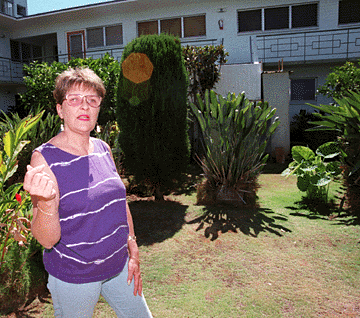
Peg Sawyer:
"I'm just trying to keep my head above water."
Owner of one of the 20 units in the Coolidge Apartments,
where residents are facing as much as a sevenfold
increase in lease rent.
Photo by Craig T. Kojima, Star-Bulletin
Peg Sawyer:
"I'm just trying to keep my head above water."
Owner of one of the 20 units in the Coolidge Apartments,
where residents are facing as much as a sevenfold
increase in lease rent.
Photo by Craig T. Kojima, Star-Bulletin
They owe thousands of dollars of back rent on their ground lease.
And even though many live on fixed incomes, they face as much as a sevenfold increase in their $70 monthly lease rent. Some worry they could lose their homes, unable to scrape up the extra money.
"I'm just trying to keep my head above water," said Peg Sawyer, who at 51 is one of the younger homeowners in the 20-unit building. Others are in their 70s, 80s and 90s.
The plight of the Coolidge residents offers a valuable lesson for the roughly 25,000 other leasehold condo and apartment owners who must renegotiate their Oahu ground rents in coming years, some for the first time.
The lesson, for the most part, is about preparation - or lack thereof.
Homeowners must be ready to deal with a process that can be complicated, costly and controversial. They should get sound advice about what to expect. And they should not expect swift resolutions. Negotiations can drag on for months or more.
The Coolidge homeowners, for a variety of reasons, went into their renegotiation ill prepared. They didn't set aside money in the event the talks went to arbitration, which is where the case appears headed. Experts say even the simpliest of arbitrations, usually involving attorneys and appraisers, can cost a minimum of $40,000 to $50,000.
The Coolidge group also didn't set up a reserve fund for higher rent. Some projects facing renegotiation will estimate the new rent - even before negotiations have started - and increase the maintenance fee to cover the estimated amount, preventing a big buildup of back rent.
In the Coolidge case, back rent has been accumulating since March 1991, when the lease was supposed to be renegotiated. The two sides have yet to agree on what the new monthly amount should be, though Bishop Estate, the landowner, has pegged it at more than $500 per unit. Further complicating matters, both sides have raised the possibility of the apartment owners buying the land from the estate.
He said he hopes the estate waives some back rent and that the co-op, on behalf of the homeowners, eventually will be able to buy the land. The estate recognizes the financial predicament faced by Coolidge's elderly homeowners, added Kashiwa, who has discussed the matter with Bishop executives. "They understand whatever the (estate) is trying to do, the people can't afford it."
Estate spokeswoman Elisa Yadao said it would be premature to comment on how the Coolidge case will be resolved.
"We've been going very carefully," proceeding according to the terms of the lease, Yadao said.
Those familiar with leasehold cases say the Coolidge one is not unique.
Many lessees in projects facing renegotiation don't set aside money to deal with negotiating costs or what are expected to be substantially higher rents, they say.
"People hate facing that day when they have to kick in more money," said Mike Pang, a Realtor who represents lessees. "They keep procrastinating."
Said Anne Niethammer, board member of the Hale Coalition, an advocacy group for lessees: "Quite a few refuse to do anything. They just bury their heads in the sand and hope for the best."
Developers started building condominiums on leased land in Hawaii in the 1960s and 70s, typically with leases calling for renegotiation after the first 25 or 30 years. That means many will come up for rent renewals over the next decade.
A 1992 study by the Honolulu Board of Realtors estimated that close to 200 projects representing roughly 25,000 units would be up for renegotiation between 1996 and 2005. Another 200-plus projects would come due after that, the study said.
After the first renegotiation, rents usually are reset every 10 years until the end of the lease.
Rents, though, aren't the focus of negotiations. Land values are. Once a value is set, it is used to calculate the new rent based on a formula specified in the lease (typically the value times 6 percent to 8 percent).
If the two sides can't reach agreement on a value, the dispute goes to arbitration, with each side picking an appraiser and the two appraisers deciding on a third.
The three appraisers become the arbitrators and determine, based on information provided by both sides, the property value.
Because local land values have risen dramatically since the 60s and 70s, many homeowners facing renegotiation for the first time can expect steep rent increases.
Critics of the leasehold system say the increases can be so steep people will be forced to give up their homes - an indication, they say, of the terrible social costs of an antiquated system.
Frank Slocum, a retired Secret Service agent who lost a Waikiki apartment in a lease-rent dispute, says the system gives too much power to lessors and too little to lessees.
"It's not illegal, it's immoral," Slocum said. "It's a stacked deck. The landowner holds all the cards."
"The rent renegotiation is the reality check ... that brings it back to what it should be," said Peter Savio, a Realtor who represents Bishop Estate in lease-to-fee sales. "That's a painful process for a lot of people, especially if they haven't prepared for it."
When disputes go to arbitration, the findings usually don't favor either side, say some people familiar with the process. Savio said arbitrators thus far have tended to set values closer to what lessors sought - a contention Pang disputes.
But even when arbitrators reach conclusions closer to the lessees' positions, some homeowners still dislike the process, claiming rents are becoming too unaffordable.
"I've never seen anything so unfair and unjust," said Roger McQuary, a board member at Kuhio Ebbtide Development, a Waikiki apartment cooperative.
The co-op recently went through an arbitration with landowner Kapuni Development Corp. and came away with a much lower rent than what the company initially sought.
McQuary noted that the 67 homeowners at Ebbtide have spent about $135,000 on two renegotiations since 1990. (The apartments are built on several parcels with different leases.)
Sam Gilbert, president of Kapuni Development, said the arbitration process is fair. In most cases, neither side will be ecstatic about the outcome, "but it's livable," he said.
Not all cases, however, go to arbitration.
Some landowners and lessees are able to come to terms on their own. And even cases that go to arbitration may be settled before arbitrators have to issue decisions.
But in extreme cases, renegotiations can get especially nasty, and homeowners actually can lose their homes. That's what happened at the 15-unit Hale Hui apartment complex in which Slocum, the retired federal agent, owned a rental unit.
The landowner sued the apartment cooperative to recover back rent, which had grown to such a level that some homeowners simply walked away from their units. The cooperative declared bankruptcy in 1994 and the building eventually reverted to the landowner.
"We thought we got a raw deal," Slocum said. "But that can happen. People can lose their places through a series of unfortunate events."