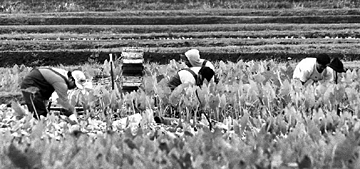
Farmers work a taro field in Hanalei. Taro, especially the kind used for poi, is one of the crops that showed increased production last year, new state numbers show. Photo By Ken Sakamoto, Star-Bulletin
Farmers work a taro field in Hanalei. Taro, especially the kind used for poi, is one of the crops that showed increased production last year, new state numbers show. Photo By Ken Sakamoto, Star-Bulletin
The state Department of Agriculture's final numbers for 1995 crops show that overall agriculture production brought in $494.1 million for local farmers, down 2 percent from 1994.
"That's not bad considering the big drop in sugar," said Donald Martin, state agricultural statistician at the Department of Agriculture.
"Overall, diversified agriculture was at $275.3 million, up 4 percent," he said. "This very definitely is encouraging. If the weather had cooperated we would have had an even better year."
So far this year, weather has been more favorable but the actual numbers won't start coming in until surveys late this year and next spring, Martin said.
"We expect that sugar will continue to decline 15 to 20 percent but we could see a boost in pineapple prices," he added. "For diversified crops, we are looking for vegetables to be improved and are optimistic for a bigger coffee crop (statewide) although there is some concern in the Kona area."
According to the final estimates by the Hawaii Agricultural Statistics Service, crop production for 1995, in order of farm value, was:
 Sugar cane production was down 24 percent, to 4.07 million tons last year from 5.36 million tons in 1994. The indication for 1996 is 3.35 million tons as plantations continue to close. Farm value was $131.5 million, down 18 percent from 1994.
Pineapple output was 345,000 tons, down 5 percent but the value was $87.4 million, up 11 percent. "There were stronger prices in the processed and fresh pineapple," Martin said.
Flowers and foliage had a value of $67.7 million, up 1 percent. "This is a reverse of two prior years of decline," he said.
Macadamia nut production was 50 million pounds, down 5 percent, primarily because of dry weather. Value was $37.0 million, up 2 percent.
Milk output was 139.4 million pounds, up slightly from 139.0 million pounds last year. Value was $32.1 million, up 1 percent.
Vegetable production was 82.2 million pounds, up 12 percent. Value was $31.7 million, up 9 percent. "We would have had an even higher vegetable production except the dry weather held it down," Martin said.
Papaya production was 50.8 million pounds, down 18 percent last year. Value was $18.5 million, up 34 percent. "This was a record year reflecting high demand."
Cattle production was at 34.0 million pounds, down 10 percent. Value was $14.6 million, down 26 percent.
Egg output was at 186 million eggs, down 5 percent. Value was $13.5 million, down 4 percent. "We had fewer layers (hens) last year," Martin said.
Coffee farmers produced 5.4 million pounds, up 26 percent largely due to higher production in Kona. Record farm prices helped boost farm revenues to $11.5 million, up 37 percent.
Dry weather this year in Kona is hurting production and has coffee farmers worried. However, Martin said coffee is growing statewide.
"We're expecting production on the other islands to keep increasing," Martin said. Kona had 46 percent of the statewide coffee production last year, and 71 percent of the statewide valuation because higher quality coffee is grown in Kona, he said.
Taro production was 6.5 million pounds, up 7 percent. Crop value was $3.1 million, up 11 percent. "Chinese taro was down because of the dry weather but the taro for poi was actually helped by the dry and sunny weather," Martin said.
Banana output was 13 million pounds, down 5 percent, because of dry weather. Value was a record $5.2 million, up 3 percent.
Ginger root production was 5.8 million pounds, down 3 percent. Value was $5.0 million, down 3 percent.
Guava farmers harvested 16.4 million pounds, down 7 percent due to dry weather and lower demand. Farm value was at $2.4 million, down 7 percent.