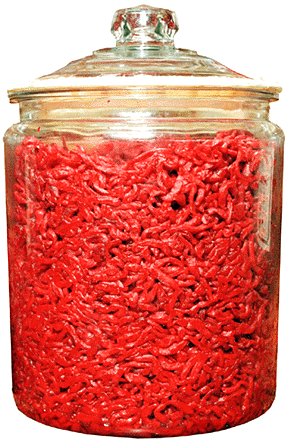
Shredded mango.
Shredded mango.
 When Rachel Laudan started teaching at the University of Hawaii, she noticed that students would bring and share an intriguing range of snacks to class - tidbits like mochi, dim sum and poke. Intrigued, she wrote journal-like essays about such encounters and after a year, had an inch-high stack of essays about Hawaii's eclectic eats.
Nine years later, Laudan has parlayed those essays into a 296-page book, "The Food of Paradise" (University of Hawai'i Press, 1996, $38.95 and $24.95). It is about the islands' unique, multicultural tradition of Local Food, which she spells with a capital L and F.
 "Often I'd be talking with someone and I would just want to burst into tears," she said in a phone interview last week from San Miguel de Allende in Central Mexico. "These were just such incredible stories. I wanted people to have some sense of what had gone on in Hawaii to make Hawaii's food.
"Hawaii now has this enormously rich set of foods - Local Food - a real fusion East-West-Pacific food, and they should be proud of it because it is the record of all of their efforts over these centuries."
 Laudan, a London-trained academic, author and food cosmopolitan, aspired to write more than a cookbook. The result is vastly engaging. She offers a relaxed, sincere, gently humorous and well-researched treatise about two subjects isle residents love - food and themselves.
"The hardest part - and it sounds kind of silly - was the emotional part," she said. "And that was doing justice to the people or the people's parents or grandparents or great-grandparents or great-great-great-great-great-grandparents that I was writing about, because I didn't want this to be just a recipe book. I wanted this to be a story about how food was made in Hawaii.
 "Sometimes, when I was talking with people and they would tell me how they struggled to keep a rice farm going, or how they grew taro, or how they were trying to keep a truck farm going with a big shopping mall on their back, or how they were trying to keep a cracker factory going; sometimes, I was just reading in some of the books in the State Library about the history of different groups in Hawaii and I'd read about people who'd come off the plantations and peddled vegetables, or set up noodle factories, or developed ways of making sake in tropical heat and," she paused at length, "what came over me time and time again was the sheer, incredible courage and hard work and determination and persistence of the people who've made Hawaii's food."
Laudan had come to the UH in 1987 to teach the history of science and technology. She spent two years observing and writing about food rites, such as mango picking and mom-and-pop store operations. She then made a proposal to UH Press, then spent more four years, from 1990-94, researching and writing.
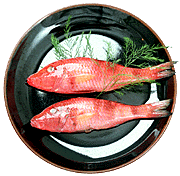 Her research revealed that the first Polynesians who landed on the shores of the Hawaiian archipelago found naught but "fish, limu (seaweed), shellfish, birds, eggs, a few ferns, a couple fruit that grew way up on the mountains above the 3,000-foot level where they were not very accessible. But there were absolutely no carbohydrates, no taro, no rice, nothing that makes the bulk of what a person eats," she said.
Seventeen centuries later - after successive immigrations from Pacific islands, then Europe and America, and finally Asia - what has resulted, according to author Laudan, is a multicultural cuisine whose sum is more than the parts.
Isle foodies generally agree with Laudan's thesis that Hawaii can boast a distinct Local Food tradition. Oahu native David Cruz, consultant chef for Indigo Restaurant, thinks isle-born chefs have an advantage in integrating local flavors and styles.
Cruz, who is of Hawaiian, Japanese, German and Guamanian extraction, said, "when I was growing up, my mom experimented with every ethnic culture. There was no food that she didn't cook; so I grew up tasting all of these different kinds of foods and applying them to new things.
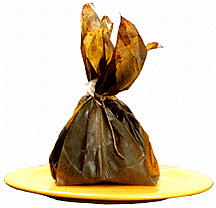 "An example is the portobello mushroom dish I did for Kelvin (Ro) at Kahala Moon (Cafe), that was based on an adobo dish that my mom used to do with meat and I just did it with mushrooms. It was basically the same thing - vinegar, garlic, chicken stock, a little bit of herbs and an Italian or French influence with the roasted-garlic paste on a bruschetta. That example probably most clearly portrays what I've been doing," he said.
Blossom Poepoe of Molokai confirms Laudan's premise because "they're all kind of intermarried now; so they kind of mix it (ethnic food) all up. Before I used to see the Japanese just cook and eat Japanese, but now I see them eat just about everything."
Poepoe is manager of Kanemitsu Bakery & Restaurant, home of popular Molokai Bread and the Kanemitsu Mini Supreme homemade burger.
Helen Kanawaliwali O'Connor, a health educator at Wai'anae Coast Comprehensive Health Center, is also a Molokai native. She felt that Friendly Isle home cooks keep their own ethnic food traditions and digress from time to time.
 Rachel Laudan
"In the home it's (ethnic culinary tradition) distinct, but I do cook chicken hekka and my version of what I think is pinacbet," she laughed, "and I do it according to my taste and what I think is a good taste. But I don't do it that often; I go out to a Filipino restaurant more because I like their taste. So I would say the foods are distinct, only once in a while that we mix it up."
UH anthropologist Jon Okamura had interesting observations about the plate lunch as a symbol of racial harmony. He said people sharing and inviting others to eat in their homes is a more appropriate example of tolerance in isle relations. "Anyone can go to Grace's or Zippy's and buy a plate lunch and eat by themselves. That doesn't imply any kind of appreciation of another culture or the people of that culture. I'm glad (Laudan) didn't extend her argument into that.
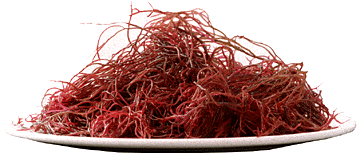
One assertion by Laudan is poke is not a traditional Hawaiian dish. "Neither the most extensive study of Hawaiian uses of fish nor the first ethnic cookbook mentions poke as a fish dish," she wrote, "nor does the definitive Hawaiian dictionary nor the major glossary of pidgin. Recipes labeled poke do not occur in cookbooks published before the mid-1970s."
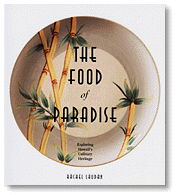 Poke, notwithstanding, the book entertains because Laudan writes with the wide-eyed wonder of a newcomer. The book is equal parts memoir, history and recipes. As she said when asked why such a book hadn't been written before: The goldfish is the last one that will write about water.
Laudan welcomes comments on the book and will autograph book plates. Contact her at: Calazada de la Luz 42, San Miguel de Allende, Guanajuato 37700, Mexico; e-mail: lardan@servidor.unam.mx.
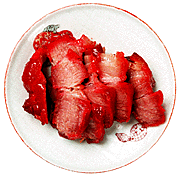
2 pounds pork butt, cut into 1-inch cubesMarinate meat with all the other ingredients in a nonreactive covered dish for 2 days. Place in a nonstick casserole and simmer for 15 to 20 minutes until nearly tender. Then rapidly boil off the liquid. There should now be a little rendered fat in the pan. Fry the pork in this until the cubes are lightly browned and crisp. Place in a dish and garnish with green onion rings. Serve with rice and a vegetable that is juicy or creamy to offset the crisp, slightly sour pork. Makes 4 servings.
2/3 cup white vinegar
1/4 cup water
2 small red chile peppers, chopped (or 1 teaspoon crushed red chile pepper flakes)
6 cloves garlic
1 teaspoon salt
Sliced green onions, for garnish
 Approximate nutritional analysis per serving pork: 375 calories, 17 grams total fat, 6 grams saturated fat, 150 milligrams cholesterol, 640 milligrams sodium.*
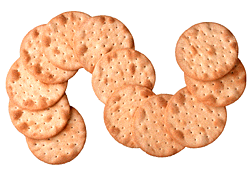
"Take 1 or 2 round saloon pilot crackers (hard tack) for each person to be served and soak them well in milk in a shallow, well-buttered roasting pan. When well soaked, pour off extra milk, being careful not to break the sodden saloon pilots. Then take generous spoonfuls of soft butter and spread on each cracker, followed by a heaping tablespoon of raw or brown sugar. Cover the crackers well. (This can be done ahead of time, but don't let it dry out.) About a half an hour before serving, put the pans in a hot oven (375 to 400 degrees) and bake until the sugar has melted and the cracker surface, become slightly crusty. Serve hot with thick cream."
Approximate nutritional analysis per serving (based on 4 tablespoons milk, 2 teaspoons butter, 2 tablespoons raw sugar per cracker): 330 calories, 15 grams total fat, 9 grams saturated fat, 40 milligrams cholesterol, 290 milligrams sodium. Per serving with 1 tablespoon thick cream per cracker: 385 calories, 21 grams total fat, 13 grams saturated fat, 60 milligrams cholesterol, 290 milligrams sodium.*