LaBare sent $300 to the Florida company, presumably to get help consolidating debts on three credit cards.
Big mistake.
LaBare paid for something that he could've gotten for a nominal fee - and perhaps even for free - from either of two not-for-profit organizations in Hawaii.
On top of that, the company didn't deliver on all its promises, he said. It charged hidden fees, wouldn't put some things in writing and had to be prodded into action with numerous long-distance phone calls and letters, LaBare said.
"The whole thing from the get-go was unprofessional," he said. "It was very frustrating."
LaBare is not alone in his frustration.
Credit counseling experts say so-called credit repair companies or debt consolidators frequently solicit Hawaii customers through shopper ads, mass mailings, late-night television commercials or other measures. Usually, the companies are based on the mainland and offer to erase a consumer's bad credit - for a sizable fee.
That's illegal in Hawaii.
Even if the offer is made by a mainland company, it is against Hawaii law to collect money based on the representation that the company can erase or repair an accurate credit report, according to JoAnn Uchida, executive director of the Office of Consumer Protection.
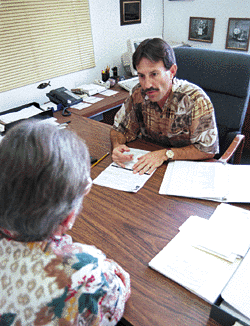
Michael Haxton, president of the nonprofit Hawaii Credit
Counseling, advises a consumer needing help with debt.
Haxton warns debtors to steer clear of for-profit companies
promising to work miracles on bad credit.
Photo by Craig T. Kojima, Star-Bulletin
Still, the customer solicitations keep coming, often targeting low-income, lesser-educated residents. At any given time, at least two or three companies usually are trying to hustle Hawaii customers, the experts say.
And financially strapped consumers continue to buy the pitches, much to the dismay of credit counselors.
"It's an ongoing problem," said Chuck Crawford, managing director of Consumer Credit Counseling Service. "People shouldn't be paying for something that they don't need to pay for."
"If you're desperate, though, you'll take desperate measures," added Michael Haxton, president of Hawaii Credit Counseling.
Consumer Credit Counseling and Hawaii Credit Counseling are the two not-for-profit organizations that advise consumers with debt problems and can set up creditor repayment plans at reduced rates. The counseling is free and the monthly fee for the repayment programs, administered by the organizations, is a maximum of $15 to $20. The fee sometimes can be waived or reduced.
The problem is many people are unaware of the organizations' services, Haxton said.
And when people are in serious financial straits and looking for help, they often get taken by companies out to make a buck.
"These are notorious scams," Haxton said. "They take people's money and, poof, they disappear."
The problem got so bad that the state in 1989 specifically outlawed credit repair businesses making false claims.
Haxton said the law has helped alleviate the problem, but local companies still surface every six months or so and operate just long enough to attract the attention of authorities. Then they move on.
To illustrate that point, Haxton opened a 1996 phone directory and found two companies he believed fit the bill. He dialed both numbers. Both were disconnected.
The problem concerning credit repair was underscored last year when the state sued Consumer Credit Bureau of Hawaii, alleging that the Pearl City business charged exorbitant fees promising, among other things, to clear all negative information from a consumer's credit report.
After collecting fees ranging from $300 to more than $1,000, Consumer Credit Bureau didn't perform the promised work and, rather than help customers, often left them in a worse position, the state alleged.
In one week, Haxton said, his agency heard from six people who claimed to have paid more than $17,000 collectively to the company.
Troy Edmund Cypriano, the company's general manager, in court documents denied the state's allegations. He has closed his business and last month reached a settlement with the state.
James G. Ching, Cypriano's attorney, said his client settled even though he probably would have prevailed in court. But Cypriano didn't want the case to turn into a mudslinging match and wanted to resolve the matter without further litigation, Ching said.
As part of the settlement, Cypriano was fined $25,000 ($20,000 was suspended) and was ordered to repay more than $6,000 in restitution to seven people. He did not admit to any wrongdoing.
Uchida, whose agency handled the Cypriano case, said her office doesn't get a large number of cases but the ones it does get tend to be fairly serious. Haxton said the severity of the problem is masked because people often won't file complaints, embarrassed to admit that they got conned.
The market for potential victims has grown as the state's economy has struggled the past several years. Personal bankruptcies and foreclosures have soared.
"With more and more people having financial problems, the target market is going up," Haxton said. "These are people willing to take more risks or any risks to resolve their situation."
For those in financial straits, the two nonprofit agencies can set up debt management or repayment programs with a consumer's creditors. In most cases, the creditors - ranging from banks to national retailers - will only deal with the nonprofit groups, not the for-profit credit repair businesses.
The agencies typically can negotiate interest rates, late fees and other expenses that are reduced or, in some cases, waived, helping ease the financial burden on the consumer.
LaBare, the consumer who dealt with the Florida company, said the company was able to renegotiate the debt on two of his credit cards at a lower rate - but only after much haggling on his part. The third still is unresolved. "All they did was make that one worse."
LaBare said he would never again deal with a for-profit debt consolidator. "They're just trying to make money off you," he said.
If you're considering paying a company to negotiate better rates on your credit cards and other debt, be wary. Scams abound. Experts offer these tips:
Make sure the company is a nonprofit. Check with Internal Revenue Service and ask the company to provide copy of nonprofit authorization.
The two local nonprofit agencies that help consumers with debt problems are: