Kitchens go
Mobile
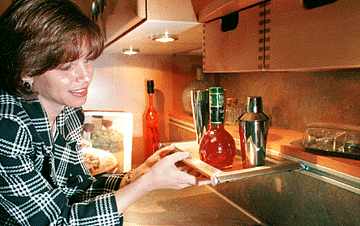
Above: Wall-mounted storage by Mobilo can be adjusted along a track,
as
Laurie Adams of Studio Becker Zeyko shows. The items, available
at the
shop, will be on display at a building and homes show in
December.
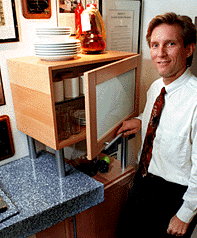
Below right: Tory Adams, owner of Studio Becker Zeyko,
shows the versatility of Mobilo kitchen beech 'furniture.'
Photos by Ken Ige, Star-Bulletin
Designers cook up
solutions to
kitchen storage
By Jerry Tune
Star-Bulletin
Fifty years ago, kitchens were put together piece-by-piece in the same way furniture was added to a room. Then in the 1950s, the trend for built-ins swept the country. Now it appears we will be getting some of both methods.
While old-fashioned kitchen furniture is not seen much anymore, there is new kitchen furniture coming from Europe.
At the same time, however, most kitchen consumers still want the built-ins and dream of beautiful woods like cherry or maple, say Hawaii kitchen designers.
What's the recipe for the perfect kitchen? Like that old favorite family stew, just about anything can go into the pot.
Kitchen designer Troy Adams is bringing in the "Mobilo" system from Germany to the December Building Industry Association's Home Building and Remodeling Show, which will feature about 300 exhibits.
Mobilo is more flexible than the standard fixed cabinets lined up in a row. There are solid beech wood cabinets, but the system also includes baskets on posts so frequently used items are easy to grab. Or you have a swiveling wall with big utensils hooked on the front, and storage baskets on the back (with silverware or bottles) only a swivel away.
"We think the Mobilo system will work great in a lot of condominium situations where there is limited space," says Adams, owner-president of Studio Becker Zeyko.
"We've been getting calls from people with 'ohana' (second living units) situations where they can't use a full kitchen."
Becker Zeyko introduced the system in Germany about a year ago and Adams saw it in January at a Cologne kitchen show.
Adams figures perhaps the biggest appeal will be to developers who can save valuable time in finishing the kitchen space for condominiums.
"A lot of the condominiums are going to smaller units much like what's being done in Europe and Japan," he says. "With this system they can finish the floor and walls and then move in the kitchen furniture. They don't have to do a lot of measuring (for the built-in cabinets) and they can save probably half the time of installation."
Adams estimates that a full kitchen in Mobilo is about $18,000 for a condominium or $24,000 for a home; while a standard built-in kitchen for new construction is about $25,000 to $35,000.
Remodeling homeowners don't need to buy a complete Mobilo system. If you only want the chrome post and baskets, the cost is about $700 to $800, depending on how many basket attachments you want. If you want the post with the curved wall that swivels, Adams says, cost is about $1,200.
There are also wall-mounted brackets which can be fitted with moveable storage units. So if the storage unit is needed at the other end of the kitchen, just slip it off the bracket and move it.
Young people on a limited budget can build a quality kitchen slowly - item by item as they get the money. While Mobilo may become popular, it could take a while because Americans already know and love built-ins.
Judy Dawson, president of the Aloha chapter of the National Kitchen and Bath Association, says people today want to open up their kitchens so there is room for guests to visit while the host does the cooking.
"They either want a great room (with large spaces) or a flowing into an adjacent room or patio," says Dawson.
Many of her clients at Designer Kitchens and Baths have kitchens that are 20 or 40 years old and have never been remodeled. Costs average about $25,000 to $35,000, she says, but can go up to $80,000 if commercial cooking equipment is used and extensive construction changes are made.
But she says that prices shouldn't scare people. Mixing in more costly items like stone counters with less costly options can be effectively done. "You could spend $2,000 on a cooktop but back off of an oven if you don't do a lot of baking," she says.
The most popular trend is traditional wood built-in cabinets, says Michael Smith, a certified kitchen designer with Kitchen Concepts Plus Inc.
"People want the old world look of natural wood," says Smith. "White is out. For the past year, they want real wood. Cherry and maple seem to be the most popular."
When consumers depart from tradition, Smith finds they are doing more free-form counters and floating cabinets. "That has real eye appeal," says Smith.
Marie Blackburn, a certified kitchen designer with Kitchen Source, agrees that wood is back in the kitchen. But there are so many more options available, she adds.
 You can get real wood or a plastic laminate that feels and looks like wood.
Cabinet makers are putting out new products that are more durable, with better hinges, and all of the appliances can be covered with wood to match the cabinets so the appliances "disappear" in the kitchen.
A new guideline calls for introducing different counter heights into the kitchen. The standard height is 36 inches, but Blackburn points out that everyone including children work in the kitchen.