L A
J O I E
d e
C U I S I N E
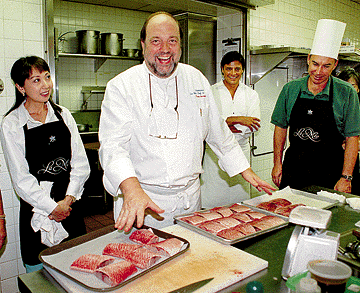
Chef Garnier at La Mer restaurant in the Halekulani Hotel,
surrounded by his students, aims to dispel the myths
of French
cuisine in his cooking class. "Only taste is
important," he says.
"You cook with your heart and your feelings."
Photo by Ken Sakamoto, Star-Bulletin
The art of French cooking
is a matter of mastering the basics
Story by Nadine Kam
Star-Bulletin
PESTO that comes out of a jar. Ready sauces that come out of a foil pouch. One trip to the supermarket is enough to convince anyone that the art of cooking has gone the way of hanging the clothes out to dry or walking over to the television set to switch the channel.
The notion of fine cuisine hardly fits in with a society running in convenience food mode, but a few practitioners of the fine art of French cuisine are attempting to engage new fans, in part, by teaching them how to cook.
At Cliquo, chef Yves Menoret said, "There is a certain clientele for French food. I was the chef at Bagwell's and at Bali and I have the same customers. I always see the same people coming back. It's very difficult to bring in new customers.
"I think that people think French food is expensive, that it's fancy. They think that it's too rich, which it is not; they think they have to dress, and that should not be."
If people feel a bit intimidated by the idea of French cookery, it's likely because of aristocratic origin and continued association with Parisian royalty. It is Charles V's chef Taillevent who is credited with first systematically compiling recipes, published in the cookbook, "Le Viander" in 1375.
Subsequent standardization of techniques and codification of recipes credited to French chefs provided a blueprint of skills and a record from which others could work, enabling future generations to create without having to reinvent methods for sauteing and roasting.
Menoret and partner Bruno Chemel try to demystify French cuisine by conducting classes in their kitchen every second and fourth Saturday of the month.
"We get about five or six people every time. The recipes we have, anybody can do at home. We use ingredients they can find very easily. We don't want to do such things as demi-glace because nobody will make it."
At La Mer in the Halekulani, a Le Cordon Bleu workshop proved so popular last fall that the staff wanted to continue this tradition. On a recent Saturday morning, 12 people showed up for a lesson with executive chef Yves Garnier, who showed that beyond chopping, stirring and introducing foods to heat, cooking begins with no more than simple appreciation.
While La Mer manager Jean-Yves Kervarrec translated Garnier's instructions from French into English, no translation was necessary to see Garnier's enthusiasm. He worked quickly, but stopped often to sniff the bouquet of fresh-cut tomatoes and herbs, and contemplate the silver, shimmery beauty of a whole onaga.
Science and simple chemistry, such as knowing the water content of butter, have their place in cooking. But in the long run, it's art cooks strive for. In making a reduction of chicken broth, truffles and truffle juice, he said, it doesn't matter whether a recipe calls for reduction by time or thickness. "Only taste is important. You cook with your heart and use your feelings."
The lesson in joy, rather than precision, was not lost on students such as Mireille Leitich, who teaches friends to cook, and Harriet Mizuguchi, the wife of Sen. Norman Mizuguchi. Her local-style campaign cookbooks have been a hit with his constituency.
Rather than looking at French cookery as a style limited to masters, Mizuguchi, formerly a home economist, said, "French cooking teaches you the basics. It teaches all the sauces and techniques. If you want to get creative later, you can start by using different ingredients."
Simple tricks, such as clarifying butter, can prevent foods from burning. "Tips like this, that chefs are able to pass on, are able to give us help in everyday cooking. Now I always keep clarified butter on the side," Mizuguchi said. "If you want to do a quick saute, all you need is clarified butter, a little white wine and garlic and you can have a pretty elegant meal with very little effort.
"It becomes effortless down the line when you have the ingredients on hand, and the knowledge to put it together."
Also teaching cookery is Leitich of Sur La Table (On the Table). But because she teaches on a nonprofit basis, paying for the food out of her own pocket and donating her teaching fee to transition homes for battered women and children, her classes are limited to friends and acquaintances.
Although the Swiss-born Leitich teaches all styles of cookery, French cooking is the most requested. The interest, she said, stems from the abundance of television cooking programs and the sheer availability of ingredients.
"The way we eat today is totally different from 20 or 10 years ago. Ten years ago you couldn't get the ingredients you can get today."
In spite of the rap French cuisine gets for being expensive, she said, "I've never spent a lot of money on food, but I've always had good food on the table."
And although Leitich is fond of the old ways - she criticizes French teens for their use of slang and shortcut French and describes the era of nouvelle cuisine as "being nothing; there is no sauce, no butter, it is overboiled things" - she is not averse to modern conveniences such as Pepperidge Farm's puff pastry dough.
"You can only make it in Hawaii if you have an air-conditioned kitchen. But even then, it's not worth it because you have to layer each strata with butter, and the butter has to be cold. I used to do it when it was colder, but butter was not that expensive. It takes a pound and a half of butter and butter is so expensive now."
Of course, the moment everyone waits for is when that pastry and entree arrive on the table. The highlight of each of class is the moment when all settle at the table to partake in their creation.
Even at home, Mizuguchi said, "Food has always been a source of pleasure for me, and I believe that for my family as well.
"You always read about the deterioration of the family, and for me, what it takes is sitting down together at the dinner table. That's were you communicate with each other, pass on your values, and its a way of passing on your culture, through foods."
The facts
 In the Cliquo kitchen: Bruce Chemel and Yves Menoret offer instruction from 10 a.m. every second and fourth Saturday of the month. Learn to prepare entrees and desserts, then enjoy results at the chefs' table. Costs $50. Call 377-8854 for information and reservations.
Holiday Menu by Cliquo: Chemel and Menoret guide students through a noncredit class at the University of Hawaii at Manoa's College of Continuing Education and Community Services. Prepare Foie Gras served with Mesclun Salad, Pithivers (puff pastry), Galette des Rois (Twelfth Night Cake), and Petits Fours (little cakes) de Noel. The 10 a.m. to noon session will be held at the JMD Educational Center, 99-1269 Iwaena St. in Halawa Valley. A $38 fee includes supplies and samples. Call 956-8400 for information and reservations.
Cooking at Halekulani: Culinary workshops are offered on an occasional basis. To add your name to a mailing list, call the food and beverage office at 923-2311, ext. 5040.
For Harriet Mizuguchi's campaign cookbook, write: Mizuguchi for Senate Campaign, P.O. Box 452, Pearl City, HI 96782; call 832-0150; or stop by the campaign headquarters at Kalihi Shopping Center.
Clarifying butter
This procedure separates milkfat, or butterfat from the water and milk solids in butter. The pure fat can be heated to higher temperatures for sauteing or frying, without risk of burning the milk solids, which can leave an unpleasant flavor.
To clarify, place butter in a heavy sauce pan, remembering you will lose 2 tablespoons of water and solids out of every 8 tablespoons of butter. With heating, three layers will appear: a thin, white foam on top, the clear yellow fat in the middle, and water and solids on the bottom. At this point, stop heating, before bottom sediment turns brown.
Skim top layer, spoon out clear yellow fat and reserve, taking care not to disturb sediment. Store clarified butter in refrigerator in a tightly closed container for 3 to 4 weeks or freeze up to 6 months. The milk solids can also be saved and used to grease pans.
Wait for crepe
Crepe batter is quick to prepare, but it must be allowed to rest at least 30 minutes after it is made, allowing the grains of flour to expand and the batter to thicken. Leftover crepes can be wrapped in plastic and frozen.
The Recipes:
Onaga with Truffle Juice, and more.