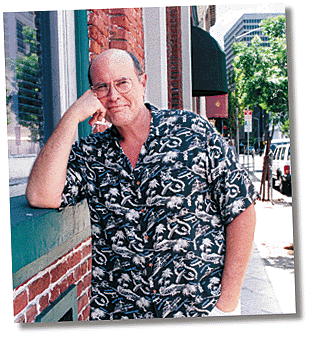
Frank B. Shaner, host of the falsetto contest, says the art form
is enjoying a resurgence and credits singer Dennis Pavao,
among others, with keeping it alive.
By Ken Sakamoto, Star-Bulletin
Frank B. Shaner, host of the falsetto contest, says the art form
is enjoying a resurgence and credits singer Dennis Pavao,
among others, with keeping it alive.
By Ken Sakamoto, Star-Bulletin
"I was coming off the stage at the Don Ho Show and she told me instead of using falsetto as a comic bit I should take it seriously, learn one song, and sing it well."
Shaner took her advice. He became a "hired gun" who could come out of the audience in a local bar and bring down the house with his rendition of "Ikona." After participating in Kindy Sproat's Big Island falsetto contest, he thought falsetto singers on Oahu should have a similar showcase.
Shaner tomorrow hosts the 2nd Annual Frank B. Shaner Falsetto Contest - the event is part of the Aloha Festivals - at the Royal Hawaiian Hotel. Tony Conjugacion and Kalei Bridges will appear as featured vocalists and a field of 15 singers will compete.
"Last year we had a terrific turn-out from places like Waianae, Waimanalo and the Big Island, but this year we're getting singers from all over the state. I hate to use the word 'contest' because I think they're all terrific, but one of them will be more terrific (in the eyes of the judges) than the others," Shaner explains, his eyes twinkling.
The winner receives a recording contract; the others will share the experience of perpetuating the art and performing before a capacity crowd of falsetto fans.
"Singing at home or singing karaoke isn't the same as being out there on that legitimate stage. Last year the performances of the individuals all went up a notch. They step out in front of all those people, and all of a sudden they dig deep and they go. It becomes quite an evening."
Shaner's interest extends to collecting stories and legends about the origins of falsetto in Hawaii. One source cites 1809 as the precise arrival date; Russians on Kauai get the credit. Others say that the earliest missionaries didn't consider it proper for women to sing and that men were trained to sing the soprano and alto parts; a variation of that theory is that women were allowed to sing, and that falsetto came about when lay-about men amused themselves by mimicking the women.
Ask elsewhere and falsetto was brought to the Big Island by Mexican cowboys in 1832. "Many of the great falsetto singers still come from the Big Island," Shaner notes.
German-born Heinrich "Henry" Berger is said to have introduced Hawaiian audiences to falsetto yodeling during his decades as bandmaster of the Royal Hawaiian Band; falsetto harmonizing apparently became particularly popular during final decades of the monarchy.
One thing that's certain is that falsetto is enjoying a resurgence of popularity. Great singers have always been out there, but it seems that more people are listening and more young vocalists are singing and recording it.
"I think it's been brought back out into the mainstream beyond the grassroots. The Hui Ohana - and Dennis Pavao as a solo artist - certainly did a lot to keep it in the forefront. Tony Conjugacion was that young singing prodigy on stage with Melveen (Leed). He's still doing it today and sounds terrific."
Among the other artists on Shaner's personal list of favorites are Joe Secretario, Uncle Joe Keawe and Genoa Keawe.
"My love for this art form is deep for some reason. I just love the sound of it and it's a great way to sing."
Shaner never heard from his mystery woman again.
What: 2nd Annual Frank B. Shaner Falsetto Contest
When: 7 p.m. tomorrow
Where: Monarch Room, Royal Hawaiian Hotel
Cost: $12
Call: 545-1771